


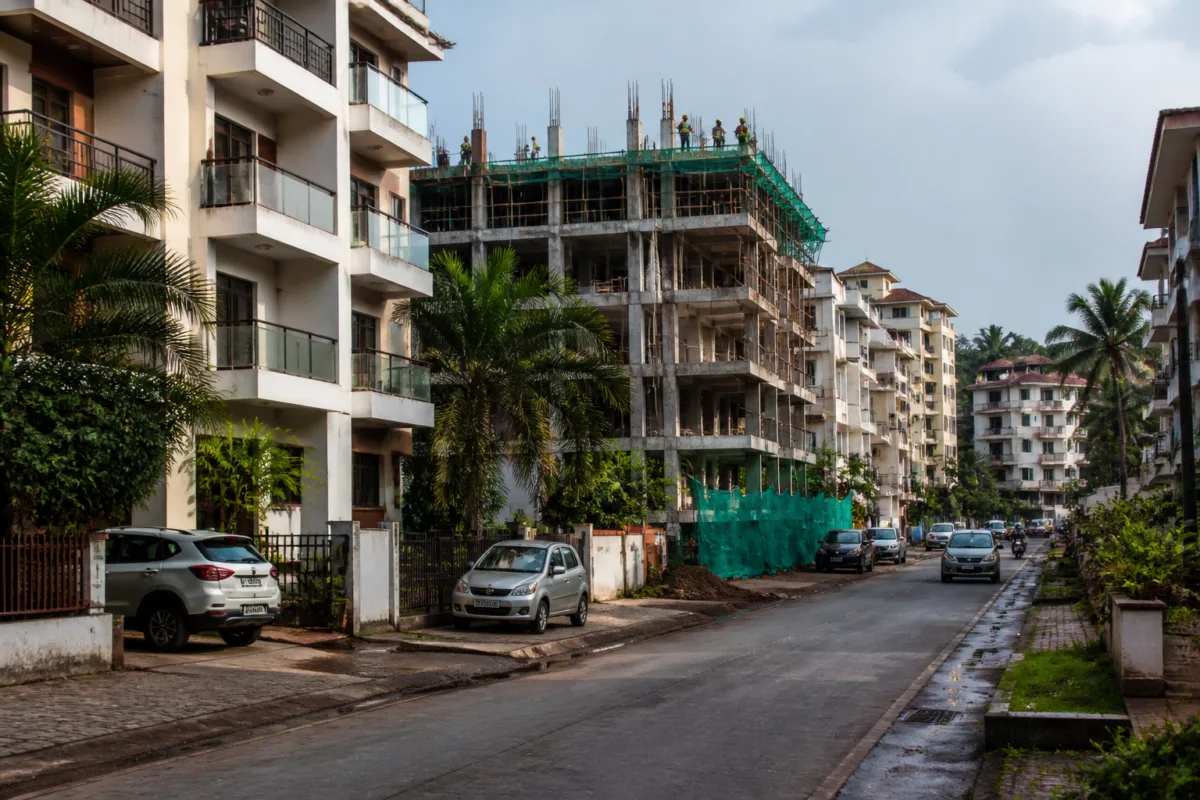
The Goa government has notified a framework allowing additional Floor Area Ratio (FAR) and building height for eligible developments across the state, while placing limits on density, road access, safety, parking and environmental compliance.
The amendments to the Goa Land Development and Building Construction Regulations, 2026, were published in the Extraordinary Official Gazette by the Department of Town and Country Planning (TCP) on November 24 and took effect immediately, The Goan reported. The government informed the High Court of Bombay at Goa about the changes, with the matter scheduled to be heard next on January 19.
Under newly inserted Regulation 6.1.2, the government may grant additional FAR and height on the recommendation of the TCP Board. The provision applies to developments in municipal, planning and village areas where the plot measures at least 300 square metres.
The concessions are linked to the existing permissible FAR and the width of the abutting road. Annexure XIII-A covers roads from 6 metres wide to 10 metres and above. The overall FAR is capped at 300, calculated on the total net effective plot area, while building height is capped at 40 metres.
A lower height ceiling of 14.9 metres applies in certain lower-FAR zones along roads measuring between 6 and 10 metres. This makes road capacity a central condition for additional development potential, although the report does not provide the full table setting out the FAR and height permitted for every road-width category.
The framework covers residential and settlement areas as well as commercial, public, semi-public and institutional, transport, warehousing, communication and industrial zones. Goa Industrial Development Corporation estates and industrial areas are excluded.
Four- and five-star hotel projects cannot use the concessions. Projects on plots of at least 500 square metres along roads at least 8 metres wide must submit a notarised affidavit stating that they will not use additional FAR or height to establish such hotels.
The amendments also exclude developments within protected monument buffer zones. Coastal Regulation Zone areas will continue to be governed by coastal regulations, according to the report.
Developers must pay prescribed fees before receiving technical clearance and comply with setback, structural safety, existing-building load-bearing capacity and additional parking requirements. A Fire and Emergency Services no-objection certificate is mandatory before an application for a construction licence.
The regulations introduce requirements intended to limit the resource impact of additional development. Rainwater harvesting is compulsory for all projects, while solar photovoltaic systems and/or solar water heating must cover at least 5 per cent of the sanctioned load.
Projects consuming more than 9.7 kilolitres per day of water in areas without sewerage networks must install sewage treatment plants. The government may relax this requirement for proposals that had already been approved.
The framework therefore combines expanded development rights with conditions intended to address access, fire safety, parking, structural capacity, water management and energy use. Its implementation will depend on how the TCP Board applies the road-width-linked provisions and how the notified requirements are assessed during technical clearance and construction licensing.

