


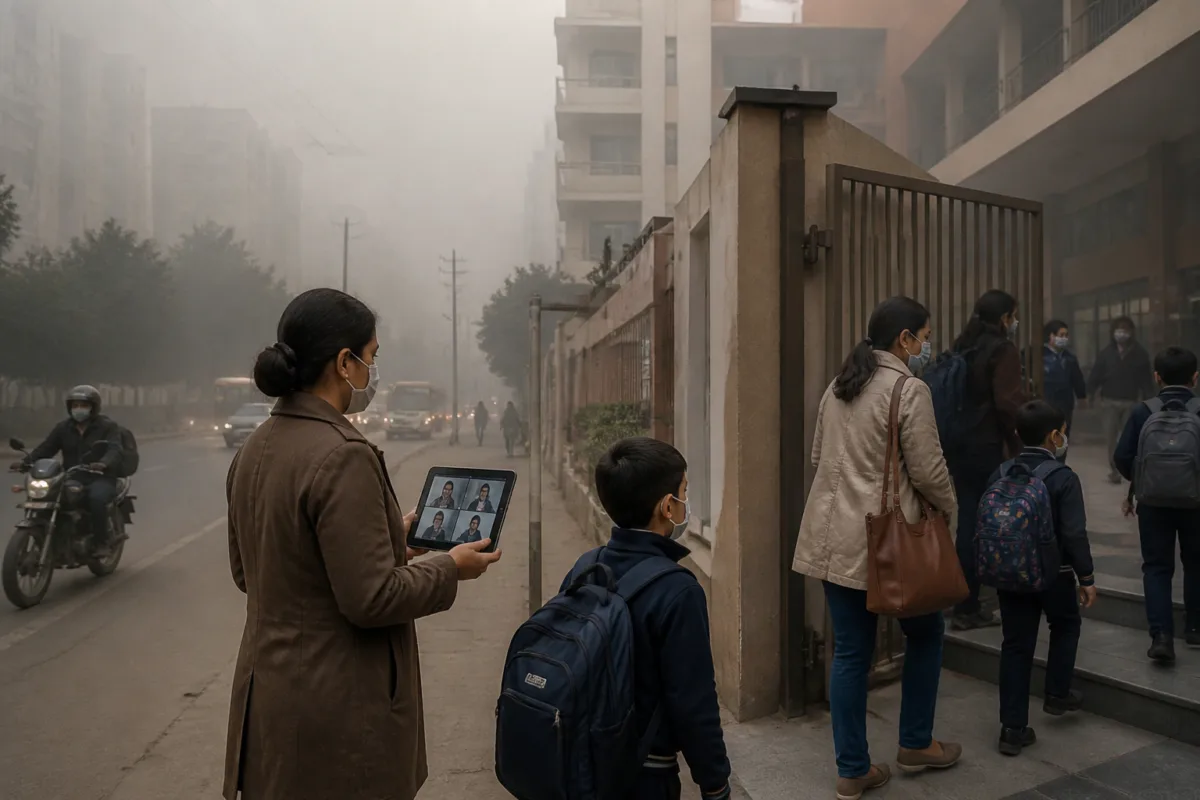
Ghaziabad has ordered government and private schools to conduct classes up to Grade 5 in a hybrid mode as air pollution worsened across the Delhi-NCR region and the city recorded an Air Quality Index of 379 on Friday. The order was issued by the district Basic Education Officer after Stage III measures under the Graded Response Action Plan (GRAP) came into force.
The direction applies to all schools in Ghaziabad and allows classes for students up to Grade 5 to be conducted through a combination of physical and online teaching. The order cited the implementation of GRAP Stage III rules as the basis for the decision.
The move came as pollution levels reached the highest levels of the season in several NCR cities. Noida recorded an AQI of 368, while Greater Noida reported an AQI of 356. Delhi’s average AQI reached 403 on Friday morning, entering the ‘severe’ category for the first time this season, according to the report.
Hourly data on the Central Pollution Control Board’s Sameer application showed Delhi’s AQI at 403 at 6.05 am. The reading remained at the same level at 8 am and 9 am. The 24-hour average AQI for the day was scheduled to be recorded at 4 pm.
The CPCB data showed that 33 of Delhi’s 58 monitoring stations reporting figures by 8 am were in the ‘severe’ category. Another 24 stations recorded ‘very poor’ air quality, while one station was in the ‘moderate’ category.
The highest reading was recorded at IIT Delhi, where the AQI reached 488. Chandni Chowk recorded 479 and Delhi University’s North Campus recorded 478. Other high readings included 456 at Burari Crossing, 451 at ITO and 451 at Jawaharlal Nehru University.
Several other Delhi locations also remained in the severe category. Jahangirpuri recorded an AQI of 430, followed by Wazirpur at 427, Anand Vihar at 419, Rohini at 413, Terminal 3 of Indira Gandhi International Airport at 403 and Tikri Kalan at 402.
The Ghaziabad school order places the focus on how pollution-control measures are being translated into changes in daily urban routines. While the immediate decision concerns classroom attendance, its implementation will require schools to coordinate physical lessons, online instruction and communication with parents across both government and private institutions.
The district education authorities’ direction remains linked to the operation of GRAP Stage III measures. Further decisions on school functioning will depend on the pollution conditions and instructions issued by the relevant authorities.

