


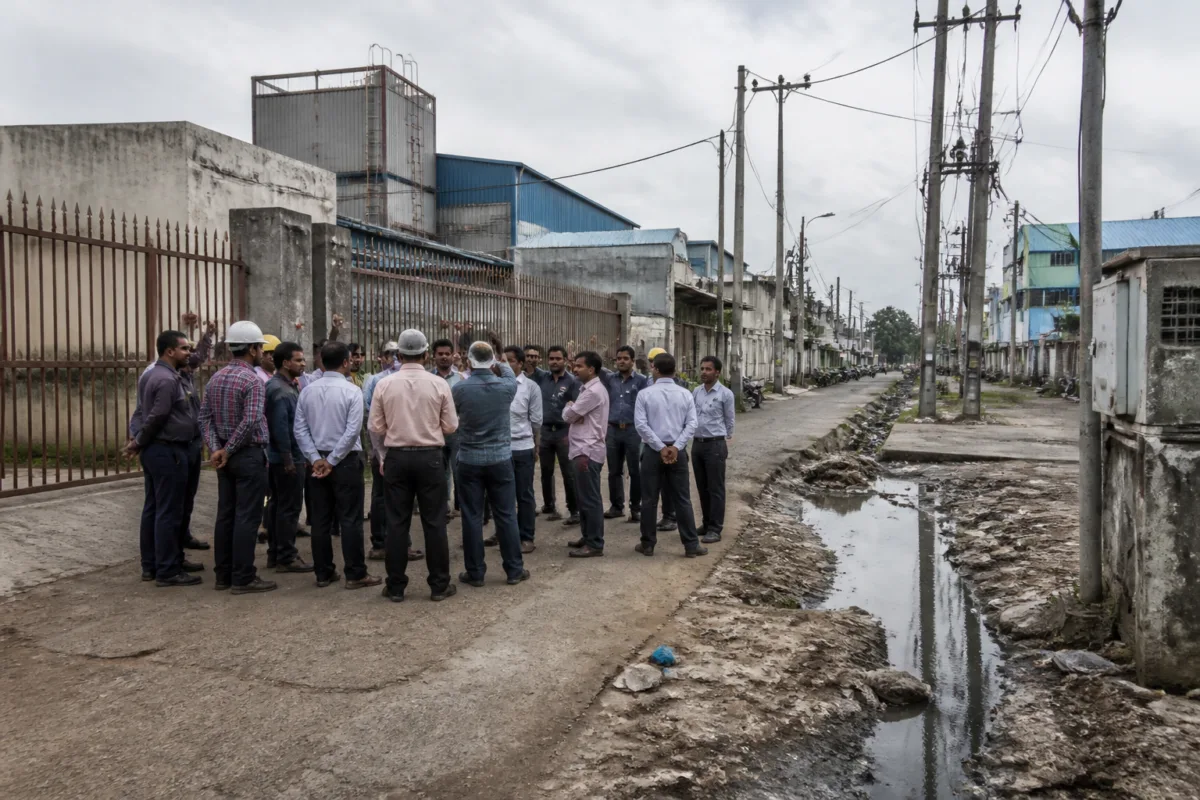
Industrial organisations in Ghaziabad held a symbolic protest by chaining themselves during a press conference in the Meerut Road industrial area, alleging that poor civic infrastructure, repeated power interruptions, security concerns and restrictive regulatory rules are making it harder to run factories in the city.
The protestors said industrial areas are facing broken roads and inadequate drainage, while electricity tripping and the absence of sufficient security arrangements are adding to operating difficulties. They questioned how manufacturing can expand when basic services inside industrial estates remain unreliable.
Upendra Goyal, president of the Uttar Pradesh state board of the All India Manufacturers’ Organisation, said at the press conference that problems facing industrial areas and entrepreneurs were increasing continuously. He alleged that the government was indifferent to these concerns and questioned how the state’s ease-of-doing-manufacturing objective could advance under such conditions.
According to the industry representatives, entrepreneurs are also facing difficulties because of actions and rules associated with the National Green Tribunal, the Uttar Pradesh Pollution Control Board, the Central Pollution Control Board and the Commission for Air Quality Management in the National Capital Region and Adjoining Areas. They described these measures as increasingly restrictive and alleged that regulatory pressure was forcing some businesses to consider leaving the region.
Sushil Arora, president of the Industrial Area Manufacturing Association, alleged that the Uttar Pradesh State Industrial Development Authority, or UPSIDA, had become synonymous with industrial harassment because of the extent of permissions required for routine business activity. He said entrepreneurs needed approval from the authority for several small and large operational changes.
Arora also cited rules governing changes in company ownership and management. He said a father could not make his son a partner or director in his own industry under the existing arrangements, which he claimed was distancing the next generation from manufacturing businesses. He further alleged that some commercial activities included in the Central Government’s list of industries were not recognised as industries by UPSIDA, creating additional difficulties for businesses operating in industrial areas.
The protestors used the chains as a symbolic representation of what they described as the restrictions placed on entrepreneurs by government policies and laws. The demonstration brought together representatives and entrepreneurs including Brijesh Agarwal, Deepak Sharma, Manoj Sharma, Sanjeev Gupta, Anil Garg, Manjit Singh, Sanjeev Arora and Rajiv Gupta.
The allegations made at the press conference cover responsibilities spread across multiple institutions, including industrial-area administration, civic infrastructure agencies, electricity providers and pollution-control authorities. The report did not include a response from the government, UPSIDA or the pollution-control bodies to the entrepreneurs’ claims.

