


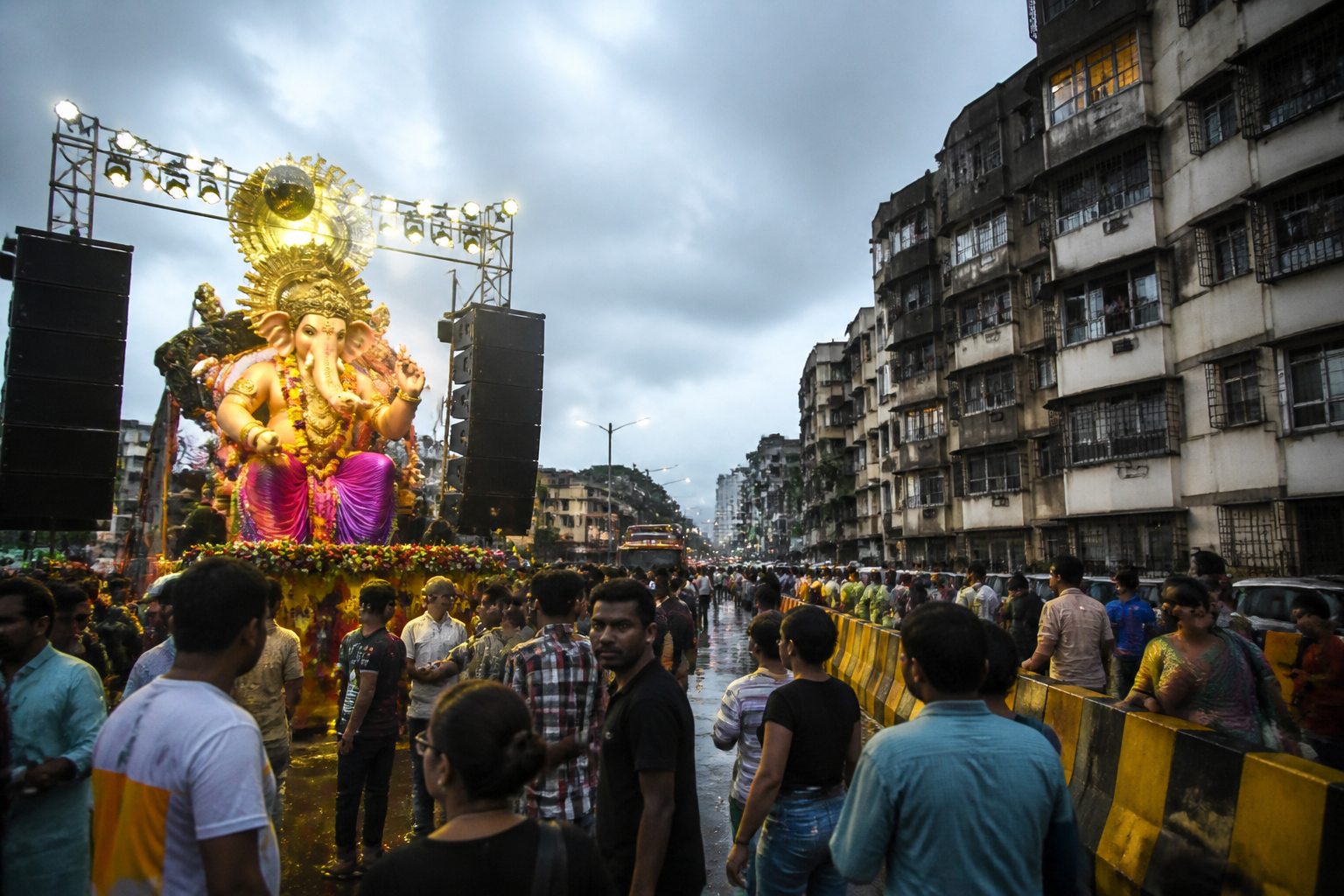
A public interest litigation before the Bombay High Court has put Maharashtra’s management of festival noise under scrutiny, alleging that rules governing DJs, loudspeakers and drums are not being effectively enforced during Ganeshotsav despite directions issued by the court in 2016. The case matters beyond the immediate dispute over sound levels: it tests whether urban authorities can convert a clear legal framework into consistent, visible and accessible enforcement across neighbourhoods.
According to a report by Navbharat Times – Mumbai, the petition has been filed by Akshay Bikkad and refers to the 2016 judgment in Mahesh Vijay Bedekar versus the Maharashtra government. That judgment, as described in the report, required strict compliance with noise-pollution rules and made clear that religious places must obtain the necessary permission to use loudspeakers or public-address systems.
The petition has been filed during Ganeshotsav, when processions, public celebrations and community programmes increase the use of amplified sound in Mumbai and elsewhere in Maharashtra. The report also links the issue to the forthcoming Navratri festivities, arguing that the court’s directions should be implemented effectively during major festivals rather than treated as rules that apply only on paper.
The court’s earlier directions, as summarised in the report, included a prohibition on the use of loudspeakers and sound systems between 10 pm and 6 am. They also required immediate action when complaints were received and protection of the complainant’s identity. Authorities were further directed to hold meetings before major festivals to inform organisers about noise-pollution rules.
These provisions reveal that the legal framework is not limited to setting a time restriction. It also creates an administrative chain: organisers must be informed, permissions must be obtained, complaints must be received and acted upon, and complainants must be protected. If any one of these links fails, the existence of a court order does not necessarily translate into quieter streets or effective protection for residents.
The petition alleges that this chain is not working effectively. It specifically identifies the monitoring of sound levels in residential, commercial, industrial and silence zones as an ongoing challenge. The report does not provide independent measurements of noise levels, the number of complaints received, the number of enforcement actions taken or the scale of alleged violations. Those missing figures are important because they determine whether the problem is occasional non-compliance or a wider failure of municipal and law-enforcement systems.
The dispute also highlights the difficulty of regulating sound in a dense city. Noise does not remain within the boundaries of the venue or procession that generates it. It travels through residential streets, commercial areas and public spaces, affecting people who may have no connection with the event. The same sound system can therefore be viewed by organisers as part of a lawful celebration and by nearby residents as an intrusion into their homes, workplaces or rest periods.
The 2016 directions described in the report attempt to manage that conflict through permissions, time limits, complaint mechanisms and monitoring. Their effectiveness depends on which authorities are responsible for implementation and how those responsibilities are coordinated. The report does not identify a single agency as responsible for every aspect of enforcement. That absence itself points to a recurring governance problem in urban regulation: rules may be clear at the judicial level while operational responsibility remains dispersed among local administrations, police authorities, event organisers and other public agencies.
The petition’s request for immediate consideration was made by senior advocate Anil Sakhare, who told the court that a dispute over noise pollution had emerged in Pune during Ganeshotsav. The report states that one person was attacked after objecting to a high-volume DJ. This claim is presented as part of the advocate’s submission and is not independently detailed in the supplied material. If established, it would show that noise regulation is not only an environmental or administrative matter but can also become a question of public safety when objections are treated as opposition to a community celebration.
The possibility of such conflict makes the confidentiality provision for complainants particularly significant. A complaint system can work only when residents believe they can report violations without being exposed to retaliation. The 2016 directions, as reported, recognised this by requiring the identity of complainants to be kept confidential. The petition alleges that the broader enforcement system continues to fall short, but the supplied report does not establish how often complainant confidentiality has been breached or whether the mechanism is functioning in specific districts.
The case also raises a question about how courts’ environmental and public-order directions are reviewed over time. A judicial order can specify what must be done, but compliance requires routine administrative capacity: updated permissions, trained personnel, functioning complaint channels, equipment for measuring sound, records of action taken and communication with festival organisers. Without publicly available enforcement data, residents and courts may find it difficult to distinguish between formal compliance and actual implementation on the ground.
The report identifies several measurable elements that could become relevant as the case proceeds. These include the number of permissions issued for loudspeakers and public-address systems, the hours during which amplified sound is used, the location of events in relation to silence zones, the number of complaints received, response times, enforcement notices and prosecutions or other actions. None of these figures is supplied in the current report, so no conclusion can yet be drawn about the scale of violations across Maharashtra.
That evidentiary gap is central to the policy debate. Assertions that rules are not being followed need to be tested against administrative records and field-level monitoring. Conversely, the absence of published data should not be treated as proof that compliance is satisfactory. The court proceedings may clarify what evidence the petitioner places before the bench and how the state responds to the allegations.
The reported case is therefore less about choosing between festivals and regulation than about whether a city can administer both at the same time. Festivals occupy streets, public grounds and neighbourhood spaces, while the consequences of amplified sound extend into homes, hospitals, schools and other sensitive areas. The legal provisions described in the report already recognise this shared urban space. The unresolved issue is whether the institutions responsible for applying them have the capacity and willingness to act consistently.
The Bombay High Court bench of Chief Justice Mahesh Chandra Tripathi and Justice Sethna may hear the petition on 5 October 2026, although the report says the advocate sought an earlier hearing. The next stage will indicate whether the court seeks a response from the Maharashtra government and what material it requires on compliance with the 2016 directions.
