


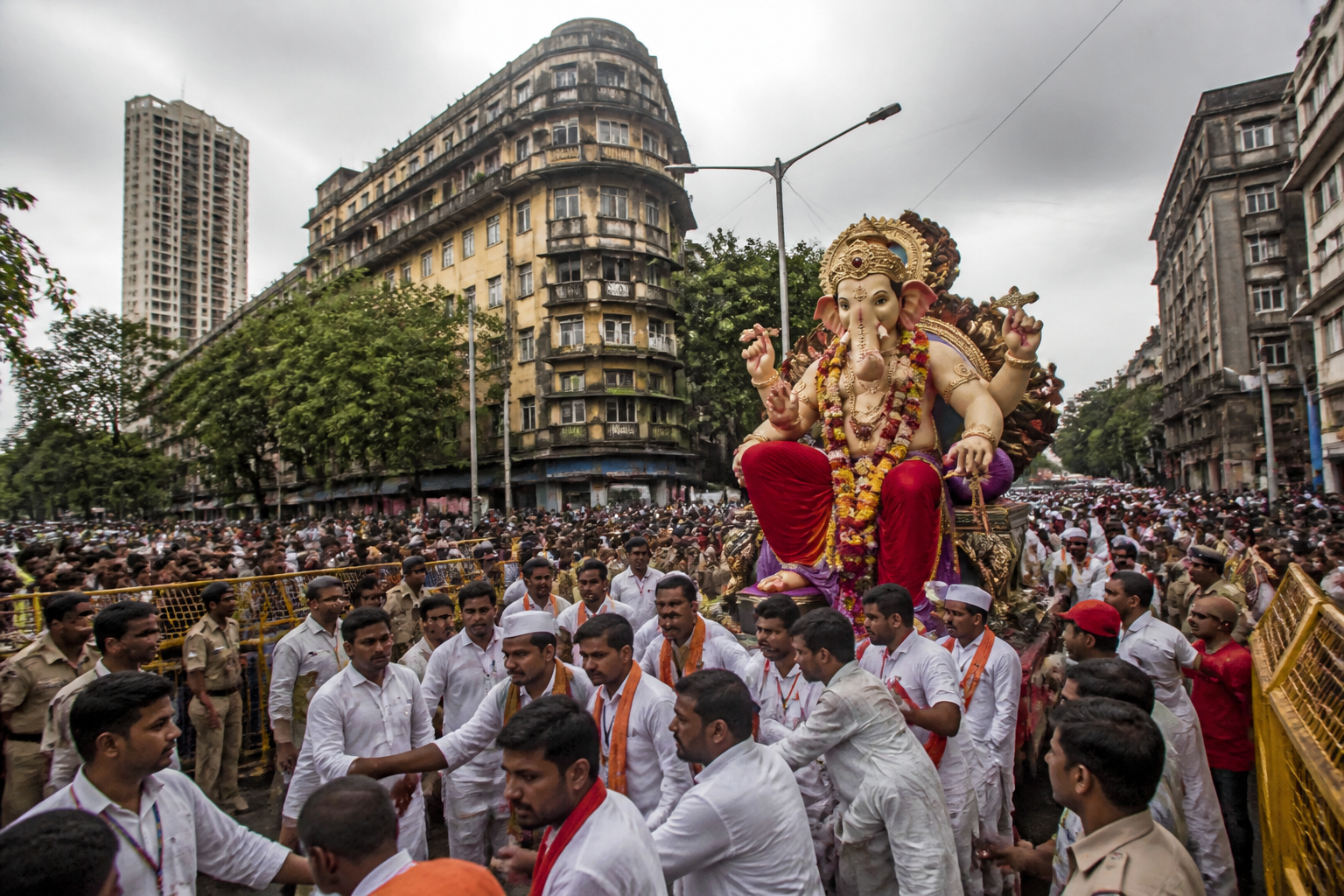
Ganesh Visarjan rules in Mumbai have come under immediate scrutiny after the Bombay High Court ordered restrictions on DJs, firecrackers, laser lights and beams at public celebrations and processions, while organisers and enforcement agencies remained unclear about how the directions would be implemented on Anant Chaturdashi.
The restrictions are aimed at controlling noise and air pollution during Ganeshotsav and other religious festivals, according to a report by Loksatta – Mumbai. The order covers the use of firecrackers on public roads and at public places, as well as DJs, laser lights and beams during processions. It also requires adherence to prescribed noise limits and the use of sound-level measuring equipment.
The report said that Ganesh mandals could face a minimum security deposit of Rs 1 lakh if conditions relating to sound levels, noise measurement equipment and prescribed limits are violated. However, the absence of detailed instructions from the Maharashtra government created uncertainty among public Ganesh mandals, police personnel and other government agencies ahead of the city’s main immersion processions.
Mumbai’s Anant Chaturdashi processions were scheduled to begin from the morning of September 25, with mandals moving towards immersion points. The processions commonly include bands, Nashik-style musical groups, traditional drums and loudspeakers. Local leaders and social organisations also set up welcome stalls along procession routes, where loudspeakers may be used.
The issue has an immediate urban impact because major Ganesh mandals in Girgaon, Lalbaug and Parel attract large numbers of devotees from Mumbai, other parts of Maharashtra and neighbouring states. The resulting crowds affect road traffic and place additional pressure on police, municipal agencies and route-management arrangements. Loud musical performances and firecracker displays have also been a recurring source of complaints from residents and contribute to noise and air pollution.
According to the report, mandal representatives were seeking clarity on whether high-volume instruments could be used, where the Rs 1 lakh security deposit would have to be submitted and which authority would take action in the event of a violation. These questions remained unresolved until Thursday night, even though the processions were due to begin the next morning.
The state government sent a letter to the police late on Thursday, but the report said that the police had not provided clear guidance by late night. This left organisers trying to interpret the court’s directions while also preparing crowd movement, sound arrangements and immersion logistics.
Many mandals subsequently decided to follow the court’s directions and exclude firecrackers and instruments capable of producing extremely high noise levels from their processions. Some organisers obtained copies of the court order to understand the requirements and avoid possible violations. The uncertainty also raised concerns among mandal office-bearers and workers about possible legal action and the financial and employment consequences of future court proceedings.
Advocate Naresh Dhibavkar said public Ganesh mandals should comply with the High Court’s directions and that the state government should have issued instructions to the relevant agencies and organisers. The immediate administrative challenge remains the conversion of the court’s pollution-control directions into clear, uniform instructions for procession organisers and enforcement personnel across Mumbai.
