


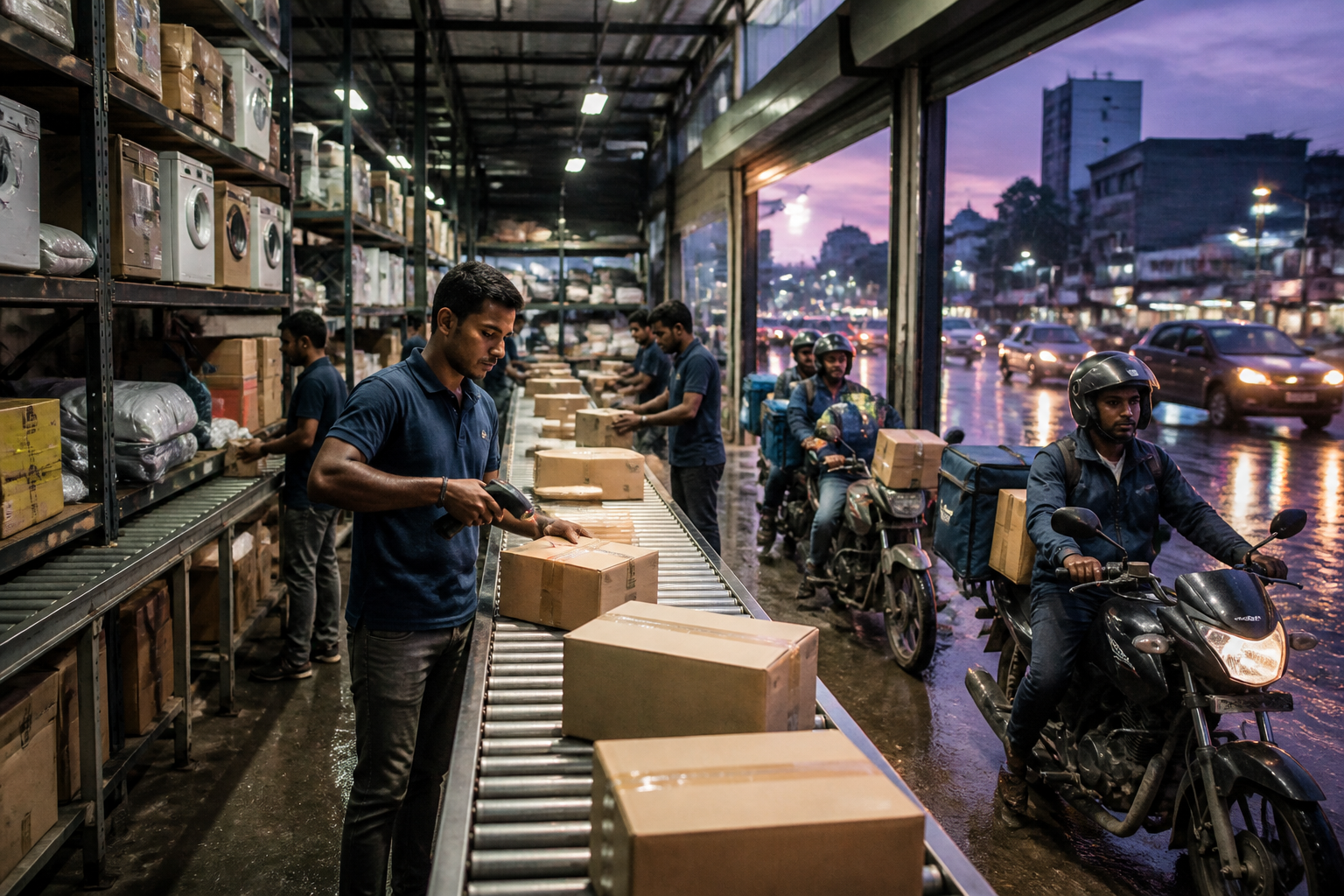
India’s festive online shopping season has opened with demand spreading decisively beyond metropolitan centres, offering a revealing picture of how smaller cities are being integrated into the country’s consumption and delivery networks. Flipkart, Amazon, Myntra and Meesho have reported sharp increases in orders from Tier-2, Tier-3 and smaller markets, while quick-commerce platforms are extending rapid delivery into categories that were once associated with scheduled e-commerce shipments.
The immediate figures are sales numbers. The larger development is geographic. Flipkart said nearly half of visits during the opening hour of its 13th Big Billion Days sale came from Tier-3 towns and beyond, while non-metro customers accounted for around 60 per cent of demand. Myntra said Tier-2 and Tier-3 cities contributed more than half of first-day orders during its Big Fashion Festival. Meesho reported that customers from Tier-3 and smaller markets nearly tripled during its sale.
Taken together, these figures indicate that festive e-commerce is no longer organised primarily around large metropolitan demand. Smaller cities are becoming important demand centres in their own right, with consumers buying not only essential or low-cost goods but also premium electronics, branded fashion, beauty products, appliances and home-related items.
That shift places new demands on the urban systems that support online commerce. The consumer sees an order confirmation and a delivery estimate. Behind it lies a chain of sellers, warehouses, sorting facilities, roads, last-mile workers, payment systems, exchange logistics and local delivery networks. As demand moves into smaller cities, the performance of these systems becomes as important to e-commerce growth as discounts and product selection.
The sales data also points to a change in what shoppers are buying. Flipkart reported that large-appliance sales grew 30 per cent year-on-year in the opening hour, while tablet sales grew 73 per cent. Amazon said premium Android smartphone sales rose 70 per cent year-on-year, with strong demand for laptops, premium wearables and large appliances. Televisions measuring 55 inches and above accounted for 65 per cent of Amazon’s television sales.
These purchases require more than a parcel network designed for clothing or small consumer goods. Large appliances need handling, storage, transport capacity and, in many cases, delivery coordination at the building or household level. The available source does not provide a city-by-city breakdown of warehouses, vehicle fleets or delivery infrastructure, but the category mix shows that the physical requirements of festive commerce are expanding alongside demand.
Affordability continues to shape that demand. Flipkart said one in four mobile shoppers opted for exchange and one in three selected no-cost EMI. Amazon reported that one in two customers used EMI. This combination of financing, exchange offers and premium upgrades allows consumers in smaller markets to participate in higher-value purchases without paying the full cost upfront.
The result is not a simple shift from low-priced to premium consumption. The opening trends show both forces operating together. Consumers are seeking discounts and financing options while also purchasing aspirational products. Meesho reported strong demand for sarees, kurta sets, children’s clothing, beauty products and home essentials, while orders on its branded Meesho Mall proposition grew more than 200 per cent year-on-year.
This matters for the geography of retail. In a conventional market, a customer’s access to products is shaped by the range available in nearby shops, local distribution arrangements and the distance to a larger commercial centre. Online platforms reduce some of those constraints by connecting consumers in smaller towns to a wider inventory. But they do not eliminate geography. They relocate the challenge from storefront availability to fulfilment, connectivity and last-mile execution.
The performance of eastern markets during Myntra’s sale illustrates how regional demand can be concentrated around local festive calendars. Demand during the Big Fashion Festival rose seven-fold over business-as-usual levels in the eastern markets, with West Bengal, Assam and Bihar contributing to the surge ahead of Durga Puja. Occasion wear, ethnic wear, footwear and beauty products were among the categories driving demand.
This regional pattern is significant because it complicates the idea of one national festive market. Platforms may run a common sale, but consumption is still shaped by local festivals, household practices, income patterns and regional preferences. The technology creates a common purchasing interface; the demand remains geographically and culturally differentiated.
The infrastructure challenge is particularly visible in quick commerce. Flipkart Minutes recorded a 3.5-fold increase in order volumes over regular days during its opening phase, while new customers grew 11-fold in the first hour. Purchases included premium electronics, grooming products and wearables. Myntra’s M-Now recorded a twofold increase in orders on the first day of its fashion festival. Amazon said that in more than 120 cities served by Amazon Now, one in every two products was delivered within minutes.
Quick commerce has traditionally been associated with everyday essentials and short-distance urban delivery. Festive demand is widening the range of goods handled through rapid fulfilment, including premium electronics and fashion-related products. That expansion increases the importance of local inventory placement, neighbourhood fulfilment points and the road network connecting them to customers.
The example of an iPhone 17 delivered to a customer in New Delhi in 3.4 minutes demonstrates the promotional power of speed, but it also highlights how delivery expectations are being reset. A few minutes may be commercially useful during a sale, yet the operational model depends on having inventory close to the customer and sufficient delivery capacity at the moment demand peaks. The source does not establish whether this performance can be replicated across all cities or categories. It does show that rapid fulfilment is becoming part of the competitive language of festive retail.
For smaller cities, the implications are different from those in established metropolitan markets. Platforms are not merely competing for existing online shoppers; they are also bringing new customers into organised digital commerce. Flipkart reported a 34 per cent increase in new customers, while Meesho said transacting customers grew about 60 per cent on the first day of its sale. The increase in participation suggests that digital retail is still expanding its customer base rather than only shifting purchases between competing platforms.
That expansion depends on trust as much as on logistics. Exchange facilities, no-cost EMI, branded shopping propositions and faster delivery help reduce the friction involved in buying higher-value goods online. At the same time, the rise in orders creates pressure on delivery operations during short, high-intensity periods. The supplied data records order growth and delivery claims but does not provide information on worker numbers, return volumes, failed deliveries or the effect of peak demand on local traffic.
Those gaps are important for understanding the full urban cost and capacity of festive e-commerce. A rise in orders can support sellers, delivery workers and local consumption, but it also requires cities to absorb more movement of goods and people. The available material does not quantify the additional traffic, packaging waste, storage demand or energy use generated by the sales. Those outcomes therefore remain unestablished rather than conclusions that can be drawn from the opening-day numbers alone.
What the evidence does establish is a strong connection between digital demand and the physical organisation of cities. Smaller-town consumers are participating in national sales at scale. Premium goods are moving beyond the largest metros. Regional festivals are producing sharp localised surges. Quick-commerce companies are extending delivery models into more cities and more product categories.
The policy and planning question is consequently broader than whether online sales are growing. It concerns how urban and semi-urban systems accommodate the next layer of consumption. Warehousing, road access, delivery addresses, digital payments, local retail competition and worker mobility all influence whether demand can be converted into reliable service. The supplied report does not identify a single public programme or administrative framework governing these systems, but the operational data makes their importance visible.
Festive online shopping is therefore becoming a useful indicator of India’s changing urban economy. It shows where purchasing power is emerging, how regional demand is being connected to national platforms and how delivery infrastructure is moving closer to households outside the biggest cities. It also shows the limits of sales data: order growth confirms participation, but not by itself the sustainability, profitability or social cost of the system supporting it.
The next evidence to watch is whether the opening-day surge translates into sustained demand across the festive period, whether smaller-city participation remains strong beyond promotional discounts, and whether quick-commerce delivery expands consistently across the 120-plus cities cited by Amazon. For now, the clearest finding is that India’s festive market is becoming less metropolitan in its demand and more infrastructure-intensive in its operation.

