


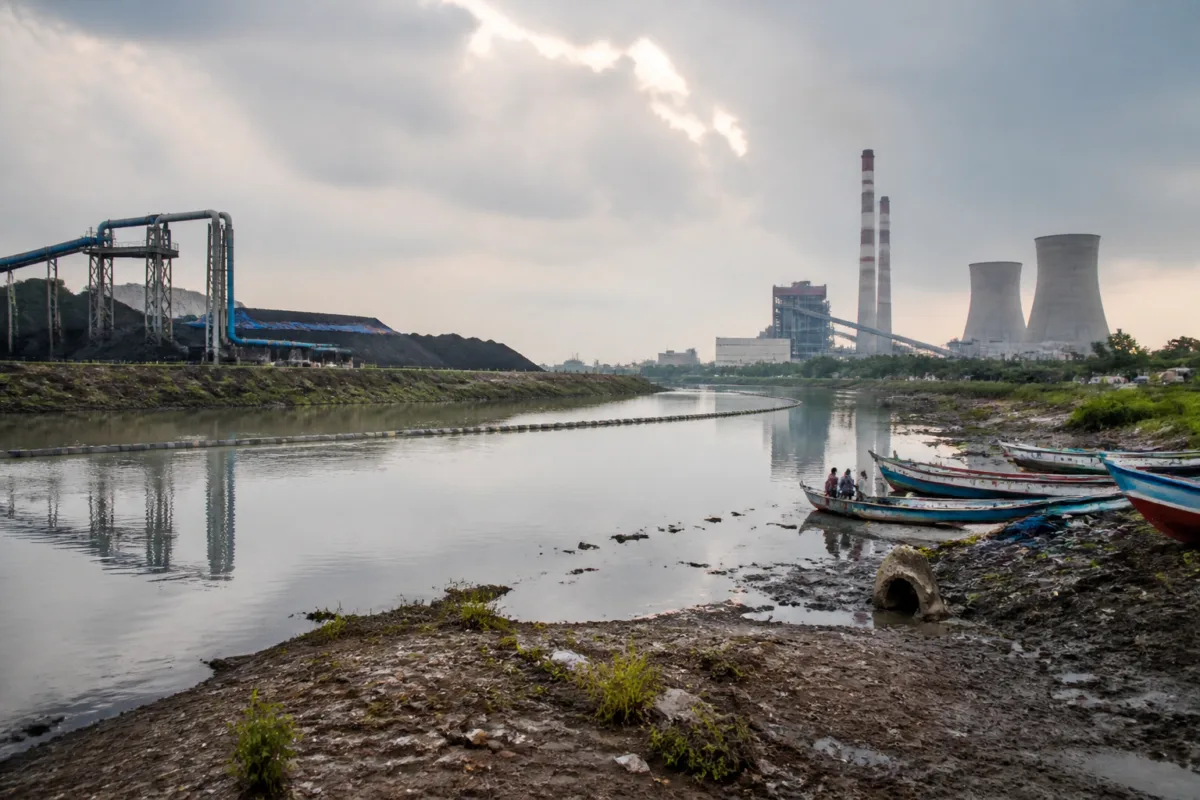
Ennore Creek pollution is continuing despite the creation of a government restoration council, according to a report by the Save Ennore Creek Campaign, a collective of citizens, environmentalists and fisherfolk. The report identifies unchecked fly ash and effluent discharge, incomplete dredging, restricted access to historical air-quality data and stalled community infrastructure as signs that the institutional response has not yet translated into measurable improvement on the ground.
The report matters because Ennore is not only an environmental zone. It is also a working landscape shaped by industrial activity, fishing settlements, waterways and public infrastructure. When pollution control weakens in such a setting, the effects are distributed across several systems at once: water quality, fish stocks, public health, livelihood security and trust in regulatory institutions.
The campaign said it prepared its assessment after multiple field visits, on-ground observations and a review of government orders. Its conclusions focus on three connected failures: pollution continues to enter the creek, restoration work remains incomplete, and mechanisms intended to monitor or respond to complaints have not functioned adequately.
The institutional gap is particularly important. The Manali Ennore Restoration and Rejuvenation Council, or MERRC, was set up last year to address environmental and development concerns in the region. However, the report said that environmental protection measures, grievance redress meetings and restoration actions had not progressed sufficiently despite the council’s formation.
This raises a basic governance question: whether creating a coordinating body is enough when enforcement, monitoring and implementation remain divided among multiple agencies. The report specifically referred to the role of the Tamil Nadu Pollution Control Board and Power Generation Corporation Limited in relation to pollution control and industrial impacts. It alleged that inaction by these institutions had allowed negative effects to continue.
### Pollution at the point of discharge
One of the report’s most specific allegations concerns the continued movement of fine ash slurry from an ash pond towards Seppakkam and into Ennore Creek. The report also said fishers had reported multiple ash leakage incidents from pipelines connected to the North Chennai Thermal Power Station.
These claims are significant because they identify possible pollution pathways rather than describing contamination only as a general environmental condition. The report’s account places industrial waste management, pipeline integrity and oversight at the centre of the problem. It does not, however, provide in the supplied material with a new laboratory assessment quantifying the concentration of pollutants in the creek or establishing the precise contribution of each discharge source.
That distinction is important for public accountability. Residents need access not only to assurances that pollution is being addressed, but also to records showing what was released, where it entered the water system, how incidents were investigated and what corrective action followed. Without such a chain of evidence, repeated complaints remain difficult to resolve conclusively.
The report also raised concerns about the availability of pollution data. It said historical real-time air-quality records from industries in the area, which were previously available on the pollution control board’s website, had been restricted to current data. According to the campaign, the loss of historical records undermines public scrutiny of pollution trends.
Historical data serves a different purpose from current readings. A current reading can indicate conditions at one point in time, while a longer record can help establish whether pollution is recurring, seasonal, linked to particular operations or improving after an intervention. The campaign’s concern is therefore not simply about access to information; it is about whether citizens and regulators can track performance over time.
### Restoration cannot end with dredging
The report’s account of Ennore also shows why restoration cannot be reduced to a single engineering activity. It said an invasive mussel infestation that began during an earlier government period continues under the current administration. Dredging at affected sites remained incomplete, it added, while dredged material continued to be dumped along the river.
Dredging can remove accumulated material from a waterway, but the outcome depends on what is removed, where it is taken and whether the source of contamination is controlled. The supplied report does not establish the technical composition of the dredged material or assess its disposal practices in detail. It does, however, point to a practical problem: incomplete work and disposal along the river can leave restoration visibly unfinished and may create further concerns for communities living beside the waterway.
The sequence described by the campaign suggests that restoration is being experienced by residents as a series of disconnected actions rather than as a complete programme. Pollution control, ecological management, dredging, disposal, monitoring and grievance redress are all treated as separate administrative tasks, even though they affect the same creek and the same communities.
This is also where the role of MERRC becomes central. A council can coordinate departments, but its effectiveness depends on clear responsibilities, public reporting and follow-through by the agencies that control industrial operations, pollution monitoring and local infrastructure. The report’s findings indicate that the existence of the council has not, by itself, resolved these implementation gaps.
### Public health and livelihood concerns remain unresolved
The campaign linked environmental conditions in Ennore to health and economic concerns, while calling for the primary health centre at Kathivakkam to be upgraded. It also sought the expedited construction of a market block for fishers, work on which it said had stalled.
These demands show that environmental restoration in Ennore is inseparable from public services and livelihood infrastructure. For fishing communities, damage to the creek can affect both the ecological resource and the facilities needed to sell, process or distribute the catch. A health centre, meanwhile, is part of the region’s ability to respond to exposure-related or other community health needs, although the supplied material does not provide clinical data linking specific illnesses to specific pollutants.
The report also referred to a mass fish death in Ennore Creek several months earlier. R Subhashini, identified as a fisherwoman, questioned the explanation attributed to the environment minister in the state assembly that sewage was responsible. She said no report on the incident had reached the community and asked how sewage alone could have caused so many deaths.
Her question highlights the importance of transparent incident investigation. A public explanation is not a substitute for a report that sets out the evidence, sampling method, findings and accountability measures. The supplied article does not include the government’s investigation report or a separate scientific assessment of the fish deaths. That absence leaves a material information gap for affected residents.
### The information infrastructure of environmental governance
The dispute over Ennore is therefore not only about physical infrastructure such as ash pipelines, canals and dredging equipment. It is also about information infrastructure: the records, meetings, complaint systems and public reports through which environmental governance becomes visible.
The Save Ennore Creek Campaign said grievance redress meetings had not been held adequately. If residents cannot regularly bring complaints before the responsible agencies, and if historical monitoring records are not accessible, institutional performance becomes difficult to test. Communities may continue to report leakage, odour, fish deaths or changes in water conditions, but those reports may not enter a transparent process that records action and closure.
This weakens both public confidence and administrative learning. Repeated incidents should generate a record of what happened, what agency responded, what repair was ordered and whether the problem recurred. The report’s criticism is that these feedback loops remain incomplete in Ennore.
The stalled community projects mentioned in the report add another layer. Work on the Ennore market block, community hall and Thiruvottiyur Industrial Training Institute was said to have stopped after the change in government. The supplied material does not provide project costs, completion targets or the reasons for the delays. It does show, however, that residents’ concerns extend beyond pollution to the delivery of basic public and livelihood infrastructure.
### What the evidence establishes—and what remains open
The supplied report establishes that the Save Ennore Creek Campaign has documented continuing concerns through field visits, observations and a review of government orders. It records allegations of ongoing ash and effluent discharge, reported ash pipeline leakages, incomplete dredging, riverbank dumping of dredged material, restricted historical air-quality data, inadequate grievance redress and stalled local projects.
It does not, in the material available here, provide an independent government response to each allegation, laboratory results, a full timeline of restoration work, or a published investigation into the fish deaths. Those missing records are important because the central issue is not whether complaints exist; it is whether the authorities have measured them, responded to them and demonstrated improvement.
The larger urban question is whether Chennai’s environmental governance can protect a water system that sits alongside heavy industry while also safeguarding the livelihoods and public services of nearby communities. Ennore shows that restoration requires more than a council, a dredging operation or a pollution-control order. It requires continuing monitoring, accessible historical data, functioning grievance channels, clear agency responsibility and timely delivery of community infrastructure.
For now, the evidence presented by the campaign points to a restoration effort whose institutional structure exists but whose outcomes remain contested on the ground. The next significant developments will be the authorities’ response to the report’s allegations, the release of any investigation into the fish deaths, the completion and disposal record of dredging work, and progress on the Kathivakkam health centre and the fishers’ market block.

