


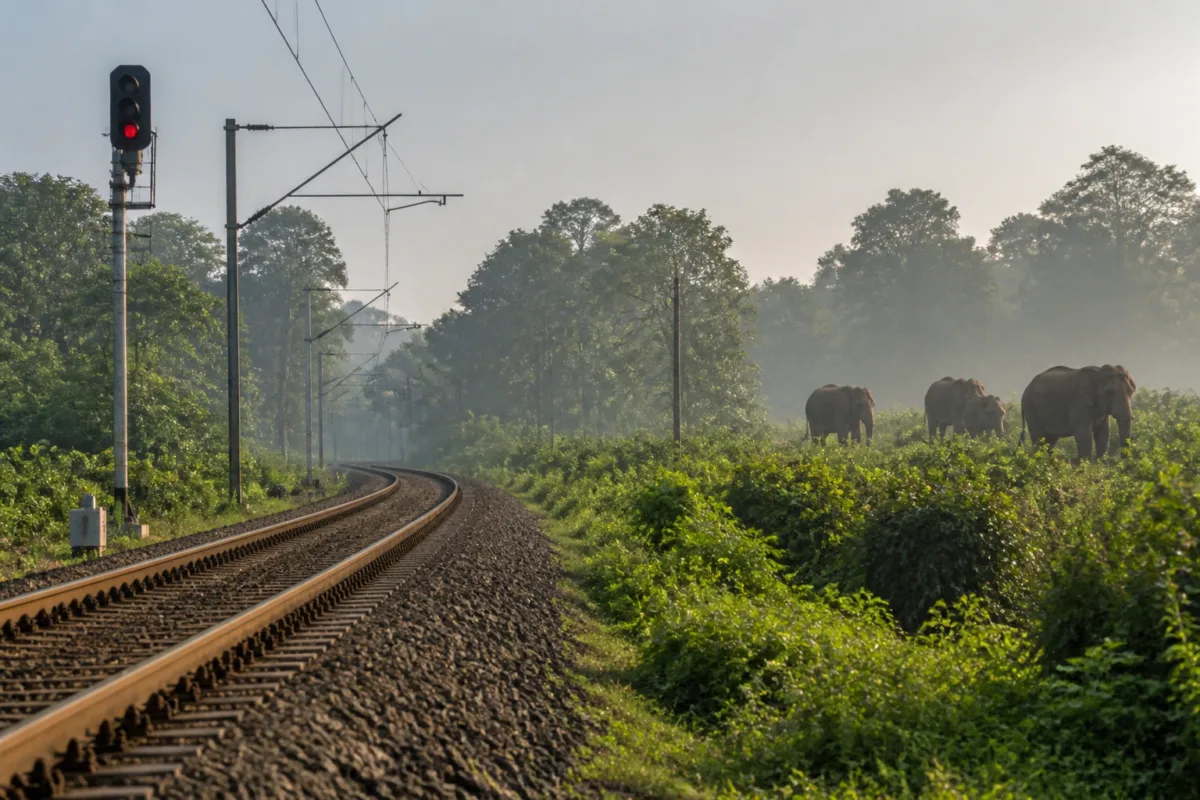
A wildlife conservation organisation has urged Northeast Frontier Railway to introduce immediate safeguards against elephant-train collisions on the Batasi–Naxalbari railway section in north Bengal, where seasonal elephant movement intersects with a busy rail route.
Hathi Sathi Foundation has written to the railway’s Katihar division seeking a strict speed limit of below 40 kmph on identified risk sections, particularly from evening to early morning and during periods of elephant movement. The recommendation was made by wildlife specialist and journalist Prerana Singh Bindra, according to an Anandabazar report.
The foundation has also sought a joint inspection involving the railway and the West Bengal Forest Department. Such coordination, the letter said, should help identify elephant movement routes, assess visibility along the tracks and determine where warning systems or safe crossings are required.
The organisation said its wildlife survey team had monitored elephant movement for 15 days at two railway-crossing locations in the Kolabari–Tukriyajhar area. The letter identified the Panitanki area as a traditional corridor used by elephants during the paddy season. It said infrastructure expansion and population pressure had fragmented historical habitat, leaving elephants with fewer options and pushing them towards potentially more dangerous routes near Naxalbari, Bengaijote and Batasi.
The recommendations include constructing safe underpasses or eco-bridges at established elephant corridors so that animals do not have to cross the tracks at grade. The foundation has also called for increased surveillance alongside the railway, stronger patrolling by forest personnel and the Airavat rapid response team during crop-harvesting and elephant-movement periods, and regular removal of dense vegetation near the tracks to improve visibility for locomotive drivers at night.
The letter further proposes a direct warning protocol linking station masters and railway staff with forest field personnel and elephant trackers. It also recommends warning signs at verified crossing points and interim alerts for railway staff while permanent speed restrictions and other measures are assessed.
Technology is another part of the proposed response. The foundation has suggested an intrusion detection system using optical-fibre sensors installed beneath the railway line. According to the letter, such sensors could detect vibrations caused by elephant movement and send advance alerts to nearby stations and train drivers. The organisation said its survey indicated that 80 per cent of elephant-train accidents occurred at night, although the report does not provide the underlying survey document.
Bindra also cited a recent incident in which forest personnel reportedly stopped the Sikkim Mahananda Express using a red-cloth signal after spotting a herd of more than 70 elephants. The account was presented as an example of how rapid communication between field staff and train operations can prevent a collision; the source does not include an independent railway confirmation of the incident.
The route is described in the report as highly sensitive, with more than 27 trains operating on it daily. That traffic volume increases the importance of reliable detection, speed control and communication between the railway and forest authorities, particularly during low-visibility hours and seasonal crop movement.
The foundation’s letter referred to the Supreme Court’s 2 September 2014 directions in the Shaktiprasad Nayak case concerning speed reduction for trains passing through dense forest areas. It asked the Katihar division and the Darjeeling forest authorities to apply the relevant guidance to the Batasi–Naxalbari section.
The recommendations remain a civil-society proposal in the available report. There is no reported confirmation from Northeast Frontier Railway that it has accepted the speed limit, ordered the joint inspection, installed an intrusion detection system or sanctioned underpasses and eco-bridges. The immediate governance question is therefore whether railway and forest officials will jointly verify the identified crossing points and convert the proposed measures into an operational safety plan.

