


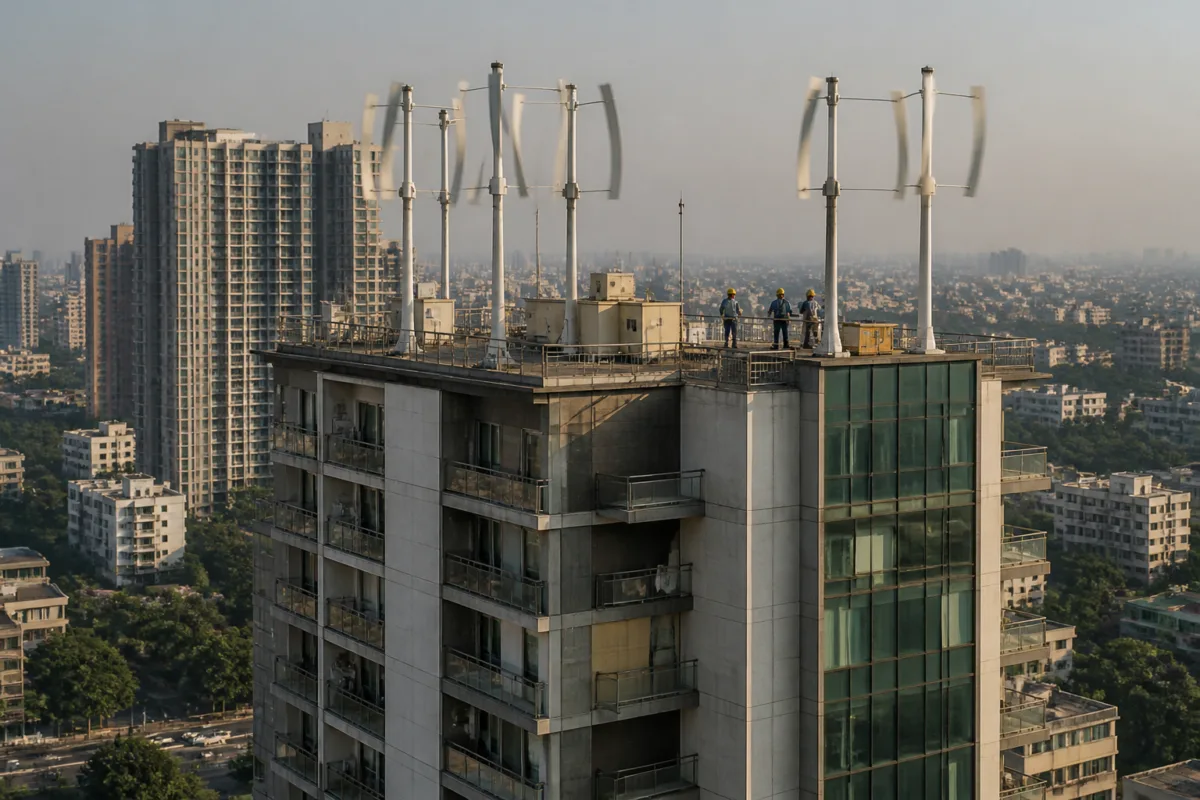
Delhi-NCR high-rises could become sites for small-scale power generation under a wind-energy technology being developed by Delhi Technological University (DTU). The proposed system would use vertical-axis wind turbines installed on tall buildings to generate electricity for part of their internal demand.
The research is being conducted in DTU’s civil engineering department. According to Dr Ritu Raj, buildings between 10 and 20 storeys could be suitable for the technology. The project is examining whether the airflow around high-rise structures can provide enough energy for consistent electricity generation in dense urban areas.
The approach would add another building-level renewable energy option alongside rooftop solar. The report does not indicate that the system is ready for commercial installation, nor does it provide an expected power output for an individual building. Its immediate significance lies in testing whether urban wind conditions can support useful generation where land is limited and rooftop space may already be occupied by services, equipment or solar panels.
The reported wind conditions vary considerably with height and season. At heights of 10 to 20 metres in Delhi-NCR, average wind speeds are reported to range from 1.5 to 3.5 metres per second, rising to 4 to 6 metres per second during summer. At heights of 50 to 120 metres, the shape of buildings can increase airflow, potentially improving the conditions for power generation.
However, the turbine proposed in the research would require wind speeds of 6 to 8 metres per second for electricity generation, according to Dr Raj. This gap between commonly reported lower-level wind speeds and the stated operating requirement is central to the technology’s feasibility. It means that building height, local wind conditions, turbine placement and the aerodynamic effects of surrounding structures will determine whether the system can produce useful power.
The proposed setup would convert the energy of moving air into electricity through several stages. Wind would turn the turbine, with the motion transferred through a gear train to a wound-rotor induction generator. A converter would then regulate the electricity for use within the building or for transfer to the grid, according to the report.
DTU’s research is described as being about 60 to 70 per cent complete, with results expected next year. Those results will be important in establishing whether the technology can move beyond a research concept and operate reliably in the complex airflow conditions found around Delhi-NCR’s high-rises.
For building owners and urban planners, the proposal raises practical questions about structural integration, vibration, noise, maintenance, electrical connections and the economics of the power generated. The report does not provide findings on these issues or confirm any specific building installation. Until those aspects are assessed, vertical-axis turbines should be viewed as an experimental clean-energy option rather than an established substitute for rooftop solar or grid electricity.

