


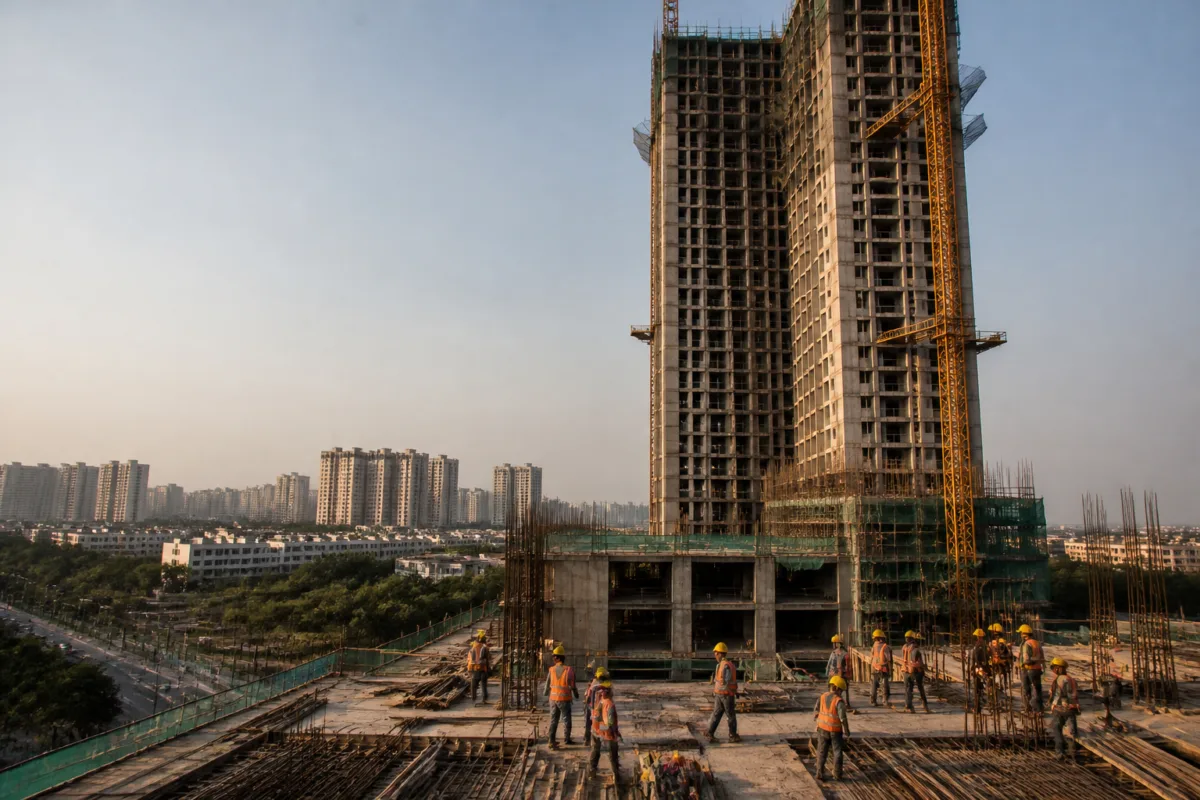
DLF expects its revenue growth to accelerate from financial year 2027-28 as projects worth around ₹75,000 crore move closer to completion and handover. The guidance offers more than a forecast for India’s largest listed real estate company: it shows how the timing of construction, occupation certificates, buyer handovers and accounting recognition can leave a large gap between sales activity and reported revenue.
The company’s group chief financial officer, Badal Bagri, said the inflection point would emerge in 2027-28 and continue over the following four to five years as the value of launched projects is recognised. DLF follows the completed contract method of accounting, under which revenue is recognised only after a project is completed and receives an occupation certificate. As a result, the company’s reported revenue does not move in lockstep with the value of projects launched or the bookings recorded from buyers.
That distinction is central to reading DLF’s latest numbers. In the second quarter of financial year 2026-27, the company reported an 11 per cent year-on-year increase in consolidated net profit to ₹1,301.35 crore, even as revenue from operations fell 23 per cent year-on-year to ₹1,260 crore for the quarter ended September. Earnings before interest, tax, depreciation and amortisation rose 17.5 per cent year-on-year to ₹1,060 crore from ₹902 crore in the corresponding period.
At the same time, new sales bookings increased sharply to ₹3,800 crore, a 478.7 per cent rise from the preceding quarter. The contrast between higher bookings and lower quarterly operating revenue illustrates the importance of project stage and accounting treatment in the development business. Sales can be recorded or committed before the associated project reaches the completion point required for revenue recognition under the company’s stated method.
For urban housing markets, this creates a different way to understand the headline numbers. A project pipeline is not the same as completed housing supply, and bookings are not the same as occupied homes. The ₹75,000 crore figure represents launched end projects that DLF expects to recognise as construction and regulatory milestones are completed. The company’s revenue guidance therefore depends not only on demand from buyers, but also on execution through construction, certification and handover.
The occupation certificate is particularly important in this process because it marks the point at which DLF says revenue can be recognised. This places the administrative completion of a project alongside its physical construction in the company’s reporting cycle. The financial impact of the pipeline will consequently be spread over the period in which projects achieve the required completion status, rather than appearing immediately after launch or booking.
DLF’s comments also point to the growing role of pricing systems in the premium housing segment. Aakash Ohri, the company’s joint managing director and chief business officer, said prices at The Dahlias had already increased by 10 per cent during the quarter and that further increases were expected once the project’s experience centre was completed. He said the project used a pricing algorithm under which prices increase with every sale and are not linked to sales velocity or the number of sales.
This approach makes price progression a programmed feature of the sales process rather than a response only to the pace of bookings. The company has not disclosed in the supplied material how the latest increase has affected total project realisation or buyer affordability. What is clear from the statement is that the project’s pricing mechanism is designed to adjust progressively as sales take place, while the experience centre is treated as another milestone before further increases.
The strategy also demonstrates how premium projects are managed through a combination of physical delivery and controlled market positioning. The experience centre is not itself a measure of construction completion, but its completion is linked by the company to the timing of further price changes. This makes the project’s sales environment part of the company’s broader revenue and margin narrative, even though the underlying revenue-recognition trigger remains project completion and receipt of the occupation certificate.
Execution conditions in the National Capital Region could affect the pace at which construction outflows are incurred. DLF managing director and chief executive officer Ashok Tyagi said construction outflows could temporarily decline as the industry entered a period of labour migration during the festive season and as Graded Response Action Plan restrictions were in force in the NCR. He said contractors and labour arrangements had been put in place to maintain decent progress, and that difficulties should ease after the restrictions were lifted.
The statement places two short-term operational pressures alongside the company’s longer-term revenue plan. Seasonal labour movement can affect the availability of workers on construction sites, while GRAP measures can influence construction activity in the NCR. DLF’s response, according to Tyagi, is to rely on existing contractor and labour arrangements rather than treat the temporary disruption as a change to the overall project pipeline. The supplied material does not establish the extent of any delay or quantify the effect on individual projects.
This distinction matters because DLF’s projected revenue inflection is dependent on a sequence of projects reaching completion over several years. A temporary reduction in construction outflows does not automatically translate into a revenue decline, but it does show that the path from launch to recognition is exposed to site-level and regulatory conditions. The company’s own comments indicate that the timing of progress will remain an operational consideration even as it maintains its broader guidance.
DLF’s rental portfolio provides another stream of recurring activity alongside development revenue. Tyagi said the company expected a quarterly exit run rate of ₹175-180 crore, excluding Atrium, equivalent to about ₹750 crore annually. The company also said it would continue with an annual dividend policy and expected a more predictable dividend pipeline from DCCDL to DLF on a regular basis, while dividends from DLF would remain annual for now.
The rental guidance and dividend comments show that DLF is presenting its business through more than one financial channel. The development portfolio is expected to generate a stronger revenue contribution as projects are completed, while the rental portfolio is described through a quarterly exit run rate. These are different indicators: one is tied to project recognition and handover, while the other reflects recurring rental income. The supplied results do not provide a consolidated breakdown of how each stream contributed to the quarter’s reported revenue.
DLF’s second-quarter performance therefore contains three separate signals. Profit and Ebitda increased, operating revenue declined, and new sales bookings rose sharply from the previous quarter. The company’s explanation for the longer-term revenue outlook rests on the future recognition of launched projects rather than on the quarter’s revenue alone. Its pricing comments focus on a premium project, while its construction comments acknowledge temporary labour and regulatory constraints in the NCR.
Taken together, the disclosures show why real estate companies cannot be assessed through bookings or quarterly revenue in isolation. Bookings indicate sales activity, but completion and occupation certificates determine when DLF says revenue is recognised. Construction progress influences the timing of handover, while pricing systems affect how future sales are positioned. Rental income and dividends provide separate indicators of recurring cash generation and capital distribution.
The central issue for monitoring is whether the ₹75,000 crore launched-project base moves through construction and certification broadly within the company’s stated 2027-28 inflection window and the following four to five years. The company has provided the broad value and timing of the pipeline, but the supplied material does not list project-wise completion schedules, expected handover dates or the share of the pipeline already covered by occupation certificates. Those details will determine how quickly the projected revenue acceleration becomes visible in reported results.
For now, DLF’s guidance describes a transition from a business measured mainly by launches and bookings to one increasingly measured by completed projects and recognised revenue. The next evidence will come from project execution, occupation certificates, handovers, the pace of premium pricing at The Dahlias, construction conditions in the NCR and the company’s reported revenue in the quarters leading into financial year 2027-28.

