


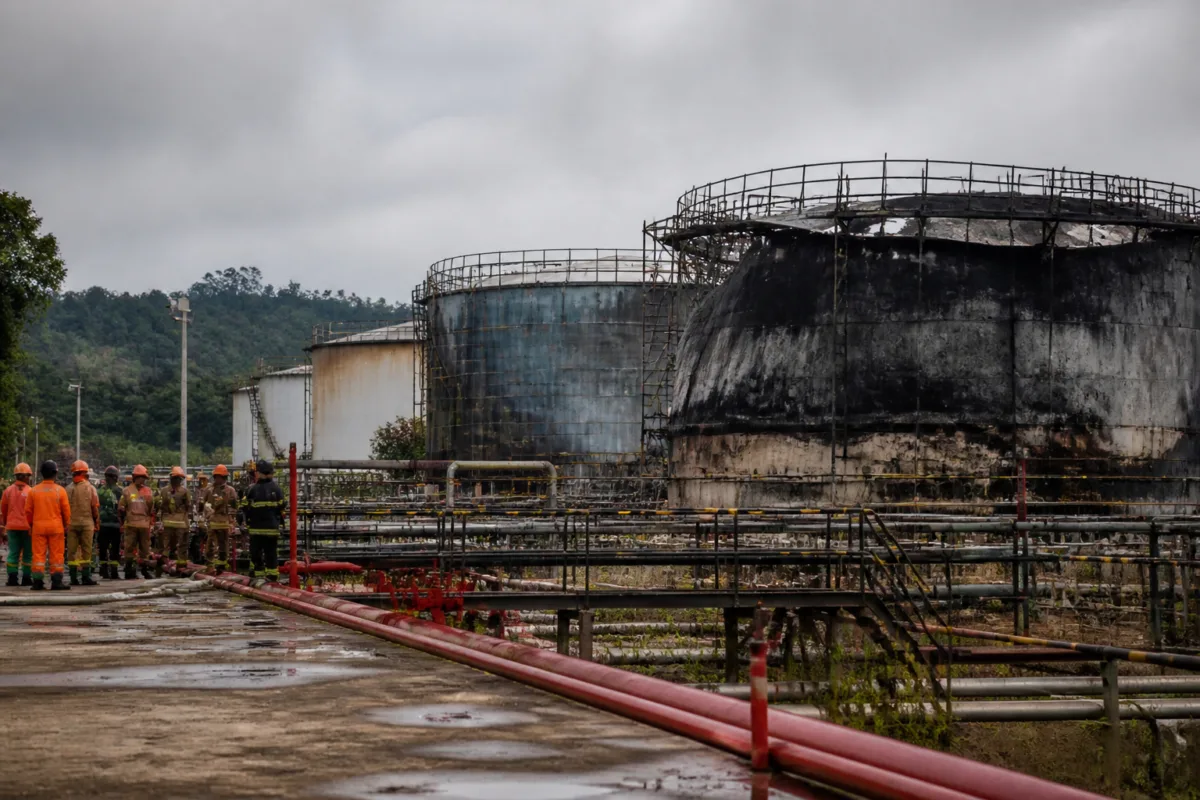
The Dibrugarh oil explosion has become a test of how industrial safety is managed after an accident, not merely how quickly emergency response is mounted. The death of worker Kumud Gogoi, 38, while undergoing treatment at a private hospital has taken the toll from the November 6 blast at Oil India Limited’s Intermediate Tank Farm in Tengakhat to five. The immediate cause has not yet been officially established, but the sequence of deaths, suspensions, compensation demands and competing accounts has exposed the institutional questions that follow a fatal industrial incident.
The explosion occurred at around 9.05 am while workers were carrying out maintenance activities at the facility. According to OIL’s preliminary assessment, the blast occurred in the Indirect Bath Heater area of the Intermediate Tank Farm, which had been isolated for maintenance since November 4. The explosion triggered a major fire. OIL has said it formed an internal inquiry committee to investigate both the immediate and underlying causes and recommend measures to prevent a recurrence.
That distinction between immediate and underlying causes is important. A technical failure, an operational error or a breakdown in maintenance controls may explain how a blast began. It does not, by itself, establish why workers were exposed to the risk, whether procedures were followed, how the facility was cleared for work, or whether warning signs had been identified earlier. The supplied account does not establish those answers. It records that the inquiry is still under way and that the exact cause has not been officially determined.
The five workers who died were Raju Dutta, 45, Tapas Gogoi, 40, Rupam Gohain, 47, Sailen Gogoi, 45, and Kumud Gogoi. Dutta died at the site, while the other four died during treatment at different hospitals. The human cost therefore extends beyond the moment of the explosion: families have had to manage deaths occurring across treatment locations, while injured workers remain dependent on specialised medical care.
OIL announced an ex-gratia payment of Rs 10 lakh to the next of kin of each deceased worker and Rs 5 lakh to each injured employee. The company also suspended four personnel—three officers and one employee—for alleged dereliction of duty in connection with the incident. These steps indicate that the company has begun assigning administrative responsibility and providing immediate financial assistance, but they do not amount to a final finding on the cause of the accident. The inquiry committee’s conclusions will determine whether the suspensions are linked to procedural failures, supervision, maintenance decisions or other issues.
The medical response has also created a second layer of responsibility. Critically injured worker Indra Gogoi was airlifted to New Delhi on November 9 for specialised treatment. Another critically injured worker is receiving treatment for serious burn injuries at a private hospital in Dibrugarh. The report does not specify the total cost of treatment, the duration of medical support, or whether OIL’s announced assistance fully covers the long-term needs of injured workers. Those details matter because burn injuries can require prolonged care, rehabilitation and income support, although the eventual requirements in these cases have not been established in the available material.
The compensation demands made after the blast show how quickly an industrial accident becomes a question of institutional trust. The All Assam Students’ Union has demanded at least Rs 5 crore for each bereaved family, employment for one eligible family member, adequate compensation and advanced medical treatment for critically injured workers. Its Dibrugarh district delegation submitted a memorandum to OIL’s chairman and managing director at the company’s headquarters in Duliajan and warned of agitation if its demands were not addressed.
Ulfa-I has demanded a one-time ex-gratia payment of Rs 1 crore for each deceased worker, employment under OIL for one eligible member of every bereaved family, and Rs 50 lakh along with advanced medical treatment for each injured worker. In a statement signed by self-styled major Nirnoy Asom, the outfit alleged that recurring safety lapses and irresponsible operational practices had contributed to repeated accidents in oilfields and pipeline installations. Those allegations have not been established by the inquiry reported by OIL and must remain separate from the confirmed facts of the November 6 incident.
The competing compensation figures also reveal a gap between a company’s standard immediate-relief package and the expectations of affected communities. OIL’s announced payments provide a defined initial response. The demands from AASU and Ulfa-I seek substantially higher compensation, jobs and continuing medical support. The available report does not state whether OIL has accepted, rejected or negotiated those demands. Nor does it establish whether compensation will ultimately be based on employment status, insurance arrangements, statutory provisions, assessed loss of income or a broader settlement.
The location of the accident adds a wider public-interest dimension. The blast took place at an OIL Intermediate Tank Farm in Tengakhat, an industrial facility where maintenance work was being undertaken. Ulfa-I’s statement alleged that previous accidents had caused deaths and damage to agricultural land, livestock and the environment. These claims are allegations, not findings in the current inquiry. Even so, they point to the need for the investigation to examine more than the equipment involved in this particular blast. A credible account would need to establish whether the incident was isolated or connected to recurring weaknesses in maintenance, supervision, contractor management and emergency preparedness.
The role of Spectron Engineers Private Limited, identified by Ulfa-I as OIL’s maintenance contractor, is another issue requiring factual clarification. The report does not establish the contractor’s responsibilities at the Intermediate Tank Farm, the division of duties between OIL and the contractor, or whether any contractor personnel were among the victims. It records that Ulfa-I held both OIL and Spectron responsible, but the inquiry’s findings are not yet available. Accountability cannot be assigned conclusively on the basis of the allegation alone.
The case also illustrates why industrial safety investigations need to distinguish between punishment and prevention. OIL’s suspension of four personnel may address suspected dereliction of duty, but disciplinary action does not automatically explain the system that allowed the alleged failure to occur. The internal inquiry has been tasked with examining immediate and underlying causes. Its value will therefore depend on whether it identifies the chain of decisions around the maintenance activity, the isolation of the facility, safety clearances, supervision, emergency response and the management of workers during high-risk operations.
The evidence currently supports a clear but limited conclusion. Five workers have died, at least two injured workers require serious medical attention, OIL has announced ex-gratia assistance and suspended four personnel, and demands for higher compensation and family employment have been submitted. The facility had been isolated for maintenance before the explosion, but isolation alone does not establish that every safety control was effective. The cause remains officially unresolved.
The next decisive document will be OIL’s internal inquiry report and any subsequent official findings. Those findings will need to clarify what happened in the Indirect Bath Heater area, whether maintenance protocols were followed, how contractor and company responsibilities were divided, and what corrective measures will be imposed. Until then, the Dibrugarh oil explosion remains both a fatal workplace incident and an unresolved test of whether industrial safety systems can learn from loss before the next accident occurs.

