


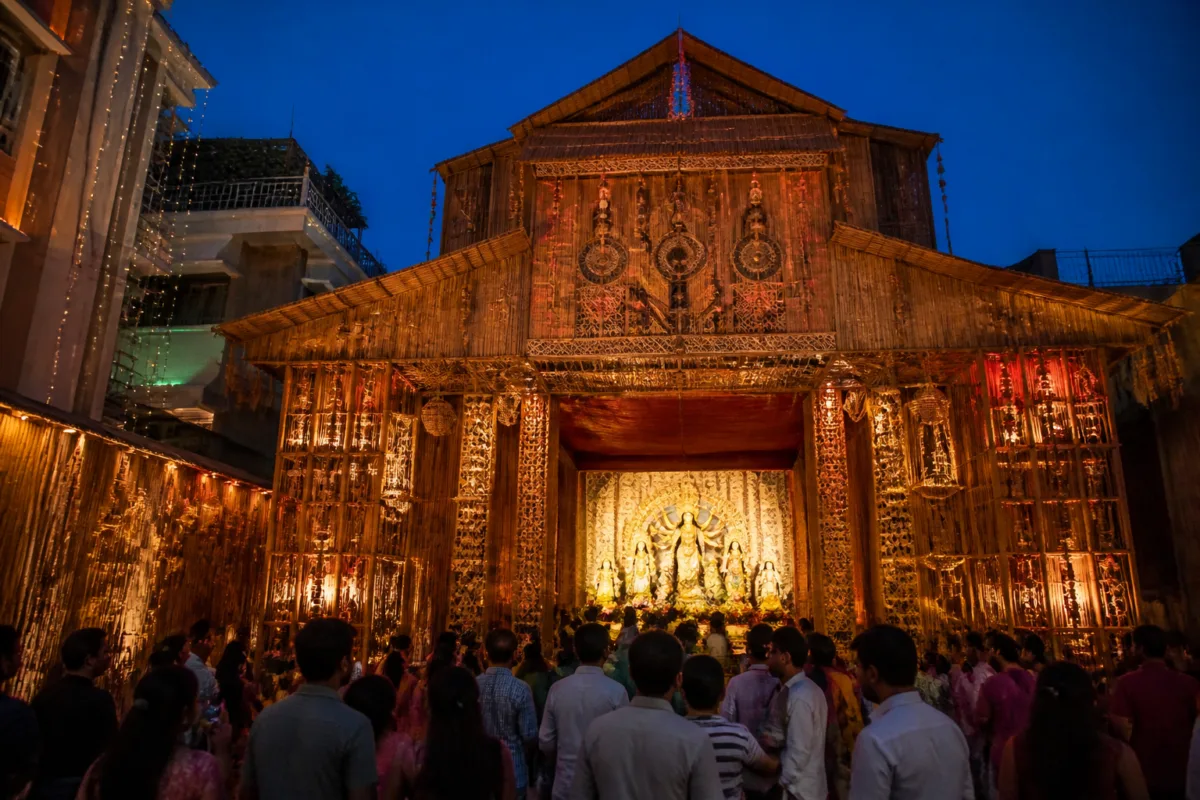
Delhi’s Durga Puja pandals are often treated as seasonal places of worship, but this year’s installations in Paharganj and Chittaranjan Park show how temporary public spaces can also become museums, workshops, community kitchens and platforms for debates about technology, ecology and disappearing crafts. Their significance lies not only in the idols or the crowds they attract, but in the way neighbourhood committees organise land, labour, materials, money and memory for a short period each year.
The contrast between the pandals is revealing. At Arambagh Durga Puja Samiti in Central Delhi’s Paharganj, a recreated North Kolkata lane frames a theme centred on the continuing relevance of print. At two committees in CR Park, the built environment itself carries the message: one uses biodegradable foam boards, clay, natural colours and waterproofing materials, while another relies on jute, bamboo and hand-crafted work by artisans from villages around Kolkata. Together, the installations show how a festival can turn temporary construction into a form of public communication.
The Paharganj installation begins with a familiar urban scene rather than an abstract display. The samiti has recreated the alleys of Shyambazar, including details such as a person sitting at a tea stall or on a balcony reading a newspaper. Its centrepiece is a model printing press, with newspapers rolling out, a newsagent sorting copies and a cyclist delivering them to homes. Typography is used to show how written letters have changed over time, while a sound track refers to old radio stations and the Doordarshan news tune.
The installation also places front pages from the Emergency, Independence and Rabindranath Tagore’s death within the pandal, with some material sourced from the Parliament Library and the National Library, according to chairman Abhijit Bose. The result is a temporary space that combines religious gathering with an account of how households and neighbourhoods once received information.
That memory is linked to a changing communications landscape. Bose recalled growing up in Odisha, where newspapers arrived a day late and several people would queue to read the same copy. His argument that digital media cannot replace newspapers is a statement from the organising committee, not a measurable finding about media consumption. Yet the physical design of the pandal makes the argument legible: the press, the newsagent, the delivery cyclist and the reader become parts of one urban chain.
This is one of the distinctive features of festival architecture. A committee can use a temporary structure to make systems visible. In the Paharganj pandal, the system is the circulation of news. In CR Park, the systems are material production, artisanal labour, community finance and collective feeding. The installations therefore function as more than decoration. They explain, through objects and spatial arrangements, how a community understands change.
## What Delhi’s Durga Puja pandals reveal about construction
At the Park Mela Ground in CR Park, this year’s theme, “Mati, Manush, Mohon”, connects the clay of the idol with the people who create the pandal and the sense of enchantment produced by the finished space. The committee has used a red-and-white palette inspired by the traditional Lal Paar saree, with dark green elements intended to underline the use of eco-friendly materials.
The reported material choices are specific. Decorations are cut from biodegradable foam boards, the idol is made of clay, and colours used on faces and hands are derived from fruits and vegetables. These details matter because they shift sustainability from a general claim to a visible construction vocabulary. Visitors encounter the environmental message through the materials themselves, rather than only through written explanations.
The limits of that sustainability claim are also important. The supplied report does not provide a life-cycle assessment, disposal audit or comparison with conventional pandal materials. It does not establish how much waste was avoided or how the materials were processed after the festival. The evidence supports saying that the committee used particular biodegradable, clay and natural materials; it does not support declaring the pandal fully sustainable.
The financial scale of the installation shows another side of temporary urban construction. Avik Mitra, the committee’s assistant treasurer, said waterproofing material and carpets alone cost approximately Rs 40 lakh. The committee also feeds between 8,000 and 10,000 people a day during community meals, while sponsorship carries much of the financial burden. These figures place the pandal within a substantial logistical operation, involving procurement, food preparation, crowd management and the conversion of a public event ground into a high-intensity community facility.
The committee begins meetings two to three months before the festivities, according to Mitra. It then decides the budget and forms departments with assigned responsibilities. This internal structure resembles a short-term project management system. It has planning, budgeting, procurement and delivery stages, although the report does not establish whether the committee follows formal municipal permissions or standardised construction protocols.
The idol is made within the colony at the Chittaranjan Park Kali Mandir, where a dedicated space is set aside for the purpose. This local production arrangement connects the festival to the neighbourhood’s physical and institutional fabric. The pandal is not simply brought in as a finished product; at least part of the process is embedded within the colony, with workspaces and community roles supporting the final public installation.
## Craft, labour and the temporary city
The K-Block CR Park pandal makes the craft question more explicit. Its structure is created with jute and bamboo, and artisans from villages around Kolkata arrived about a month before the festivities began. General Secretary Saurav Chakravarty said that everything at the pandal was hand-crafted and that the committee wanted to promote traditional artisans whose skills were being neglected amid modernisation.
This creates a direct link between festival construction and livelihoods. The built environment of the pandal depends on people who possess knowledge of bamboo, jute, shaping, assembly and decoration. The structure lasts for a limited period, but the labour behind it represents skills that organisers believe are at risk of disappearing. The temporary nature of the building does not make the labour temporary in cultural terms; it becomes a vehicle for keeping a technique visible.
At the same time, the report does not establish the number of artisans employed, their wages, working conditions or the longer-term market for their skills. Those gaps matter. A public message about craft revival can be documented through the materials and the organisers’ statements, but its livelihood impact requires evidence beyond the installation itself.
The pandals also demonstrate how neighbourhood associations can mobilise resources outside conventional permanent infrastructure. They raise sponsorship, assign committee roles, bring in specialist workers, organise food for thousands and create spaces capable of carrying a theme. Their work is not equivalent to municipal service delivery, but it shows a form of local capacity that becomes visible during the festival season.
That capacity is spatially dependent. Paharganj and CR Park provide different urban settings, but both installations require an identifiable site, access to materials, time for assembly and a community willing to manage the process. The reported costs and preparation schedules indicate that the event depends on planning well before visitors arrive. The finished pandal may appear ephemeral, yet its production is planned and capital-intensive.
## The larger urban question
The evidence from these Delhi pandals raises a broader question about what cities choose to preserve in public space. A temporary structure can hold memories of newspapers, radio and shared reading while also displaying new debates about digital change. It can present clay, bamboo, jute and natural colours as design decisions, while bringing attention to the people who make them. It can support community meals at a scale that requires serious organisation and expenditure.
The installations should not be treated as proof that all festival construction is environmentally responsible or that every committee has equal access to land, sponsorship and labour. The supplied report does not provide comparable data across Delhi’s pandals, nor does it assess waste, permissions, safety or post-festival material recovery. Those remain questions for further reporting.
What the report does establish is that Delhi’s Durga Puja committees are using temporary architecture to make cultural and urban processes visible. Arambagh’s press-themed lane maps the movement of information from production to household. The CR Park installations map the movement of materials and skills from clay, bamboo and jute to a shared public setting. In both cases, the pandal becomes a compact model of a larger city system.
The next important developments are practical: how these materials are dismantled, reused or discarded; whether the artisans continue to receive work beyond the festival; and how committees manage the costs, crowds and temporary transformation of public spaces. Those questions will determine whether the pandals remain only compelling seasonal displays or become sustained examples of community-led cultural and environmental practice.

