


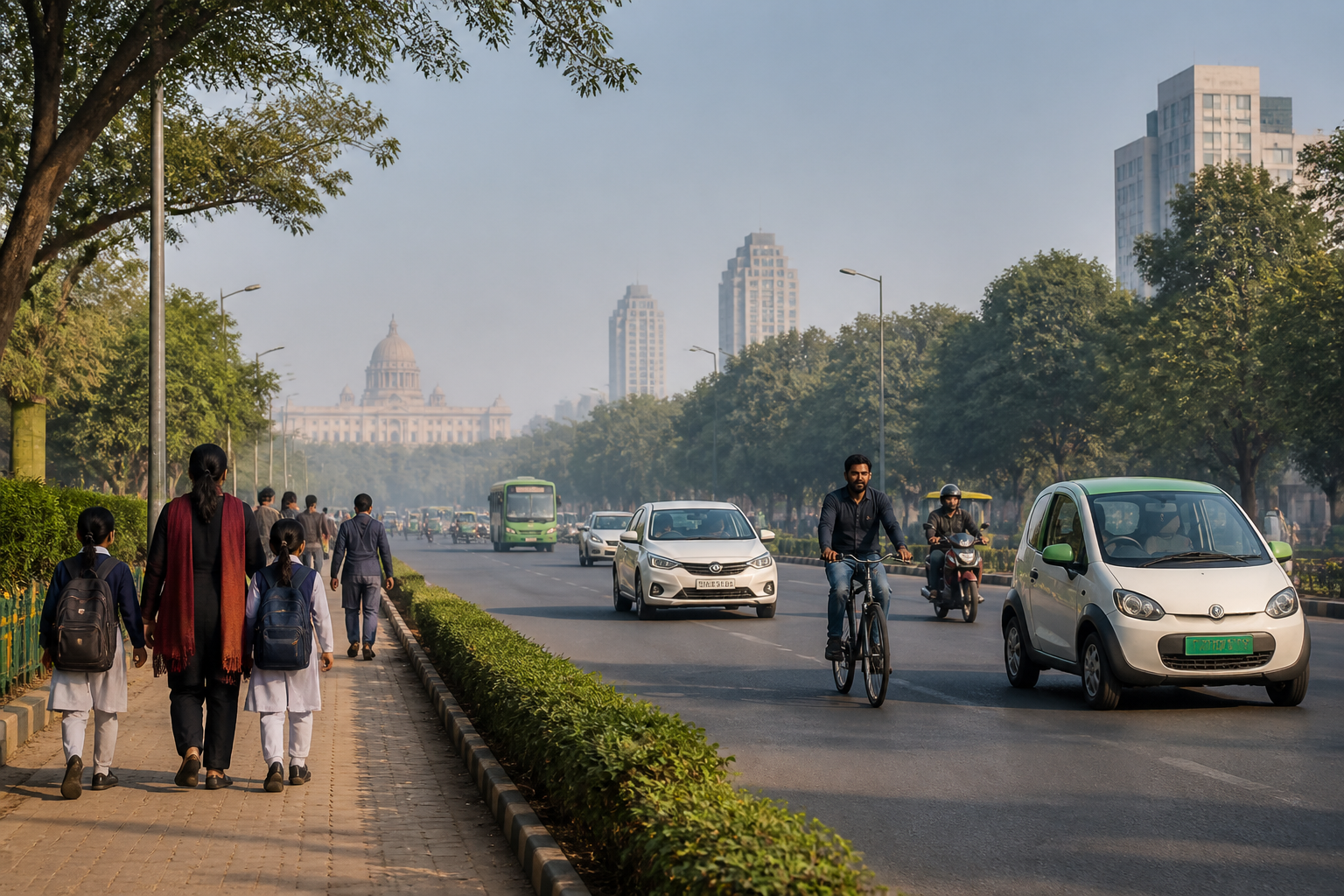
Delhi’s proposed clean air zone is not merely an air-pollution programme. The vision presented at the Urban Adda 2026 summit places the capital’s air, water, mobility, metropolitan governance and public-space decisions within one urban management framework. That shift matters because the city’s environmental problems do not operate in separate administrative compartments: emissions affect children near schools, water availability constrains new infrastructure, and transport decisions shape both access and exposure.
The proposal remains a vision rather than an announced operational programme. At the India Habitat Centre, Tarun Kumar Pithode, member secretary of the Commission for Air Quality Management, said that a low-emission zone across Delhi could be possible through cleaner policies, stricter enforcement and cooperation with surrounding areas, according to the report by Jagran – New Delhi. The emphasis on neighbouring areas is significant because the summit discussion treated Delhi as part of a wider metropolitan system rather than an isolated municipal boundary.
That framing moves the conversation beyond episodic pollution response. The report says participants discussed a city-wide strategy aimed at preventing pollution events instead of responding only after they occur. It does not provide a final boundary, implementation date, enforcement mechanism, funding plan or quantified emissions target for the proposed clean air zone. Those missing details are central to whether the idea can move from a conference vision to an enforceable urban policy.
## From pollution response to prevention
A low-emission zone generally depends on decisions about which activities are restricted, where restrictions apply, how compliance is monitored and what alternatives are available to residents and businesses. The supplied report does not establish those design features for Delhi. It records the broader direction articulated at the summit: cleaner policies, stronger rules and coordination with adjoining areas.
This institutional dimension is important. Delhi’s air-quality challenge cannot be managed only through one department or one seasonal measure if the proposed approach is genuinely city-wide. The summit’s call for cooperation with surrounding areas indicates that the geographical scale of the problem extends beyond the core city. It also suggests that the success of any future zone would depend on coordination between agencies and jurisdictions, although the report does not identify a specific metropolitan authority responsible for implementation.
The conference linked this air-quality agenda to schools. A report titled “School Clean Air Zone” was released during the event, calling for local spatial interventions and zero-emission school boundaries to protect children from toxic emissions. The proposal places schools at the centre of air-quality planning rather than treating them only as sensitive sites during pollution emergencies.
However, the available material does not specify what a zero-emission school boundary would include. It does not state whether the concept would involve traffic restrictions, changes to vehicle access, walking and cycling improvements, delivery controls or monitoring stations. The absence of these operational details does not diminish the significance of the principle, but it means the current discussion should be understood as a policy direction rather than a completed scheme.
## The water cost of urban infrastructure
The summit also connected environmental planning with water security. Sessions led by the organisation Gurujal examined water circularity amid weak monsoons and El Niño-related challenges. The discussion emphasised treating, reusing and recharging water as measures to respond to both water stress and flooding.
This is a wider urban systems question. Cities often manage water supply, drainage, flood response and new construction through separate decisions. The summit’s “Water Security for Circularity” session placed these concerns in one frame by discussing reuse and recharge alongside crisis management. The report attributes this emphasis to Gurujal chief executive Shubhi Keswani and other panellists, but it does not provide a proposed project list, investment figure or city-wide implementation timetable.
The water discussion also extended to data centres. A roundtable on the growing water footprint of data centres argued that water availability should become a key decision point before projects are approved. That proposal is especially relevant to urban planning because infrastructure approvals can create long-term demand for scarce resources. It also raises a governance question: whether water availability is assessed as a binding condition at the approval stage or considered later, after a project’s location and scale have already been determined.
The supplied report does not identify the data centres under discussion, their water consumption, the approving authorities or the applicable regulatory framework. What it does establish is the principle debated at the summit: infrastructure growth should be tested against local water capacity before approval.
## Mobility is also an inclusion question
Transport was another major part of the summit’s urban agenda. A session on infrastructure integration and gender-inclusive transport called for integrated metropolitan umbrella authorities to manage peri-urban boundaries. The proposal reflects a problem that frequently appears where urban expansion outpaces administrative coordination: roads, public transport, land-use decisions and service delivery may be planned by separate institutions even when residents experience them as one daily network.
The conference also included the release of the Raahgiri Foundation’s publication “Walkability in Indian Cities”. The report provides no findings from the publication, so it is not possible to assess its data or conclusions from the supplied material. Its release nevertheless places walking within the infrastructure conversation, alongside metropolitan integration and mobility access.
Another session, titled “From Infrastructure to Inclusion”, brought together actor Archita Sahu, United Nations officials and urban planners. Participants described safe mobility for women as a fundamental human right and called for it to be incorporated into city master plans. This moves gender-inclusive transport beyond the question of individual safety interventions and towards the structure of planning itself.
The distinction matters. If safety is addressed only through isolated measures, it can remain disconnected from street design, public transport access, lighting, footpaths and the location of essential services. The summit discussion, as reported, argues that inclusion should be visible in the master plan. The supplied material does not state whether any authority has adopted this recommendation or identify specific changes to Delhi’s planning documents.
## The administrative gap behind the vision
The most important thread running through the summit is the demand for integration. Clean air, school protection, water reuse, data-centre approvals, peri-urban management and gender-inclusive transport were presented in separate sessions, but each involves overlapping decisions about land, infrastructure, regulation and public accountability.
The call for metropolitan umbrella authorities is therefore relevant to more than peri-urban boundaries. It points to the difficulty of governing a region where environmental conditions and daily travel patterns cross administrative limits. Yet the report does not establish whether such an authority would replace existing agencies, coordinate them or operate alongside them. Nor does it specify its legal powers, financing or accountability arrangements.
These institutional details will determine whether the clean air zone vision can be implemented. A target without a defined authority can remain aspirational. A restriction without alternatives can shift costs to commuters and workers. A new infrastructure project without a water assessment can intensify resource stress. The summit’s discussions identify these connections, but they do not yet resolve them.
## Making the city legible at neighbourhood level
The event also included a community-facing component. Students and researchers displayed posters on micromobility and urban heat resilience in the central atrium, while a cultural evening brought poets and citizens together to discuss their relationships with Indian cities. These activities do not constitute policy decisions, but they show an attempt to connect technical urban debates with public experience and research.
That connection is particularly relevant to the clean air proposal. The language of a city-wide low-emission zone is administrative and metropolitan; the effects would be experienced at school gates, on footpaths, at transport interchanges and along busy streets. The “School Clean Air Zone” concept offers one possible neighbourhood-level entry point, while the discussions on walkability and micromobility indicate that air-quality planning may intersect with how people move through local areas.
The report does not provide measurements of pollution near schools, walking conditions, heat exposure or water stress. It therefore cannot establish the scale of improvement that any proposed intervention might deliver. The available evidence instead shows a policy conversation expanding from pollution control to the design and management of the urban systems that produce exposure.
Delhi’s clean air zone vision is consequently best understood as a test of institutional integration. The summit established a set of linked priorities: preventing pollution rather than reacting to episodes, protecting children through local interventions, treating and reusing water, checking water availability before approving high-demand infrastructure, coordinating metropolitan growth and embedding safe mobility in planning.
What remains unresolved is how these priorities will be converted into authority, budgets, boundaries, standards, timelines and measurable outcomes. Until those elements are defined, Delhi does not yet have a clean air zone; it has a publicly articulated vision for one. The next developments to watch are any formal policy notification, the design of school-zone measures, the proposed role of neighbouring areas and the way water and mobility conditions are incorporated into future urban approvals.

