


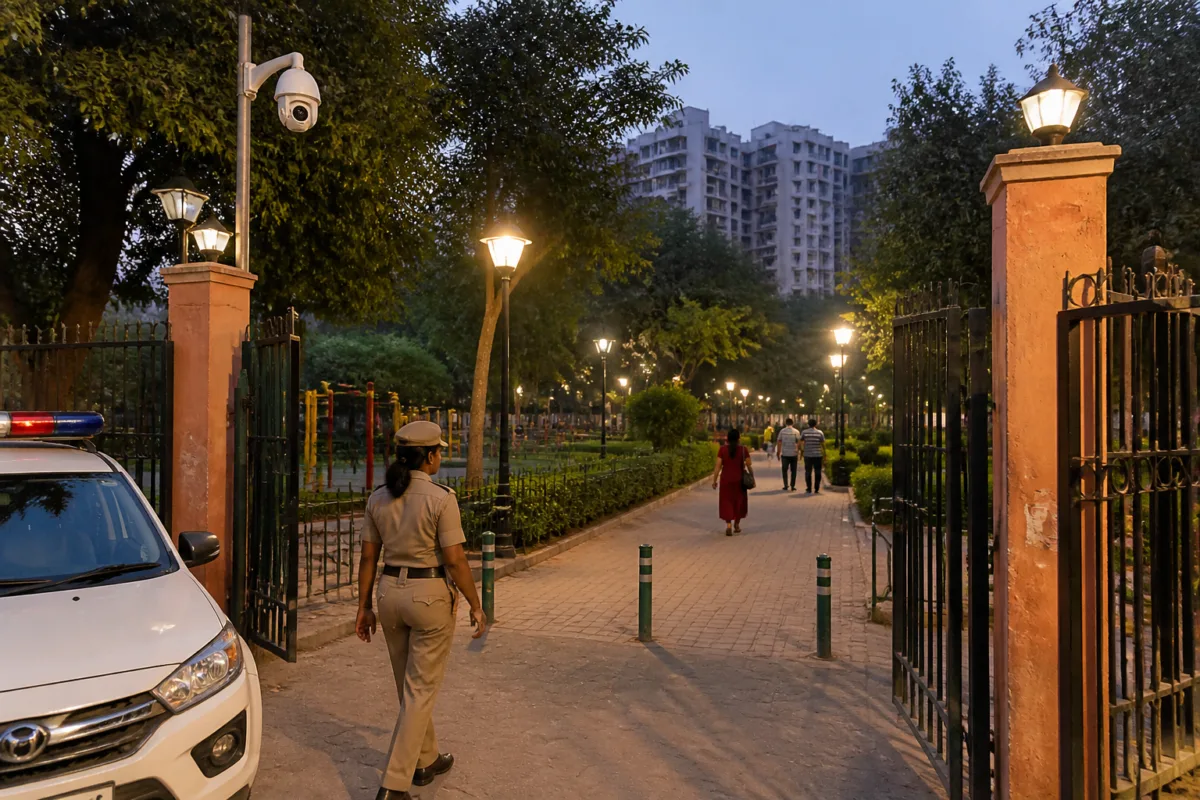
Delhi’s women’s safety plan is expanding beyond patrols and helplines into the physical design and daily management of public space. The Delhi Police has reported more than 6,000 CCTV cameras in parks, audits of 1,635 parks, a reduction in average emergency response time to eight minutes and two seconds, and a target to complete fencing and boundary wall work in all parks by 26 January 2027. Together, these measures show that women’s safety is being treated as an urban systems problem involving streets, parks, transport nodes, police visibility, emergency response and the courts.
The plan followed directions issued by Union Home and Cooperation Minister Amit Shah at the Delhi Police headquarters on 24 October to prepare a three-month action plan for women’s safety. The progress reported by the police combines built infrastructure with operational measures. Cameras, lighting, fencing and gates address the physical conditions of public spaces, while pink scooters, all-women PCR vans, women’s help desks and joint patrols are intended to improve the visibility and speed of the state’s response.
That combination matters because safety in a city is not created by a single technology or a single police unit. A camera can extend surveillance, but it does not by itself make a park usable after dark. A boundary wall can define an area, but it does not ensure regular patrols. A help desk can create an access point, but its value depends on whether complaints are received, acted upon and carried through the criminal justice process. The reported action plan is significant because it places these elements within one administrative framework.
The park measures provide the clearest example. Delhi has identified 19,822 dark spots for CCTV coverage. Security audits have been completed in 1,635 parks, with work reported on boundary walls, fencing and lighting. In 503 large parks, the police says the target for gates and regular patrolling has been fully achieved. PCR vans are also being positioned outside parks. The stated deadline for completing fencing and boundary wall work in all parks is 26 January 2027.
These figures also reveal the scale of the implementation challenge. The programme is not limited to a handful of high-profile locations. It involves thousands of dark spots and a large number of parks, each requiring coordination between policing, local authorities, maintenance agencies and, potentially, land-owning institutions. The supplied report does not identify the agency responsible for every physical intervention or explain the funding arrangements. That information will be important in assessing whether the work can be sustained after installation and audit targets are met.
The response system has shown a measurable improvement according to the police report. Average response time under the Emergency Response Support System has fallen from 11 minutes and 53 seconds to eight minutes and two seconds. The report also says that 178 pink scooters are actively patrolling, for an average of 7.4 hours per scooter, while 35 all-women PCR vans have been deployed. These measures are designed to reduce the distance between a complaint and the arrival of assistance, while also increasing the visibility of women personnel in public areas.
The figures on pink booths indicate continuing demand for direct contact. The 125 booths receive an average of 308 women complainants each day, according to the report. However, the number of visitors alone does not establish how many cases are resolved at the booth, referred to another unit or converted into formal complaints. The next stage of public accountability will therefore depend not only on the number of facilities but also on information about the nature and outcomes of the assistance provided.
Staffing is another central part of the plan. Women constitute 17.3 per cent of the Delhi Police, and the force has set a target of increasing that share to 25 per cent by 2030. Women’s help desks are described as fully active around the clock at police stations in airports, railway stations and metro stations. Anti-human trafficking units are also reported to be operating in every district. This places women’s safety within the city’s wider movement network, where stations and interchange points bring together large numbers of passengers and workers.
The deployment of personnel in schools, colleges and working women’s hostels extends the approach beyond emergency response. The police reports approximately 3,514 weekly visits to such institutions. Of these, 1,869 are by beat staff and 882 by station house officers, with the remaining visits not further specified in the supplied material. The report also records 22,662 awareness programmes reaching around 1.59 million citizens, 570,000 self-defence trainees and 340,000 participants in child-safety initiatives.
The figures suggest an effort to make safety work more routine and locally visible. Regular contact by beat staff and station house officers is different from a campaign limited to a single event. Yet the available report measures the frequency and reach of these activities rather than their outcomes. It does not state how many complaints emerged from institutional visits, whether repeat concerns were identified, or how the police used feedback from women and students to alter deployment.
The justice component is intended to close the gap between reporting a crime and securing a legal outcome. The report says 25 special courts are currently functioning and 37 more are being established. The appointment process for special public prosecutors, including experienced women lawyers, has begun for sensitive cases. From January to 31 October, 1,225 rape and Protection of Children from Sexual Offences cases were registered, with charge sheets filed in 81 per cent of them. The rate of charge sheets filed within two months was 94 per cent, compared with 99 per cent in 2025, according to the police account.
For cases in which the accused was unknown, the average time from registration of the first information report to filing of the charge sheet was 59 days. The report cites charge sheets filed within 44 days in the Noida bus case and 29 days in the Swaroop Nagar blind murder case. It also states that DNA testing has been made mandatory in all cases under the Bharatiya Nagarik Suraksha Sanhita, and that a standard operating procedure is being prepared to seek cancellation of bail for habitual sexual offenders.
These justice figures need to be read carefully. A charge sheet is an important investigation milestone, but it is not the same as a conviction or a final judicial outcome. The report provides information on registration and charge-sheet timelines but does not provide conviction rates, case disposal times, acquittals or the reasons for delays in cases that did not meet the stated timelines. The proposed expansion of special courts and prosecutors indicates that policing measures alone are not being treated as sufficient.
The administrative design of the plan therefore has four connected layers. The first is the physical environment: lighting, fencing, boundary walls, gates and CCTV coverage. The second is response capacity: emergency systems, PCR vans, pink scooters and patrols. The third is access and representation: pink booths, women’s help desks and a larger share of women personnel. The fourth is investigation and adjudication: charge sheets, DNA testing, special courts and prosecutors. Weakness in any one layer can reduce the effectiveness of the others.
The report also shows how the police is measuring performance. It cites response time, camera installation, park audits, patrol coverage, staff share, complaint volumes, outreach totals and charge-sheet rates. This is a shift from describing safety only through crime figures. At the same time, the indicators remain largely activity-based. They show what has been installed, deployed or completed, but provide less information on maintenance, camera functionality, lighting reliability, citizen confidence, complaint resolution or court outcomes.
That distinction is important for a citywide programme. CCTV systems require functioning equipment, monitoring and procedures for using footage. Park infrastructure requires maintenance after construction. Patrols require continuous staffing. Help desks need trained personnel and accessible reporting channels. The supplied report confirms expansion and stated targets, but it does not establish how these systems will be audited over time or how performance data will be published independently.
Delhi’s women’s safety plan is consequently more than a policing announcement, but it is not yet a complete account of safety outcomes. It confirms a substantial deployment of infrastructure, personnel and judicial resources, with measurable progress in emergency response and charge-sheet timelines. It also leaves important questions about maintenance, inter-agency responsibility, complaint outcomes, conviction rates and public reporting. The next milestones are the completion of park fencing and boundary works by 26 January 2027, the establishment of 37 new special courts and the police target of raising women’s representation to 25 per cent by 2030.

