


Delhi’s winter pollution plan is moving beyond the familiar pattern of imposing restrictions only after air quality deteriorates. The measures discussed at a high-level meeting chaired by Union Environment Minister Bhupender Yadav combine advance restrictions on construction, vehicle access, office attendance and parking with year-round enforcement of pollution-control rules. Together, they represent a more pre-emptive approach to managing the capital’s seasonal air-quality crisis, although their effectiveness will depend on coordination between departments and enforcement on the ground.
The Delhi government’s measures will operate from November 1 to February 28, alongside the Graded Response Action Plan, or GRAP, administered by the Commission for Air Quality Management. The annual restrictions were notified on June 23, according to the report. Unlike GRAP, which introduces progressively stricter measures in response to prevailing air-quality conditions and forecasts, the new framework makes several restrictions mandatory in advance during the winter period.
That distinction is important for a city where winter pollution has traditionally produced a cycle of emergency responses. Under the existing GRAP structure, Stage I applies when the Air Quality Index is between 201 and 300, Stage II between 301 and 400, Stage III between 401 and 450, and Stage IV above 450. The restrictions intensify as pollution worsens. The annual Delhi plan adds a calendar-based layer to that system, allowing authorities to impose selected controls before the most severe air-quality conditions are recorded.
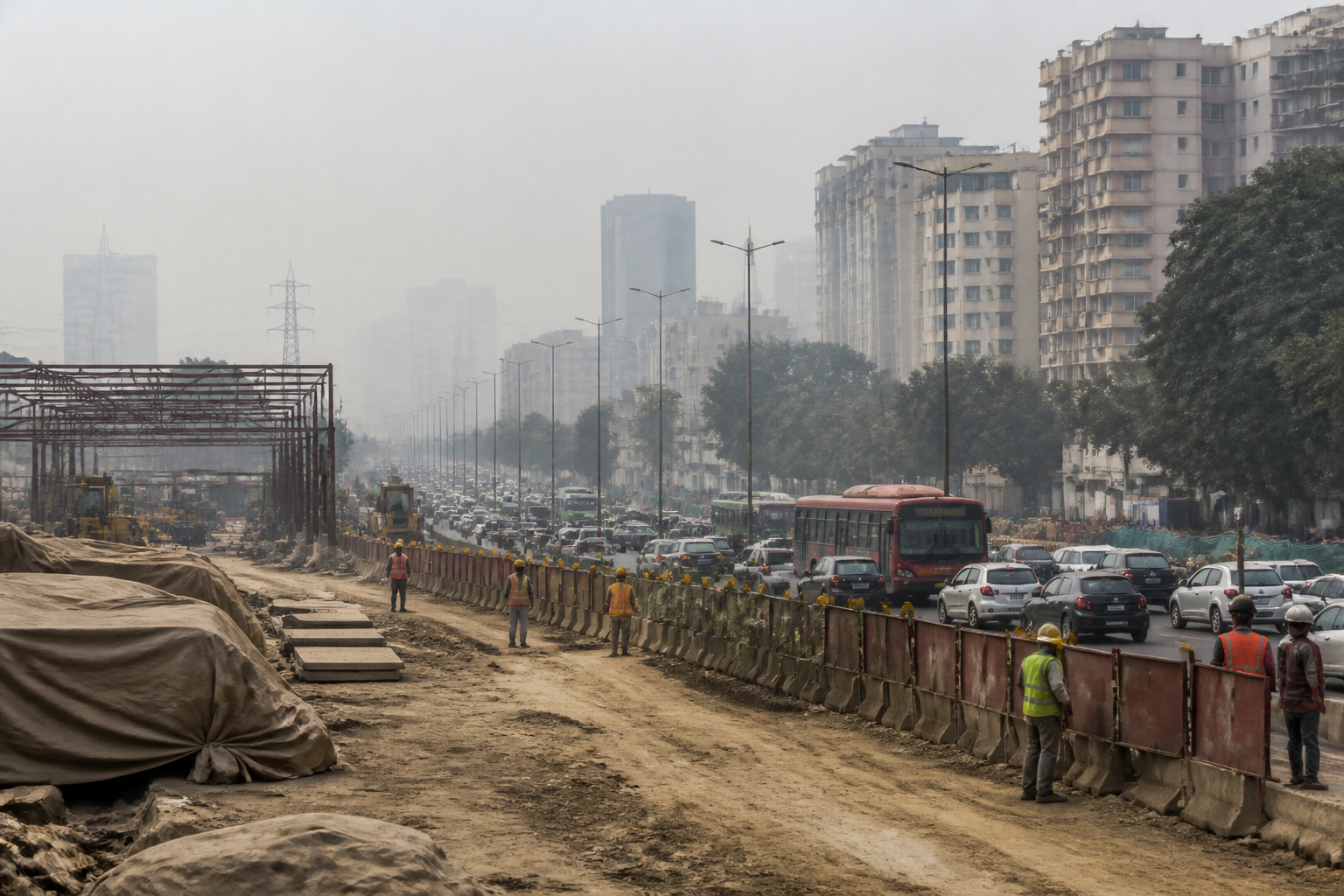
The most consequential measure for the built environment is the phased restriction on construction and demolition. From November 1 to January 31, dust-generating demolition and open civil construction activities will be prohibited, except for essential public infrastructure projects. A complete ban on construction and demolition, with exemptions for urgent government and emergency works, will apply from December 10 to January 20.
Vehicles carrying construction materials such as sand, stone, bricks, cement and debris will also be barred from entering Delhi during that period. Projects of national importance, essential public infrastructure and emergency works may be exempted. Large commercial buildings and construction sites of specified sizes will be required to deploy anti-smog guns or mist systems. Residents’ welfare associations, housing societies, institutions, contractors and other establishments will also be responsible for preventing the burning of waste, biomass, leaves, garbage and plastic within areas under their control.
These provisions place construction activity inside the city’s winter pollution governance system rather than treating it solely as an economic or planning matter. They affect the timing of projects, the movement of construction materials and the responsibilities of private sites and housing societies. At the same time, the supplied report does not establish how exemptions will be approved, how projects will be prioritised, or what penalties will apply when restrictions are breached. Those administrative details will determine how consistently the rules operate across Delhi’s large and varied construction landscape.
The plan also links mobility management with pollution control. From November 1 to January 31, motor vehicles registered outside Delhi that do not meet BS-VI emission standards will be prohibited from entering the city. CNG and electric vehicles, emergency services and other specifically exempted categories will be excluded from the restriction. Petrol, diesel and CNG or LPG retail outlets across Delhi will be required to supply fuel only to vehicles with a valid Pollution Under Control Certificate throughout the year.
An enforcement drive against vehicles with invalid PUCCs is scheduled to begin on October 1. The fuel rule creates a year-round compliance mechanism rather than limiting checks to the winter months. Its practical effect will depend on how petrol pumps verify certificates, how exceptions are handled and how enforcement agencies respond to vehicles that are denied fuel or found to be operating without valid documentation. The report identifies the policy direction but does not provide details of the verification system or enforcement staffing.
Office attendance and working hours are another part of the plan. From November 1 to January 31, government and private offices will be required to operate with no more than 50 per cent physical attendance, with the remaining employees working from home. Essential services, including hospitals, public transport, power, water supply, sanitation, disaster management and pollution-control agencies, will be exempt.
The government has advised private entities to adopt staggered working hours, car-pooling, ride-sharing and common buses to reduce vehicular movement. Municipal Corporation of Delhi offices will operate from 8.30 am to 5 pm, while Delhi government offices will operate from 10 am to 6.30 pm during the November-February period. These measures show that the plan is not limited to vehicle technology or construction dust. It also attempts to change the daily movement patterns that generate traffic and emissions.
However, the available information does not quantify the expected reduction in vehicle movement or emissions from the work-from-home mandate. Nor does it state how compliance among private employers will be monitored. The policy therefore combines a mandatory attendance ceiling with advisory measures such as car-pooling and shared buses, leaving implementation responsibilities spread across government departments, employers and transport users.
Parking is being used as another demand-management tool. Parking charges at authorised sites will be doubled between November 1 and February 28, while facilities owned and managed by the Delhi Metro Rail Corporation will be exempt. The measure is intended to make private vehicle use less attractive, but the supplied report does not indicate whether the government expects motorists to shift to public transport, park outside the city, share vehicles or reduce trips altogether. The DMRC exemption also creates a distinction between parking linked to the public transport network and other authorised parking facilities.
The institutional structure behind the plan is as significant as the individual restrictions. The high-level meeting at Paryavaran Bhawan brought together Yadav, Chief Minister Rekha Gupta, Environment Minister Manjinder Singh Sirsa and senior officials from multiple departments. It reviewed major pollution sources, ongoing mitigation measures, monitoring and coordination. Officials said the objective was to address those sources through enforcement and continuous monitoring.
The emphasis on coordination reflects the fact that the pollution plan crosses administrative boundaries. Construction controls require action by agencies overseeing projects, local authorities and enforcement teams. Vehicle restrictions involve transport authorities, police and fuel retailers. Office attendance depends on government departments and private employers. Waste-burning rules reach housing societies, institutions and contractors. The plan’s success will therefore depend less on a single notification than on whether these separate systems share information and act consistently.
The government has also framed pollution control as a year-round exercise rather than a winter-only intervention. That commitment is reflected in the annual PUCC enforcement provisions and the proposed action against vehicles with invalid certificates from October 1. Yet the most stringent construction restrictions and work-from-home measures remain seasonal, reflecting the concentration of pollution-control activity around the November-February period.
The evidence supplied with the announcement confirms a significant change in the timing and breadth of Delhi’s response. The city will retain the air-quality-triggered GRAP framework while adding restrictions that are activated according to a fixed calendar. It will also combine source-specific controls covering construction dust, vehicle emissions, waste burning and travel demand.
What remains unclear is the operational architecture beneath the policy: the exact process for granting exemptions, the monitoring capacity available to departments, the enforcement consequences for violations and the expected contribution of each measure to pollution reduction. Those questions will matter because advance restrictions can provide administrative certainty, but only sustained implementation can show whether they reduce exposure for residents and avoid repeated emergency escalation as winter progresses.
