


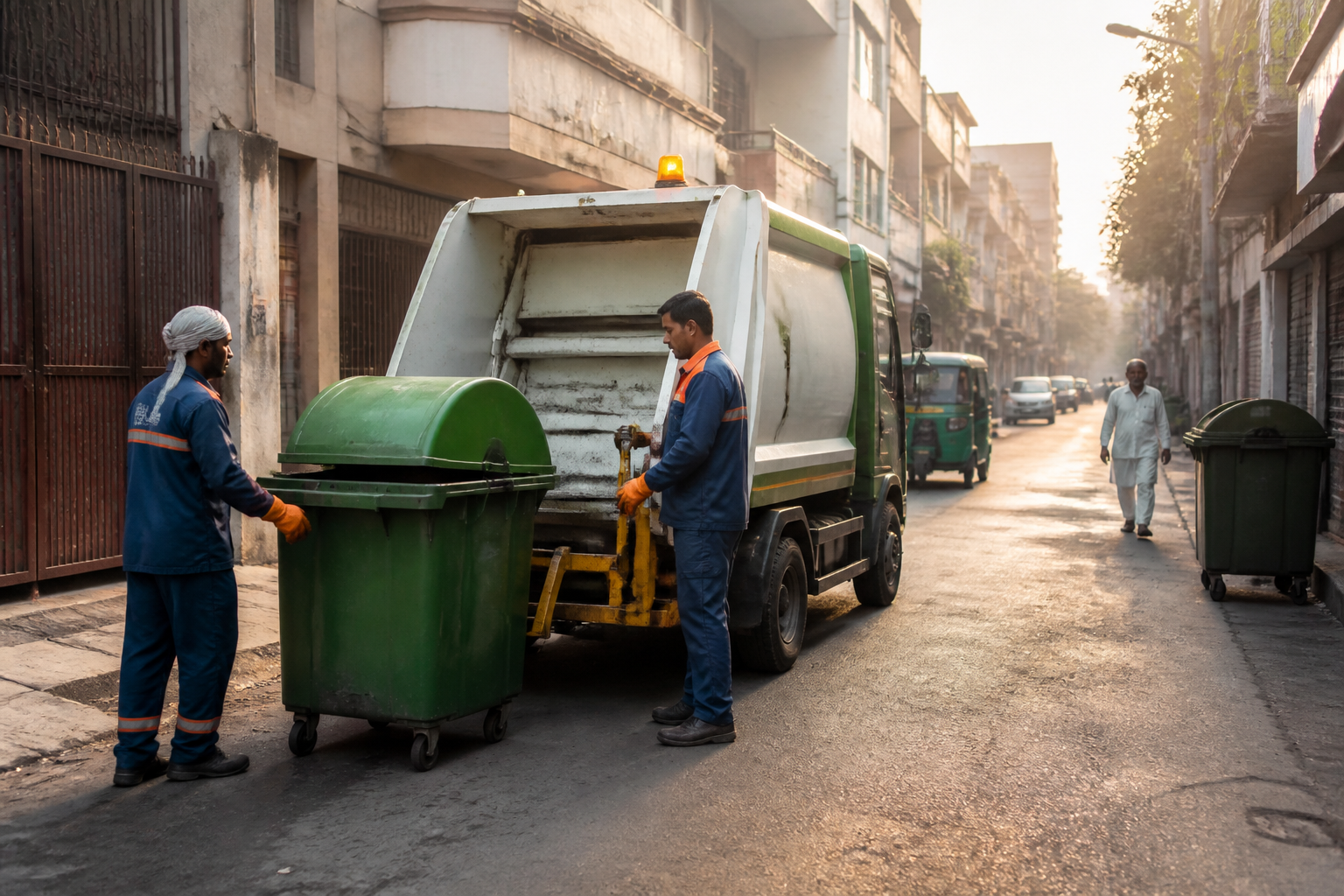
Delhi’s waste management system is set for a ward-level restructuring, with the Municipal Corporation of Delhi preparing sanitation action plans and reducing the city’s dependence on conventional community bins, MCD Commissioner Sanjeev Khirwar said on Wednesday.
Khirwar has directed Zonal Deputy Commissioners to assess sanitation arrangements in every ward and identify decentralised facilities located within a distance of 5–6 km for treating biodegradable waste. The proposed treatment options include biogas, compressed biogas, composting and other technologies.
The plan marks a shift towards matching waste collection and processing arrangements with the physical and functional differences between parts of the city. MCD will adopt separate collection models for residential societies, unauthorised colonies, congested streets, slums, hospitals, markets and institutional areas, according to the announcement.
The corporation also plans to deploy smaller vehicles in narrow lanes, where larger collection vehicles may face access constraints. It will reduce the number of community bins, work towards making markets bin-free and expand night sweeping, mechanised cleaning and zero-waste colonies.
The ward-wise assessments are expected to establish the sanitation requirements of individual areas and map nearby facilities for biodegradable waste treatment. The proposed 5–6 km radius is intended to bring processing options closer to the locations where waste is generated, although the announcement did not specify the number, capacity or commissioning schedule of the facilities.
MCD’s proposed collection models distinguish between areas with different built forms, street widths and waste-generation patterns. Residential societies, markets, hospitals and institutional zones require different operating arrangements from unauthorised colonies, slums and congested streets, where access and storage conditions can vary significantly.
Reducing community bins would also change how waste is stored and collected at street level. The corporation has not provided a timeline for removing or reducing specific bins, nor details of how household and commercial waste generators will be brought into the proposed systems. The announcement also did not specify the locations of planned biogas, compressed biogas or composting facilities.
The proposed expansion of night sweeping and mechanised cleaning will add an operational layer to the ward plans, while zero-waste colonies are intended to strengthen local waste management practices. Details of the number of colonies to be covered and the performance criteria for the initiative were not provided.
Zonal Deputy Commissioners will first assess existing sanitation arrangements in their respective wards and identify suitable decentralised treatment facilities. The MCD’s next stated step is the preparation of ward-wise sanitation action plans, after which different collection and treatment models will be applied to the city’s residential, commercial, institutional and informal areas.
