


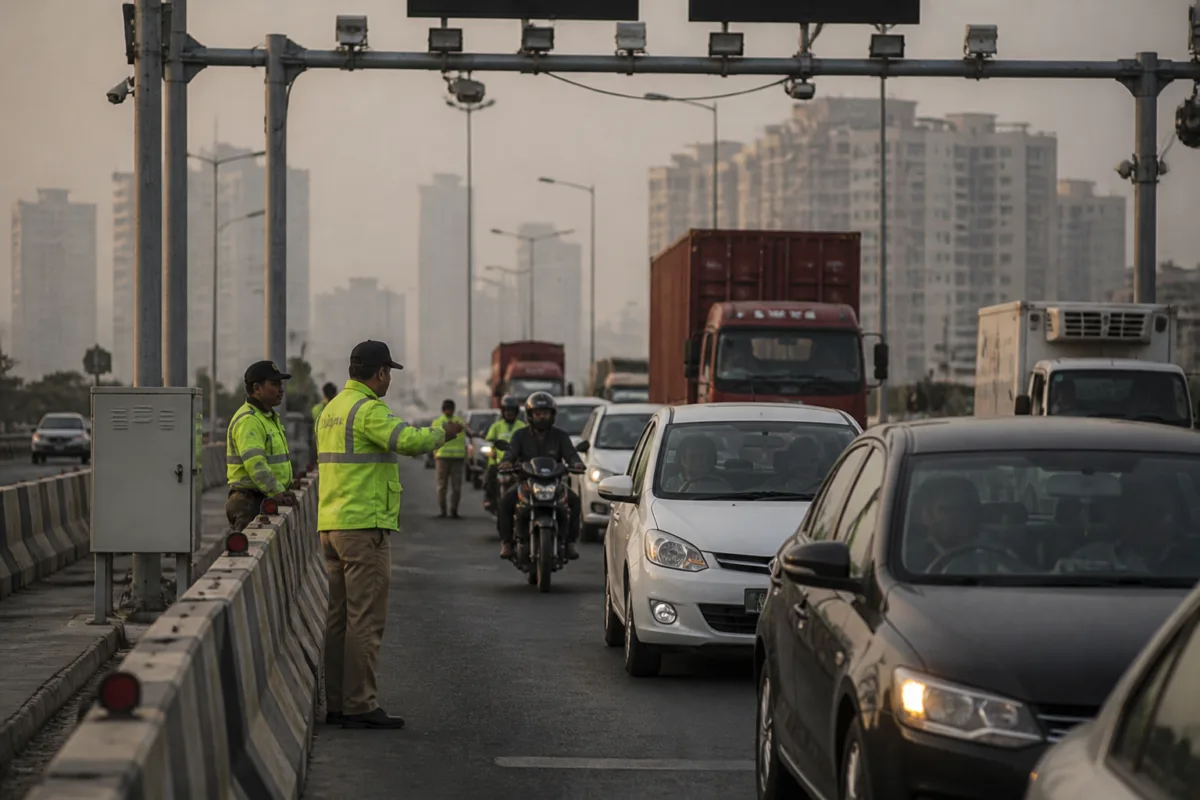
Delhi will restrict the entry of petrol and diesel vehicles below the BS-VI emission standard from November 1, with the measure set to remain in force until January 31, 2027, according to a report by Jagran. The Delhi vehicle ban is expected to affect private cars, commercial goods vehicles and, for the first time under the reported restriction, two-wheelers travelling into the capital from neighbouring NCR cities.
The restriction will apply to vehicles registered before April 2020, when BS-VI emission standards became mandatory for new vehicles in India. Vehicles from Gurugram, Faridabad, Noida, Greater Noida and Ghaziabad that do not meet the BS-VI standard could be stopped from entering Delhi during the restriction period.
The Delhi Transport Department is preparing to strengthen enforcement at the city’s borders. Automatic Number Plate Recognition cameras and other surveillance systems are expected to be used to identify vehicles, while about 300 personnel may be deployed at entry points to monitor compliance.
The reported restriction could affect an estimated 12 lakh vehicle users across the National Capital Region. Jagran reported that around two lakh vehicles travel to Delhi daily from Gurugram and Faridabad, with up to 70 per cent described as being below the BS-VI standard. More than four lakh below-BS-VI vehicles are reported to travel from Noida and Greater Noida, while a similar number are said to move between Ghaziabad and Delhi. BS-IV vehicles account for more than half of the vehicles from Noida and Greater Noida mentioned in the report, including a large number of privately owned petrol cars.
The measure is intended to control the deterioration of air quality during Delhi’s winter pollution season. It could also affect office commuters, traders, delivery operators and freight companies that depend on daily cross-border movement. The reported inclusion of two-wheelers expands the potential impact beyond commercial traffic and private cars to a larger group of lower-cost daily commuters.
Harish Sabharwal, national president of the All India Motor Transport Congress, opposed the proposed restrictions on BS-IV vehicles, according to the report. He said the movement of around 2.5 lakh trucks into Delhi could be affected, with possible consequences for transport businesses, vehicle operators’ livelihoods and the supply of goods to the city.
Anil Chhikara, a former deputy commissioner in the transport department, called for a review of the policy. He said that restricting vehicles only on the basis of their manufacturing year or emission category may not be a practical solution. Chhikara suggested that BS-IV vehicles in good condition could be considered for relief after undergoing pollution and mechanical fitness checks at authorised automated testing centres.
BS-IV emission standards were in force in India from April 1, 2010, to March 31, 2020. BS-VI standards came into effect for new vehicles from April 1, 2020. The report noted that some BS-IV vehicles have also crossed prescribed age limits, although vehicles registered between 2018 and 2020 may still be in serviceable condition.
The reported enforcement plan and the final implementation requirements will determine how vehicles are screened at Delhi’s borders and how commuters and freight operators adjust their travel arrangements before the restriction begins on November 1.

