


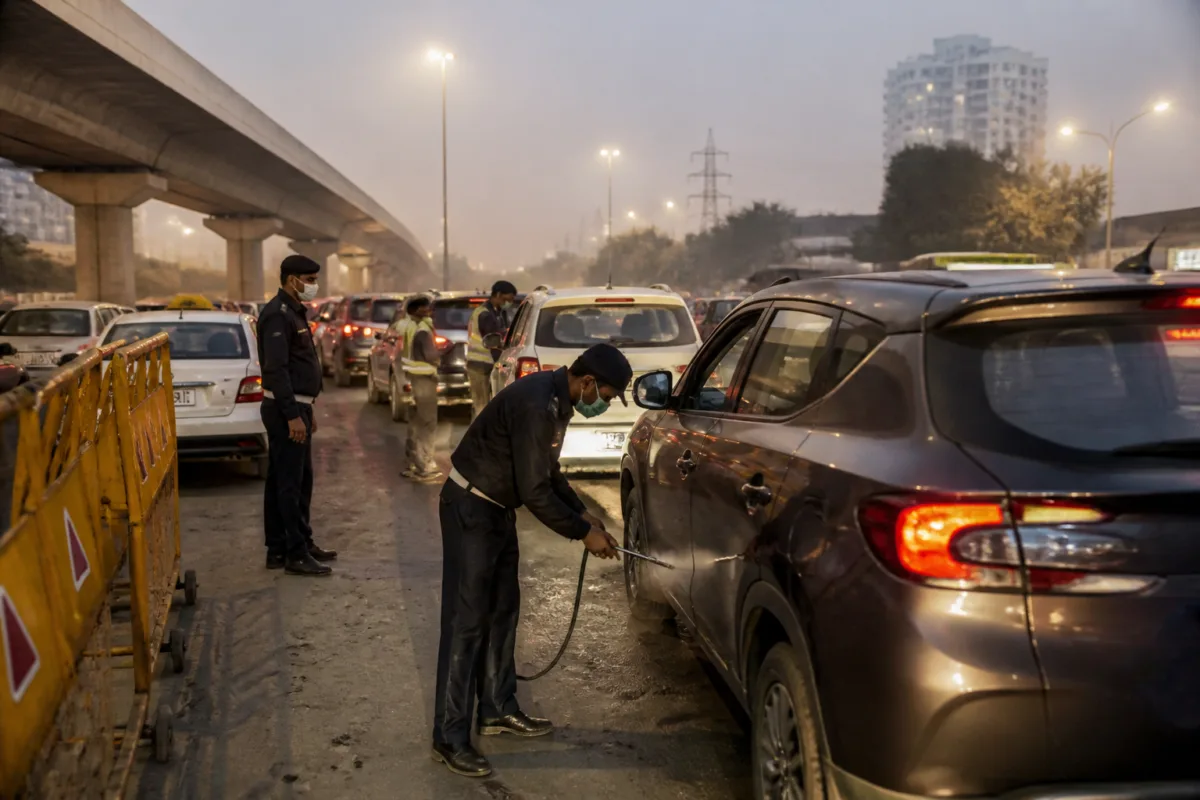
Delhi traffic jams are creating a pollution-control paradox before Diwali: measures intended to keep high-emitting vehicles out of the capital are producing long queues in which engines remain switched on, adding emissions at already congested roads and borders. The problem places enforcement, mobility and air-quality management inside the same urban system rather than treating them as separate tasks.
The reported congestion has been particularly visible at the Sarhaul border near Gurugram and around Ghazipur, where vehicles have queued amid festive shopping, increased movement from the National Capital Region and checks for vehicles below BS-VI standards. The report also cites traffic snarls on NH-9 near Ghazipur. These locations are not merely points of delay. They are interfaces where Delhi’s pollution rules meet the daily flow of people, goods and vehicles across administrative boundaries.
That distinction matters because a restriction can be formally successful while producing operational side effects. A vehicle stopped before entering Delhi may not contribute emissions inside the city in the same way as a vehicle that travels through it, but a long line of idling vehicles at the border still consumes fuel and releases pollutants. The enforcement process therefore becomes part of the emissions equation. Its effectiveness cannot be assessed only by the number of vehicles stopped or challans issued.
The estimates cited in the report show how quickly the additional emissions can accumulate. A petrol car idling for one minute is estimated to release about 30.7 grams of carbon dioxide. If 400 cars remain switched on for 10 minutes at the Sarhaul border, the resulting carbon dioxide emissions would be about 123 kilograms. At 20 minutes, the estimate rises to roughly 245 kilograms. At the Ghazipur border, a queue of 30 to 40 vehicles waiting for 10 to 20 minutes is estimated to produce between 9 and 25 kilograms of emissions.
These are estimates rather than direct measurements of the exact queues described. The report notes that actual emissions depend on the vehicle model, engine capacity, air-conditioner use and maintenance. Even so, the calculations identify the administrative problem clearly: small delays multiplied across hundreds of vehicles can turn a checkpoint into a local emissions hotspot.
The fuel calculations illustrate the same point from another angle. A typical petrol car consuming about 0.8 litres per hour would burn approximately 133 millilitres in 10 minutes of idling and release around 307 grams of carbon dioxide. A diesel car using about 0.6 litres per hour would consume roughly 100 millilitres and release about 268 grams during the same period. Together, the two examples amount to about 575 grams of carbon dioxide over 10 minutes. The estimates use emission factors of 2.31 kilograms of carbon dioxide per litre for petrol and 2.68 kilograms per litre for diesel.
Carbon dioxide is not the only relevant concern. Traffic congestion also prolongs exposure to vehicle exhaust near roads, junctions and enforcement points. The supplied report links vehicles with a substantial share of Delhi’s emissions inventory, citing a 2021 draft inventory by The Energy and Resources Institute. Vehicles accounted for about 47 per cent of PM2.5 emissions, 78 per cent of nitrogen oxide emissions and 49 per cent of non-methane volatile organic compounds in the cited estimates. The transport sector’s contribution during winter was assessed at 15 to 20 per cent.
Those figures do not mean that every episode of congestion produces the same proportional increase in ambient pollution. Weather, wind, traffic composition, road geometry and the presence of other sources all influence local air quality. They do, however, show why traffic management is central to pollution policy. When the transport system slows down, emissions can rise even without a corresponding increase in the total number of vehicles on the road.
The issue also exposes the limits of treating vehicle restrictions as a single enforcement event. Delhi’s air-quality response depends on multiple agencies and jurisdictions, while commuters and freight vehicles move continuously between them. A border check may be administered by one authority, approach roads by another and traffic diversion by a third. If these functions are not coordinated, an intervention at one point can shift congestion to another or create a queue that weakens the environmental benefit it is meant to deliver.
The report quotes Anumita Roychowdhury, executive director of the Centre for Science and Environment, as saying that stopping older polluting vehicles is necessary but that checks must be designed so they do not create congestion at the borders. The measures suggested in the report include automatic number-plate recognition, eligibility checks before vehicles reach the border, sufficient inspection lanes and separate holding areas for vehicles requiring further examination.
These proposals point to a broader change in enforcement design: pollution control needs to operate before the bottleneck, not only at it. Advance verification could reduce the number of vehicles needing manual intervention. Automatic number-plate recognition could help identify vehicle eligibility without requiring every vehicle to stop. Additional lanes could separate routine movement from vehicles that need inspection, while holding areas could prevent the main traffic stream from being blocked.
The practical challenge is that such systems require administrative capacity and reliable information. A technology-led system must correctly read number plates, connect to current vehicle records and provide a clear process when a vehicle is flagged. More lanes require available road space, staff and a plan for handling vehicles that fail the eligibility check. A holding area must be large enough and located so that it does not simply move the queue onto another road. The supplied report does not establish whether these facilities are currently available at the affected borders.
Festive traffic adds another layer to the problem. The report attributes increased congestion to shopping activity in markets and vehicles entering Delhi from the NCR. That demand is time-sensitive and dispersed across roads, commercial areas and border crossings. Traffic management in such conditions cannot rely only on a restriction at the city boundary. Busy markets and major roads also require active management so that stationary traffic does not become a parallel source of emissions.
The report refers to a study based on tests involving 341 vehicles at 11 traffic intersections in Delhi, which assessed fuel wastage and emissions during congestion. The reference is important because it places the border queues within a wider pattern: idling and stop-start movement are recurring features of the city’s transport network, not isolated problems created only by festive checks. However, the supplied material does not provide the study’s full methodology or findings, so its precise results cannot be assessed here.
This evidence also clarifies what a meaningful evaluation of pollution-control measures should include. Counting stopped vehicles, detected violations or issued challans captures enforcement activity. It does not by itself establish the net environmental outcome. Authorities would also need to assess traffic delay, queue length, idling duration and changes in emissions around the checking point. Without those indicators, a measure may appear effective in administrative records while its local implementation generates additional pollution.
The central governance question is therefore one of system design. Delhi’s vehicle restrictions, border management, road operations and air-quality monitoring are connected through the behaviour of drivers and the physical limits of roads. A rule that ignores those connections can create friction at the exact locations where the city is most dependent on smooth movement. The border is both a regulatory boundary and a transport corridor, and its performance must be judged in both roles.
The reported congestion does not establish that vehicle checks should be abandoned. It shows that enforcement must be organised to protect traffic flow while identifying vehicles that do not meet the applicable requirements. The immediate facts are clear: festive demand and border checks have produced queues; engines left running add fuel consumption and emissions; and experts cited in the report have called for more efficient checking arrangements.
The developments requiring attention are whether authorities introduce advance eligibility checks, automated identification, additional inspection capacity or holding areas, and whether traffic management is strengthened at markets and busy roads. The lasting test will be whether pollution-control operations reduce emissions without creating new roadside hotspots through avoidable congestion.

