


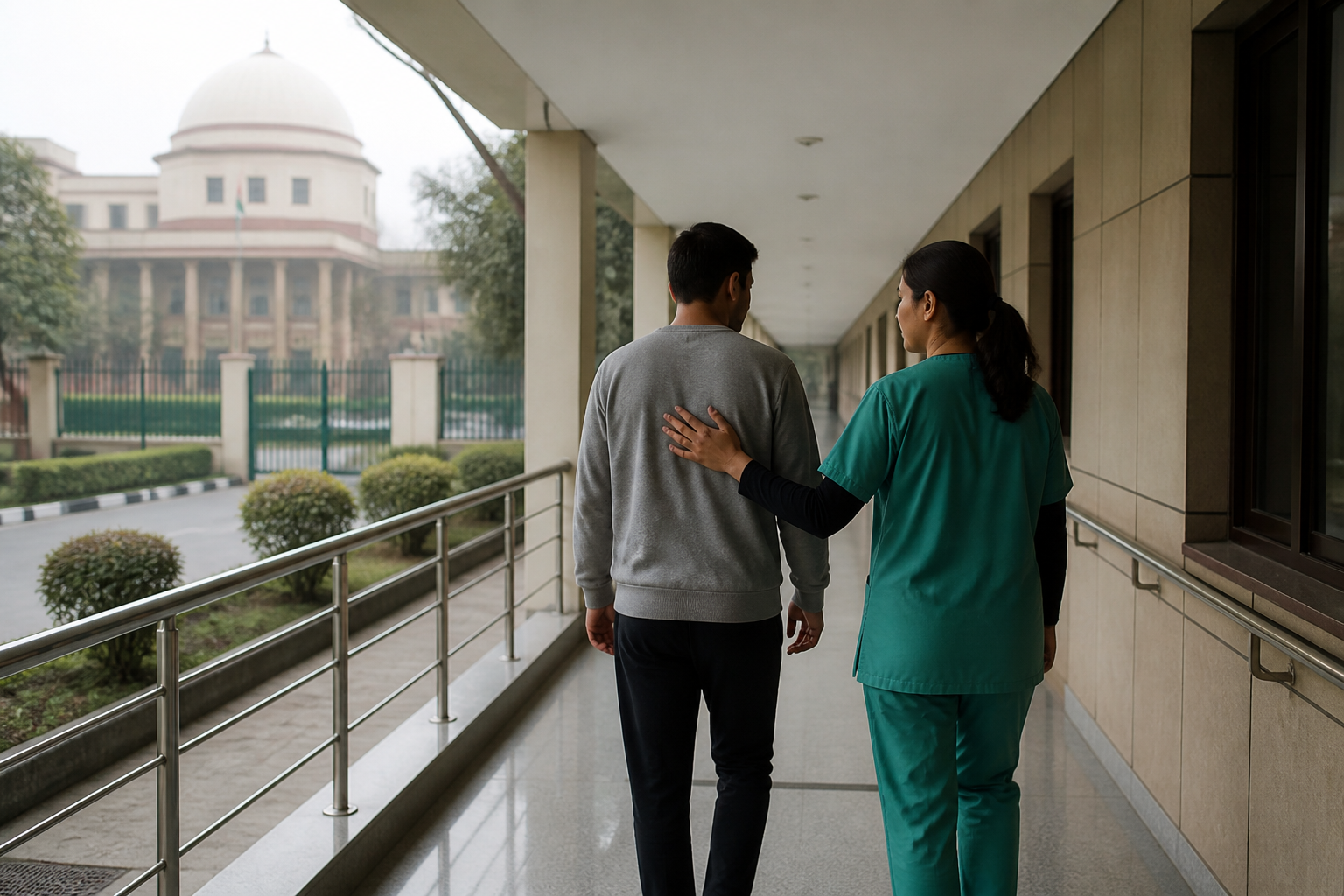
A Delhi court’s decision to suspend prosecution against a man with severe schizophrenia does more than close two long-running criminal proceedings. It exposes the difficult institutional space between criminal justice, psychiatric treatment and residential care when an accused person is unable to understand a trial, defend himself or return safely to his family.
Additional sessions judge Hargurvinder Singh Jaggi of Saket Courts passed twin orders on October 15, discharging Mahender Singh from two sessions cases after medical evaluations found him unfit to stand trial. The court directed that he continue receiving residential care at Nav Chetna Home in Rohini and psychiatric treatment at the Institute of Human Behaviour and Allied Sciences, or IHBAS.
The case is significant because the court’s response was not limited to determining whether Singh should remain subject to prosecution. It also addressed what would happen to a person whose mental illness had left him unable to participate in the legal process and whose family had said it could not care for him. The orders therefore bring into view a chain of responsibilities extending from the courtroom to hospitals, residential homes, police authorities and relatives.
Singh was an accused in two cases registered at Malviya Nagar police station. One related to the alleged abduction of Subhash Chand Batra and his driver, Santosh Kumar, on October 13, 2000, under charges including kidnapping for ransom and criminal conspiracy. The second involved allegations of criminal intimidation, anonymous threats and conspiracy. Singh was arrested in May 2015 after remaining absconding for years.
According to the report, his mental condition deteriorated during the proceedings. Medical assessments conducted by PGIMS, Rohtak, found that he suffered from schizophrenia resulting in 90% permanent mental disability. He later went missing and was eventually found wandering on the streets before being produced before the court in December 2025. His wife and sons expressed their inability to care for him.
These details show why a conventional criminal-procedure response was inadequate in this case. The court was dealing with an accused person who, according to the medical assessments and judicial findings reported by the Times of India, could not understand the proceedings or mount a defence. At the same time, returning him to his family was not considered a workable option. The result was a need for continuing institutional care rather than a simple transfer between custody and home.
The court invoked Section 330(3)(b) of the Code of Criminal Procedure and ordered Singh’s continued care, upkeep and treatment. The report does not set out the full text of the provision, but records that the judge used it to create a continuing care arrangement after finding that prosecution could not proceed in the ordinary manner. The legal order consequently linked the protection available to an accused person with the practical question of where that person could live and receive treatment.
That institutional link is central to understanding the case. A court can recognise that a person is not fit to stand trial, but recognition alone does not provide accommodation, psychiatric treatment or day-to-day supervision. In Singh’s case, the arrangement depended on two named institutions: IHBAS for psychiatric treatment and Nav Chetna Home for residential care. The court also acknowledged the work of the medical teams at both institutions, describing their contribution as involving continuous care, treatment and service.
The episode also illustrates how gaps in family capacity can become a public institutional responsibility. Singh’s wife and sons told the court they were unable to care for him, while the judge observed that returning him to the family would be a “herculean task”. The report does not identify the reasons for the family’s inability to provide care, and it does not establish how long the residential arrangement will continue. What it does establish is that the court considered family return impractical and ordered an alternative form of support.
The case’s timeline further demonstrates the prolonged nature of the problem. The alleged offences date back to 2000. Singh was arrested in 2015, his condition deteriorated during the proceedings, he later went missing, and he was found wandering before being brought before the court in December 2025. By the time of the October 2026 orders, the criminal cases had intersected with years of illness, absence, arrest, medical assessment and institutional intervention.
The court’s observations, as reported, place the presumption of innocence alongside the need for humane safeguards. Judge Jaggi wrote that criminal prosecution imposes “heavy, invisible fetters and dark clouds of suspicion” on an accused despite the presumption of innocence. The judge added that the situation becomes more tragic when mental illness leaves a person incapable of understanding proceedings or preparing a defence.
This is also a governance question because no single institution appears to control the entire sequence. The police were involved in the original cases and in Singh’s arrest. Medical institutions assessed and treated him. A residential home provided accommodation and care. The court determined his legal status and issued directions for continued support. His family remained part of the care decision but could not take responsibility for his return. The reported order therefore shows the justice system operating alongside a network of health and social-care institutions rather than in isolation.
The available evidence does not establish how many other accused persons in Delhi face comparable difficulties, how residential psychiatric care is funded, or whether similar arrangements are routinely available. It also does not provide information about staffing, capacity, waiting lists, discharge procedures or oversight at the institutions involved. Those limits matter because one court order cannot by itself measure the scale or performance of the wider mental-health and custodial-care system.
What the case does confirm is the consequence of a missing or inadequate care pathway. Singh was found wandering on the streets after going missing, and his family could not resume care. Without the intervention described by the court, the legal question of his prosecution could not be separated from the basic question of his safety and treatment. The order treated those issues as connected, directing continued residential care and psychiatric attention rather than leaving the medical problem outside the court’s concern.
The language used by the court also makes clear that legal safeguards for persons of unsound mind are not merely technical procedural devices. The judge said such provisions must be applied humanely and must protect people who are incapable of defending themselves through appropriate legal safeguards, care and treatment. In practical terms, that approach requires the court to consider the person’s medical condition and living arrangement while deciding how the criminal case should proceed.
For Delhi’s urban institutions, the case highlights the importance of coordination. A person moving between police custody, court production, hospital assessment, residential care and family contact can become vulnerable whenever responsibility shifts from one institution to another. The report does not allege a specific administrative failure in Singh’s case; instead, the documented sequence shows why each transition requires an identifiable authority, an appropriate care setting and continuing medical supervision.
The order also draws attention to a category of urban residents who may be visible only at moments of crisis: people with severe mental illness who are found wandering, brought before courts or presented in criminal cases. The supplied material does not provide broader data on this population, so no citywide conclusion can be drawn from the case alone. But the facts recorded by the court show how homelessness, illness, family incapacity and criminal procedure can converge around one individual.
The immediate outcome is clear. Mahender Singh has been discharged from the two sessions cases after medical evaluations found him unfit to stand trial, while his care, upkeep and treatment are to continue through Nav Chetna Home and IHBAS. The longer-term questions remain institutional: how such care arrangements are monitored, what happens if a person’s condition changes, and how courts and care providers determine the next step. The reported orders establish the legal protection and current care direction, but the supplied material does not describe the future review or discharge process.

