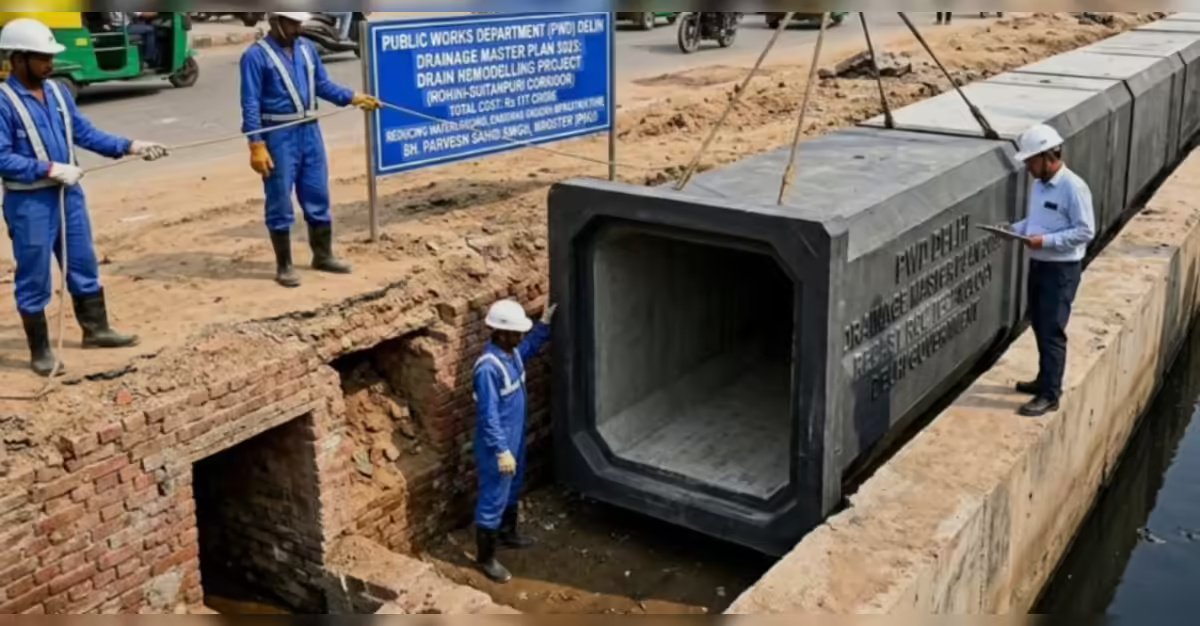
Delhi’s urban drainage system is undergoing a structural upgrade as civic authorities introduce factory-built drainage components to modernise stormwater infrastructure across the capital. The move to Delhi precast drain technology marks a significant shift in how the city designs and builds drainage networks, with the aim of reducing waterlogging, improving durability and preparing the city for more intense rainfall events linked to climate change. Officials responsible for public works and urban infrastructure say the new approach replaces conventional cast-on-site drain construction with prefabricated reinforced concrete segments manufactured in controlled factory conditions. These units are then transported and installed on-site, allowing faster project execution while maintaining consistent structural quality.
According to infrastructure planners, the transition to Delhi precast drain technology forms part of a broader drainage master plan designed to address the capital’s stormwater management needs over the next three decades. The plan outlines coordinated responsibilities for multiple government departments tasked with maintaining and expanding drainage networks across the city. The Public Works Department alone manages more than 2,100 kilometres of stormwater drains, many of which require remodelling or expansion to cope with increasing rainfall intensity and rapid urbanisation. Experts note that ageing drainage infrastructure has contributed to recurring flooding in several neighbourhoods during the monsoon season. Urban planners involved in the programme say precast reinforced concrete drains offer several advantages over traditional cast-in-place methods. The factory-built components typically have a lifespan of several decades and are engineered to maintain higher water flow capacity. This durability could significantly reduce maintenance cycles and long-term infrastructure costs. Another advantage cited by engineers is construction efficiency. Traditional drain building requires on-site mixing of construction materials and prolonged traffic disruptions while concrete cures. Precast modules, by contrast, are assembled rapidly, minimising road closures and reducing construction-related congestion in densely populated areas.
Pilot projects using the technology are currently underway in several northern and north-western parts of the city where drainage bottlenecks have historically contributed to water accumulation during heavy rainfall. Officials monitoring the programme say additional remodelling projects are being tendered, with precast systems now becoming a standard requirement for future drainage upgrades. Environmental analysts also highlight potential secondary benefits. By improving stormwater flow and reducing stagnation, upgraded drainage networks can help limit urban pollution runoff and reduce the accumulation of contaminated water in public spaces. Such improvements are increasingly important in cities where drainage and river health are closely linked. In parallel with infrastructure upgrades, municipal agencies have accelerated seasonal maintenance operations. Large-scale desilting drives are currently underway across the drainage network to clear sediment and debris that restrict water flow. Authorities have set ambitious targets to remove millions of tonnes of silt before the onset of the monsoon season.
For a city where intense rainfall and high-density development frequently intersect, drainage infrastructure is emerging as a central pillar of climate resilience planning. If widely implemented, Delhi precast drain technology could represent a practical step toward creating a more reliable and sustainable urban stormwater system capable of supporting the capital’s future growth.