


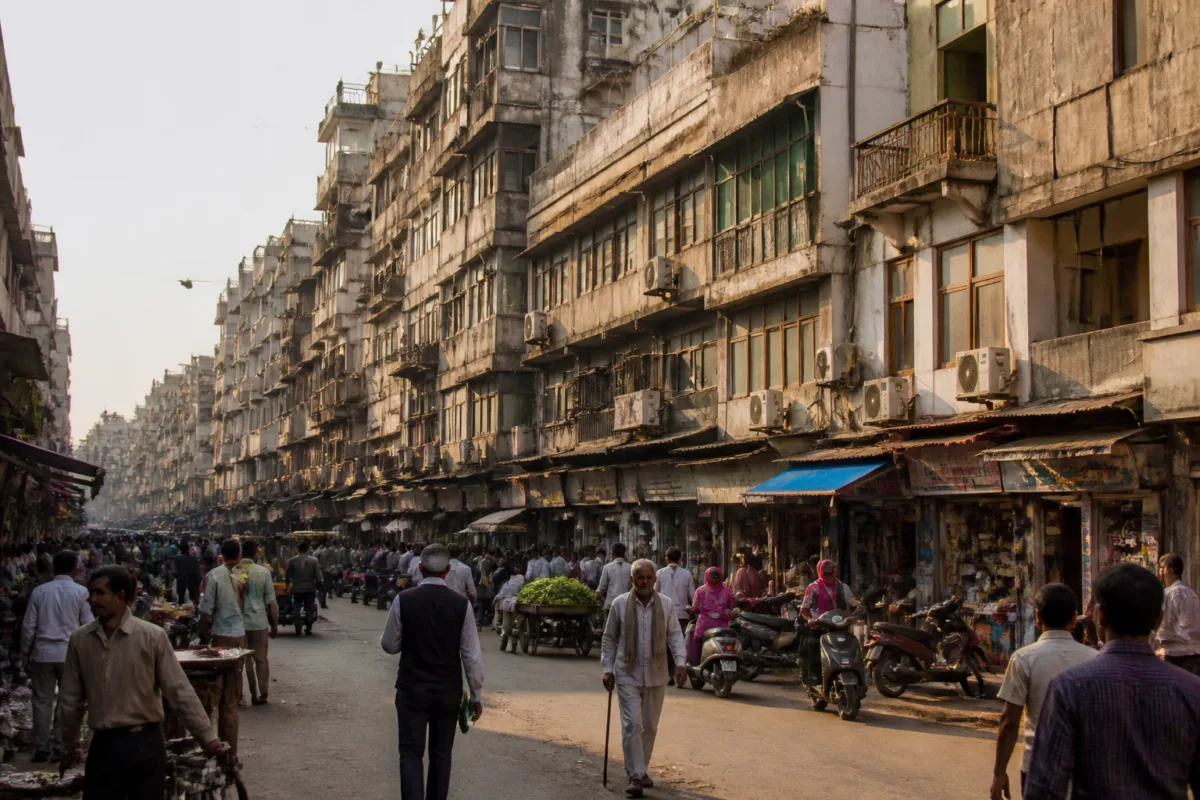
Delhi pre-2007 buildings could face municipal action after 31 December 2026, when their temporary legal protection is scheduled to expire, prompting the Kamla Nagar Traders Association to seek an extension until a permanent policy is implemented.
The association has written to the Lieutenant Governor of Delhi and the Chief Minister, asking the government to continue the existing relief for eligible residential and commercial properties. The request comes amid uncertainty over the future of properties constructed before 2007 across the capital.
According to the association, the temporary protection has already been extended twice, but a permanent solution has not been finalised. Its president, Nitin Gupta, said repeated extensions had left traders and residents uncertain about the legal status of their properties and the future of their businesses.
The reported deadline is significant for Delhi’s traditional markets, where commercial premises support traders, shopkeepers, employees and their families. The association said these markets form an important part of the capital’s economy and argued that eligible shops and commercial establishments need a longer-term legal framework rather than repeated temporary relief.
The association has proposed a clear, transparent and practical policy to regularise eligible commercial properties. It has also sought the creation of a joint committee comprising representatives of the government, the Municipal Corporation of Delhi, relevant planning authorities and market organisations.
Such a committee, according to the association’s proposal, could examine traders’ problems and recommend a time-bound solution. The group has asked the government to announce a clear action plan and provide certainty to property owners and businesses before the current protection ends.
The report does not establish that municipal action has been formally scheduled or that all properties built before 2007 are covered by the same legal provisions. It indicates that the possibility of action after the expiry of the temporary protection has intensified concern among affected property holders and market bodies.
The immediate issue is therefore not only the approaching deadline but also the absence of a confirmed permanent mechanism for properties that have operated under temporary protection. The association has asked that existing relief remain in force until a lasting arrangement is prepared and implemented. No government decision on the extension or proposed joint committee was cited in the report.

