


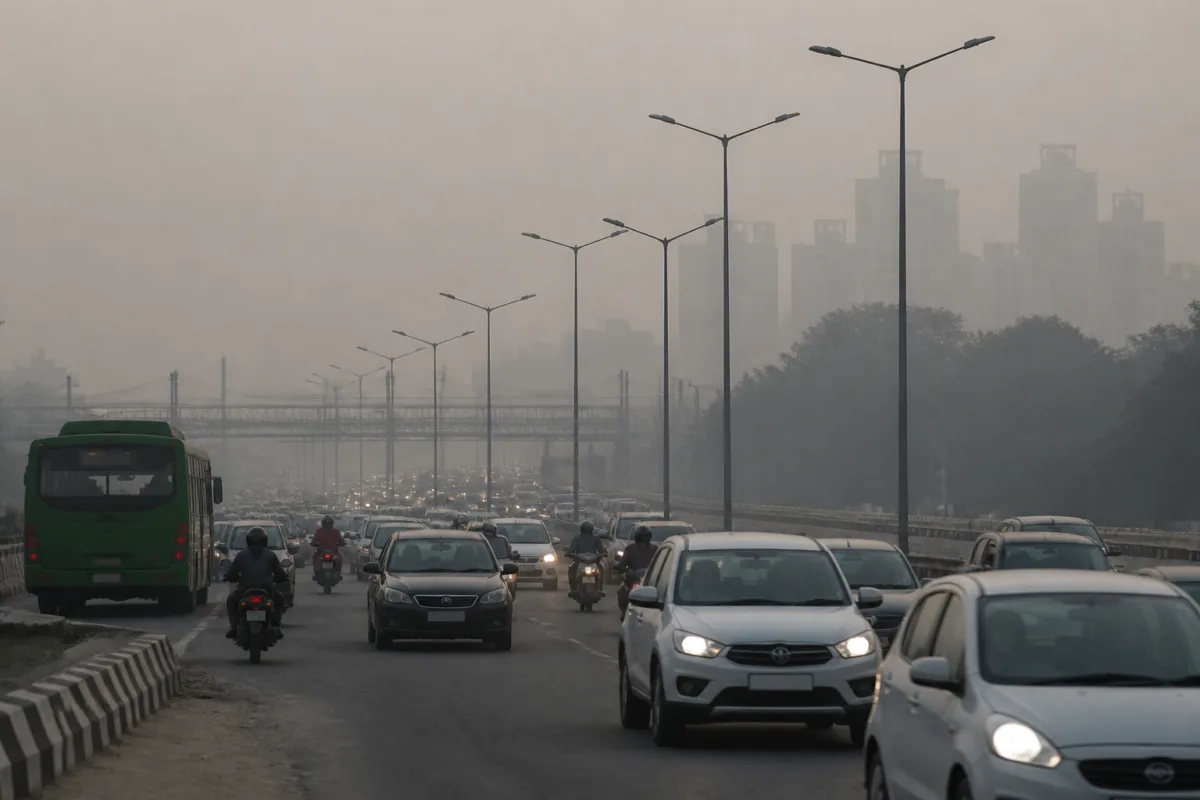
Delhi’s Diwali pollution debate is often reduced to a contest between firecrackers and vehicles. The latest figures cited by the Indian Institute of Tropical Meteorology (IITM), the Central Pollution Control Board (CPCB), the Delhi Pollution Control Committee (DPCC) and the Air Quality Early Warning System point to a more difficult reality: fireworks can produce an intense short-term spike, but transport emissions remain a major source of particulate pollution before, during and after the festival.
That distinction matters because the two sources operate on different timescales. Firecrackers release pollutants within a concentrated period, often when Delhi’s atmosphere is already losing its ability to disperse emissions. Vehicles, by contrast, add to the city’s pollution load continuously. The result is not a simple choice between blaming crackers or traffic, but an interaction between daily emissions, episodic bursts and atmospheric conditions.
The source of Delhi’s everyday burden
Data from IITM’s new Integrated Atmospheric Chemistry and Aerosol Toxicity Analysis Laboratory, or AATAL, offers one view of the city’s pollution mix. On October 24, vehicles accounted for 25% of Delhi’s PM2.5 pollution, making transport the largest identified contributor on that day. Secondary organic aerosols contributed 18.4%, secondary inorganic aerosols 16.5%, road dust 10.9% and waste burning 5%.
These figures show why vehicular pollution cannot be treated only as a seasonal issue. Traffic emissions are generated every day, regardless of whether a festival is taking place. Their contribution can vary by date and atmospheric conditions, but the underlying source remains embedded in the ordinary functioning of the city: commuting, goods movement, private vehicle use and road traffic.
The IITM Decision Support System estimated that vehicles and transport emissions still contributed 19% of Delhi’s PM2.5 pollution on November 8, the day of Diwali. That was the largest identified source in the estimate cited in the report. The proportion was lower than the 25% recorded on October 24, but it remained substantial even during a period when fireworks were expected to affect air quality.
This is an important institutional distinction. A pollution source does not need to dominate every hourly reading to remain a major policy problem. Transport emissions are persistent, dispersed across the city and linked to the daily operation of Delhi’s urban economy. Fireworks are more concentrated, but their effects are superimposed on an atmosphere that may already carry a high particulate load.
What fireworks change
Firecrackers create a different kind of pollution event. Their emissions are released over a relatively short period and include fine particles and gases that can rapidly worsen local air quality. DPCC data recorded a PM2.5 concentration of 760.99 micrograms per cubic metre at Akshardham at 11pm on November 9. This was an hourly reading rather than a 24-hour average, but its value lies in showing the intensity that can occur during a concentrated pollution episode.
The timing of such emissions is critical. Delhi’s air quality had already deteriorated before Diwali. CPCB data showed the city’s Air Quality Index falling to 382 on November 6, described in the source report as the worst pre-Diwali reading in eight years. The AQI averaged 376 on November 8, compared with 369 a day earlier, and stood at 368 at 7am on November 9.
The distribution of readings also indicates that the problem was not confined to one isolated location. Of the 54 monitoring stations that reported valid readings, 50 recorded levels above 300 and 15 entered the severe category. These readings capture the citywide condition more effectively than a single station, while the Akshardham hourly figure illustrates how sharply pollution can intensify at a particular place and time.
The figures should not be read as evidence that fireworks and vehicles contribute in identical ways. They do not. Transport is a continuing source, while fireworks create a concentrated burst. But the contrast also explains why a festival-related spike can become more damaging when it occurs against a high baseline of pollution.
Weather turns emissions into exposure
The atmosphere determines how much of the emitted pollution remains close to the ground. The Air Quality Early Warning System has stated that dispersion becomes difficult when the ventilation index is below 6,000 square metres per second and average wind speeds are below 10 kilometres per hour. Low temperatures and temperature inversion can further restrict vertical movement and trap pollutants near the surface.
This makes weather more than a background condition in Delhi’s pollution story. When ventilation is weak, emissions from different sources accumulate instead of dispersing quickly. Fireworks released during such a period do not simply disappear after the celebrations end. Their particulate matter adds to pollution already produced by traffic, industry, road dust, waste burning and regional sources.
The urban consequence is a compound exposure problem. Residents are not exposed to one neatly separable source at a time. A commuter may encounter transport emissions on an ordinary day, while the same city later experiences a festival-related spike under stagnant atmospheric conditions. The health and exposure implications of that combination cannot be understood by examining only the most visible source in a single evening.
This is also why headline comparisons between crackers and vehicles can obscure the administrative challenge. Firecracker restrictions may reduce the intensity of a short-term event, but they do not remove the emissions embedded in the transport system. Conversely, reducing traffic emissions would not eliminate the possibility of a sharp festive spike. Each source requires a different response, while weather determines how their effects accumulate.
The limits of one-night enforcement
Delhi’s pollution response is divided across several institutions and operational systems. IITM and its Decision Support System contribute source-apportionment and forecasting inputs. CPCB provides citywide AQI data, while DPCC operates monitoring stations within Delhi. The Air Quality Early Warning System assesses atmospheric conditions that influence dispersion. Together, these systems provide a more detailed picture than a single pollution reading or a single enforcement action.
The policy problem is that the sources do not fit within one administrative boundary or one calendar window. Vehicle emissions are connected to transport planning, road use and the movement of people and goods. Road dust requires controls linked to construction, road maintenance and municipal operations. Waste burning involves enforcement and service delivery. Regional sources extend beyond Delhi’s municipal limits, requiring coordination across jurisdictions.
The data cited in the report therefore points towards a layered governance problem. A festival-specific intervention may target fireworks, but sustained improvement also depends on measures addressing transport emissions, road dust, industrial pollution, waste burning and regional contributions. The institutions that monitor air quality are not necessarily the same institutions that can directly control every source.
The transport figure is especially relevant to this governance gap. A 19% contribution on Diwali does not mean that transport was responsible for 19% of every pollutant or every hour of the day. It does, however, establish that transport remained the largest identified contributor in the estimate cited for that date. That evidence makes it difficult to treat traffic pollution as secondary simply because fireworks attract more public attention during the festival.
What the numbers establish—and what they do not
The available data establishes three connected points. First, vehicles were the largest identified contributor to PM2.5 on October 24, at 25%. Second, transport emissions remained the largest identified source in the cited estimate for November 8, at 19%. Third, fireworks coincided with sharp local and citywide deterioration during a period when dispersion conditions were becoming less favourable.
The figures do not establish that fireworks alone caused Delhi’s overall AQI, nor do they show that vehicles alone explain the severe readings recorded during the Diwali period. The source-apportionment numbers describe contributions within particular estimates and dates. The DPCC reading at Akshardham was hourly, not a daily average. These distinctions matter because pollution changes by place, time, weather and the mix of emissions entering the atmosphere.
They also show why a single-cause explanation is inadequate. Delhi’s PM2.5 burden includes primary emissions from sources such as vehicles and waste burning, as well as secondary organic and inorganic aerosols that form in the atmosphere. Road dust and industrial or regional sources add further complexity. The pollution seen by residents is therefore the outcome of multiple processes, not a direct measurement of one activity.
The bigger urban question
Delhi’s Diwali pollution debate ultimately exposes the difference between an episodic crisis and a structural urban system. Fireworks can produce a visible and measurable surge, making them an immediate target for public debate and enforcement. Vehicles are less dramatic as a single event because their emissions are woven into the city’s daily mobility patterns. Yet the IITM figures show that transport remains a central part of the pollution burden even when the public conversation is focused elsewhere.
For residents, this means air-quality policy cannot be judged only by whether the post-Diwali spike is controlled. The more demanding question is whether the city can lower its everyday pollution baseline while preparing for periods when weather limits dispersion and additional emissions arrive in a short window. The evidence supplied here confirms that both dimensions matter. It also leaves the precise contribution of each source dependent on date, location, atmospheric conditions and the monitoring or modelling method used.
The next phase of Delhi’s pollution response will therefore be measured not by one night of enforcement alone, but by how institutions address persistent transport emissions alongside road dust, waste burning, industrial pollution and regional contributions. The data makes one conclusion clear: Delhi’s air-quality crisis is intensified by Diwali, but it is not created by Diwali alone.

