


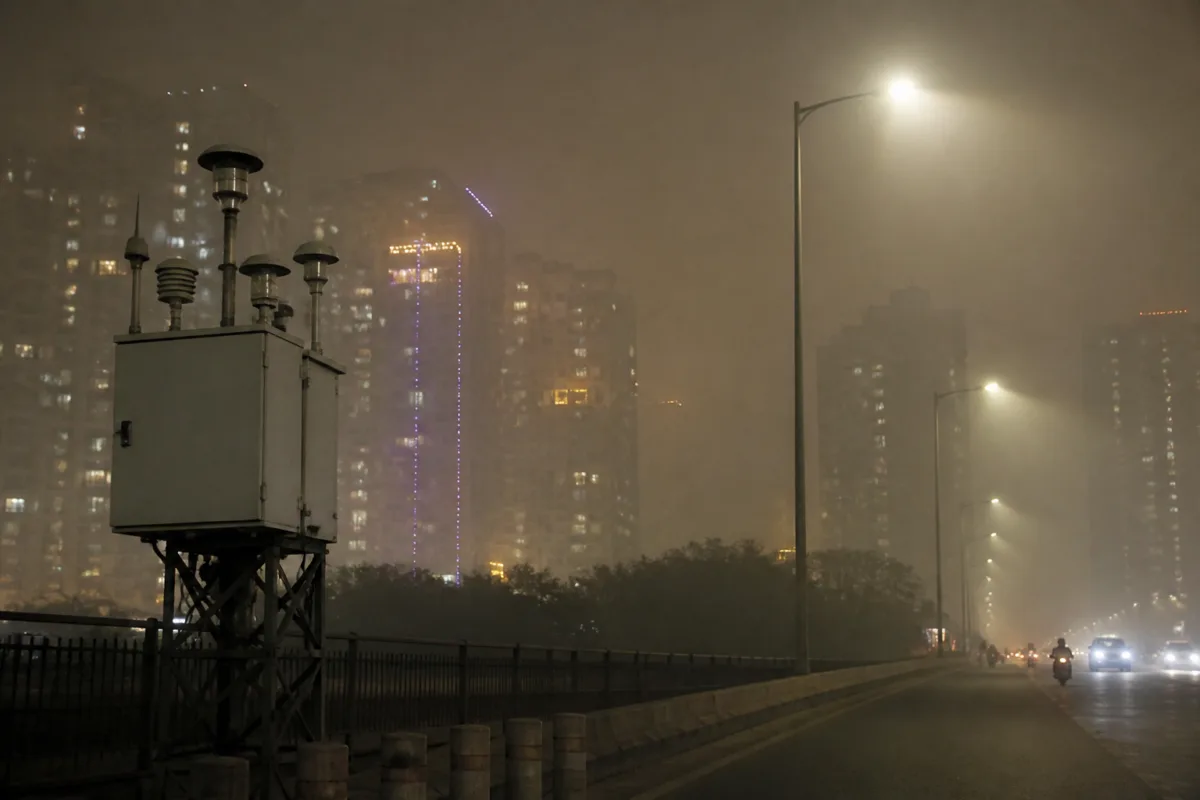
Delhi pollution data released by the Delhi Pollution Control Committee shows that PM2.5 levels rose to 3,744 micrograms per cubic metre during Diwali night, more than 60 times the national standard of 60 micrograms per cubic metre. The previously missing hourly readings were released at around 8 pm on Monday, according to Live Hindustan.
The most severe reading was recorded at Mundka at 2 am on November 9. PM2.5 there reached 3,744 micrograms per cubic metre. The Jawaharlal Nehru University monitoring station recorded 3,023 micrograms per cubic metre at 4 am, while NSUT’s West Campus recorded 3,008 at 5 am.
Other high readings included 2,908 micrograms per cubic metre at Mandir Marg at 3 am, 2,808 at Nehru Nagar at 3 am and 2,721 at Wazirpur at 1 am. The DPCC data showed that PM2.5 levels crossed 2,000 micrograms per cubic metre at 11 monitoring stations.
The figures cover 125 station-hours that were missing from the Central Pollution Control Board’s record for the Diwali night period. According to the report, all of these station-hour readings were above 1,000 micrograms per cubic metre. The missing readings relate to different stations and hours rather than a single citywide measurement.
The readings already published by the CPCB and DPCC were reported to be identical wherever data from both sources was available. However, the highest value previously visible in the CPCB record for that night was 1,000 micrograms per cubic metre. A Hindustan Times report had earlier noted that, at 1 am on Diwali night, data for 36 of Delhi’s 59 stations was absent from the CPCB record.
Incorporating the newly released readings puts Delhi’s estimated Air Quality Index at around 384, compared with the CPCB’s earlier figure of 370, the report said. Delhi’s average AQI was 376 on Sunday and 371 on Monday morning. The AQI scale reaches its upper limit of 500 at PM2.5 concentrations of about 420 micrograms per cubic metre, meaning readings in the thousands do not produce a proportionate increase in the displayed index.
A government official said air-quality monitors were now providing hourly readings. The official attributed the earlier gaps to technical problems and said all 43 stations were supplying data. The data issue also triggered a political dispute, with Aam Aadmi Party Delhi unit chief Saurabh Bharadwaj alleging that the government was manipulating pollution readings and spraying water near monitoring stations. That allegation was included in the report and was not independently established in the supplied material.
The DPCC’s release means that the official record now includes pollution peaks that were not visible in the initial CPCB data. Authorities are continuing to receive hourly readings from the monitoring network, with the status of the 43 stations forming the immediate operational update.

