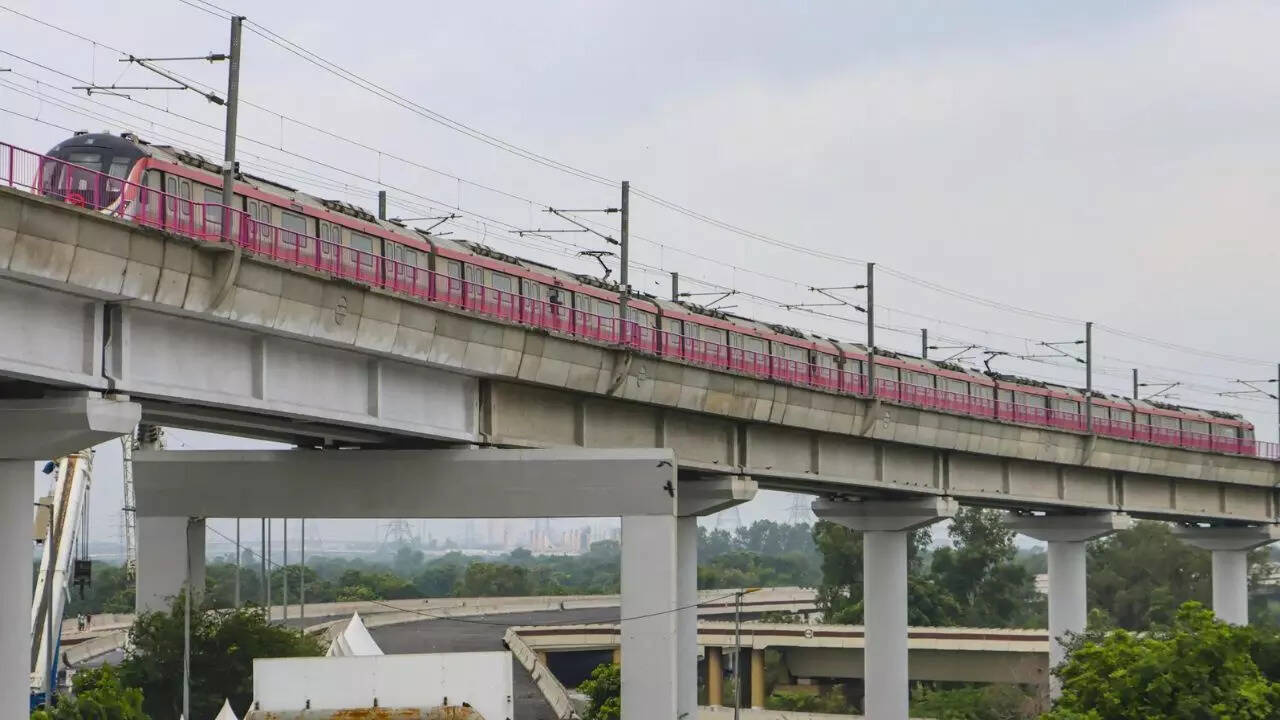
Delhi Pink Line Double Decker Flyover Nears Completion
Transport planners in Delhi are moving closer to completing a major piece of integrated infrastructure along the capital’s expanding metro network, where a Pink Line Double Decker Flyover is being developed to support both rail and road mobility within the same corridor. The structure, part of the metro system’s Phase IV expansion, reflects a growing shift toward vertical infrastructure solutions in dense urban areas where land availability is limited. The Pink Line Double Decker Flyover is designed with two functional levels: an upper deck that carries metro rail tracks and a lower deck that accommodates vehicular traffic. By combining two transport systems within a single structure, authorities aim to reduce congestion while improving connectivity in some of the capital’s most crowded neighbourhoods.
The project is located along the Maujpur–Majlis Park corridor of the metro network, which forms part of the larger Pink Line route. Developed as a near-circular alignment across the city, the Pink Line plays a critical role in linking multiple radial metro corridors and reducing pressure on central interchange stations. Urban mobility experts say such ring-style metro routes help redistribute passenger flow and shorten travel times between outer districts. One of the most visible sections of the Pink Line Double Decker Flyover lies along the Bhajanpura–Yamuna Vihar stretch in north-east Delhi. The elevated structure spans roughly 1.4 kilometres and represents a key engineering component of the corridor. While train services have already begun on some sections of the line, construction activity has continued on road ramps and related infrastructure required for vehicular movement on the lower level. The project is being delivered under the supervision of Delhi Metro Rail Corporation, which has increasingly adopted innovative structural designs to address land constraints in the capital. Officials familiar with the project say the double-decker configuration allows transport agencies to expand capacity without resorting to large-scale land acquisition, which can delay projects and disrupt established neighbourhoods.
Urban transport specialists believe multi-level infrastructure is becoming an essential feature of mobility planning in high-density cities. As urban populations grow and travel demand increases, stacking transport systems vertically allows governments to optimise limited space while maintaining efficient traffic movement. Beyond engineering efficiency, the approach also supports broader sustainability goals. Integrating metro rail with road infrastructure can encourage greater use of public transport by improving last-mile connectivity and reducing travel bottlenecks around stations. Such measures contribute to lowering vehicular emissions and strengthening climate-resilient mobility networks. The Pink Line development is part of a wider metro expansion programme that will add several new corridors across the capital in the coming years. Multiple projects involving elevated structures, including additional double-decker configurations on other lines, are being planned or constructed to accommodate both metro services and road traffic.
Once the remaining works are completed, the Pink Line Double Decker Flyover is expected to ease congestion along a key transport axis in north-east Delhi while demonstrating how integrated design can help cities manage growth without expanding their physical footprint.