


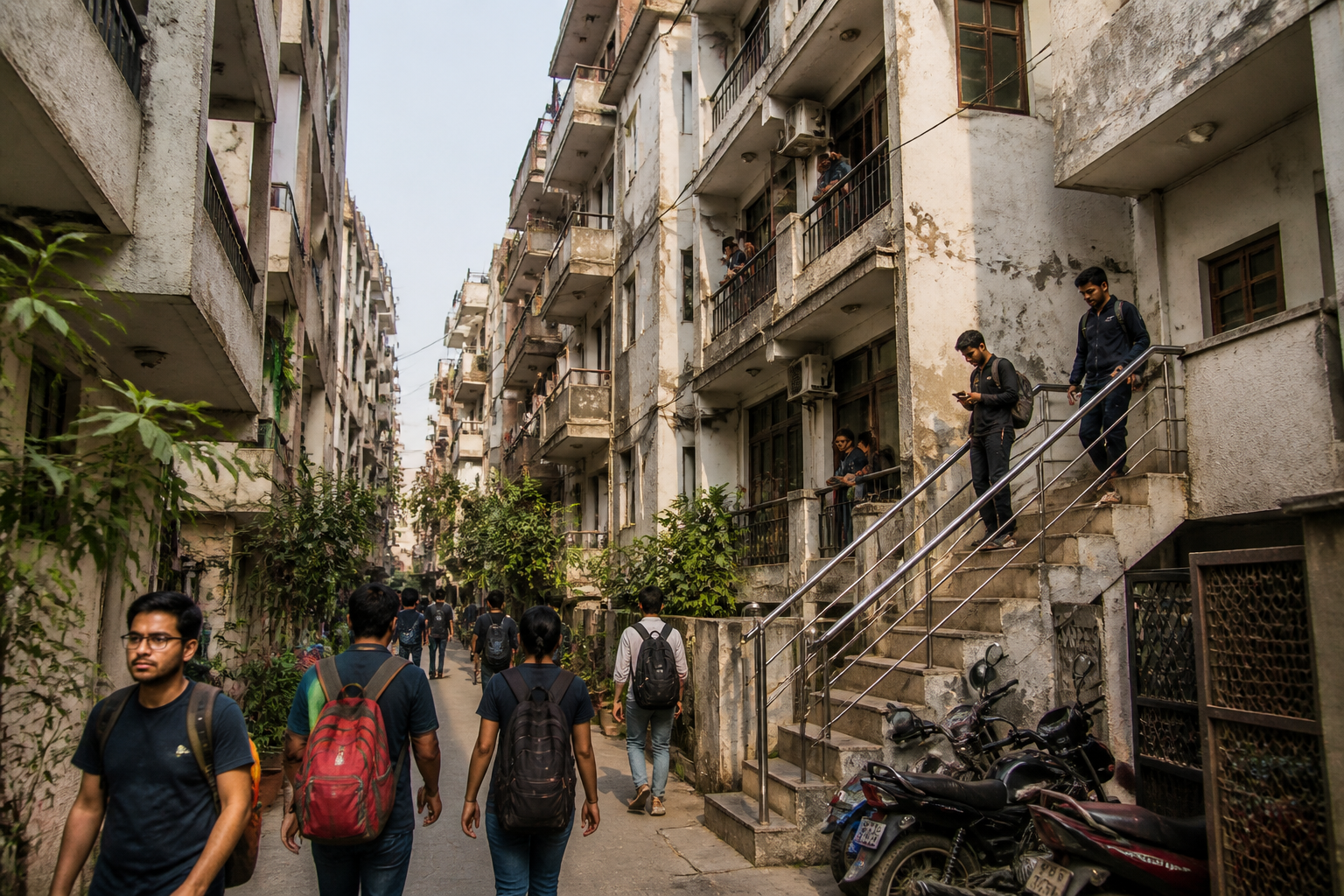
A five-storey building housing a boys’ paying guest accommodation collapsed in Delhi’s Satya Niketan on September 6, killing seven people. The police case described in the report alleges that four additional floors had been built over an older structure despite concerns that its foundation could not bear the extra load. The building, more than 40 years old, had reportedly been repaired and converted into a PG facility near Delhi University before the collapse.
The immediate investigation is focused on the building’s ownership, construction history and operation as a paying guest accommodation. But the incident also exposes a wider problem in Delhi’s urban housing market: thousands of students and young professionals live in privately operated residences where affordability and location are visible to tenants, while structural approvals, emergency preparedness and building capacity may remain opaque.
The collapse therefore cannot be understood only as a case of alleged unauthorised construction. It is also a test of how the city regulates a form of housing that has expanded around educational institutions, workplaces and transport corridors without always being treated as a distinct part of the formal housing system.
## When a home becomes a commercial operation
According to the FIR cited in the report, property owner Hariram Gupta and his brother allegedly added four floors to the old structure to increase rental income, despite allegedly knowing that the foundation could not support the additional weight. Police are also examining the reported removal of a load-bearing wall while two ground-floor shops were being merged and expanded.
The building had reportedly been leased to the PG operator Hostel Daze in August 2025. Sources cited in the report estimated that the property generated more than Rs 4 lakh a month. Police are also expected to examine an alleged local “PG mafia” involving private players who may facilitate construction and PG operations on commission.
These details point to the financial pressures that can shape the conversion of ordinary properties into high-density accommodation. A building close to a major university can command substantial rental demand. Adding floors, subdividing rooms and increasing the number of occupants can raise revenue, but it can also increase structural, fire, sanitation and evacuation risks if the underlying building was not designed or approved for that use.
The central issue is not simply whether a property earns money from tenants. It is whether the physical capacity, permissions and safety systems of the property match the intensity of its commercial use. The report does not establish the full legal status of the building or determine responsibility for the collapse; those questions remain part of the police investigation. It does, however, show how the conversion of older urban buildings into PGs can create a gap between the way a property is built and the way it is used.
## Tenants often cannot assess the risk
For students and young workers, selecting a PG usually involves practical considerations: rent, food, Wi-Fi, distance from college or work and the reputation of the operator. Building approvals and structural condition are rarely presented with the same clarity. Tenants may be asked to provide identity and admission documents, while receiving little information about the permissions governing the building in which they will live.
That imbalance is reflected in the experiences of residents quoted in the report. Sneha Mishra, who lives in a girls’ PG in Sant Nagar after moving to Delhi from Deoghar, said the Satya Niketan collapse had changed how she viewed the place she considered a second home. The question was no longer limited to comfort or convenience, but whether the building was safe enough to sleep in.
Other residents described similar concerns. Shilpashree Mondal, who lives in a PG in Noida, said budget constraints left residents with limited choice. She referred to water-supply problems, poor hygiene and dampness, and said that tenants often discover the actual condition of a property only after moving in. Pallavi Joshi, a Delhi PG resident from Haldwani, said the collapse made her pay attention to the building’s design and available safety measures.
These accounts illustrate the affordability dimension of building safety. A tenant may recognise that a better-maintained property is preferable but still be unable to pay a higher rent. In a city where students and entry-level workers depend on low-cost accommodation, safety is not always a freely available consumer choice. It is constrained by income, housing supply and the shortage of alternatives.
Vijaya Roy, a student at Delhi University’s Ramanujan College, said residents are not always shown whether a PG has the necessary permissions from the Municipal Corporation of Delhi. She also linked the dependence on PGs to the shortage of affordable hostel accommodation. Her concern is significant because a tenant’s ability to leave an unsafe property depends partly on whether another affordable option exists.
## Regulation must cover both buildings and operators
The Delhi government is working on a comprehensive policy for PG accommodation, according to the report. Urban Development Minister Ashish Sood has outlined proposed measures covering safety, security and rent regulation. The proposed framework would require operators to obtain a PG Operating Licence and complete police and municipal verification before beginning operations.
Other proposed requirements include CCTV cameras at entrances and in common areas, preservation of recordings for 30 days, visitor registers and defined visiting hours. PGs housing 15 or more students would have to employ a licensed night guard between 10pm and 6am. Each PG would also need a warden living on the premises or maintaining an office within 500 metres, with the warden required to be physically available within 15 minutes during an emergency.
These provisions treat a PG as more than a collection of rented rooms. They recognise it as an organised accommodation operation with responsibilities for access control, supervision and emergency response. That is an important shift because the risks in a PG are shaped not only by the building’s structure but also by occupancy levels, internal layouts, visitor movement and the presence or absence of staff.
However, the proposed policy’s effectiveness would depend on how it connects to existing building and municipal systems. A PG licence cannot substitute for structural safety certification, approved building plans or enforcement against unauthorised construction. Conversely, a building that is technically compliant may still be poorly managed if emergency procedures, occupancy records or resident supervision are absent.
The proposed Institutional Accommodation Committee would include college officials, student representatives, a municipal representative and a police liaison officer. Such an arrangement acknowledges that PG safety falls between multiple institutions. Colleges may not own private accommodation, municipalities control important permissions and enforcement functions, and police authorities are involved in verification and public safety. The challenge is ensuring that responsibility is clear enough for tenants to know whom to approach before an incident occurs.
## Rent regulation and the shortage of alternatives
The policy proposal also includes a Rent Regulation Committee that would determine rent bands based on occupancy, amenities, prevailing market rates and proximity to colleges and public transport. The inclusion of rent is important because the safety problem cannot be separated from the economics of urban accommodation.
If safer and better-managed PGs are consistently more expensive, low-income students and workers may remain in buildings with visible maintenance or safety problems. If rent controls are introduced without expanding supply or clarifying standards, operators may respond by reducing services, increasing informal charges or shifting accommodation outside the regulated framework. The supplied material does not establish how the proposed rent bands would work in practice, but it makes clear that affordability is central to the debate.
The shortage of college hostel accommodation further strengthens the position of private PG operators. Where students have few alternatives near their institutions, they may accept unclear permissions, crowded conditions or weak grievance mechanisms. That is not necessarily a matter of individual choice; it is also a consequence of limited formal accommodation in locations where demand is concentrated.
The proposed policy therefore addresses two connected markets. One is the market for rooms, where rent and location determine access. The other is the market for regulatory compliance, where owners and operators must be held accountable for the condition and operation of those rooms. Without credible enforcement, a licence could become another document rather than a meaningful guarantee that the accommodation meets defined standards.
## The larger urban question
The Satya Niketan collapse reveals how the city’s housing system is adapting to demand faster than its regulatory categories. Students and young professionals need flexible, relatively affordable accommodation close to universities, offices and transport. Property owners respond by converting existing buildings, while operators package rooms, meals and services as a managed living product. Yet the responsibilities attached to that transformation may remain divided between landlords, PG companies, municipal authorities, police and educational institutions.
The result is an information gap. Tenants know the rent and the advertised amenities, but may not know the approved use of the building, its occupancy limits, the status of its permissions or the emergency arrangements in place. Families sending children to Delhi face the same uncertainty from a distance. The people bearing the risk are often the least able to inspect the property or challenge the operator.
The evidence currently available confirms that the collapse has prompted police action, scrutiny of alleged additional construction and a proposed regulatory response. It does not yet establish the full chain of responsibility, the technical cause of the collapse or whether similar buildings across Delhi-NCR face the same conditions. Those questions require the investigation, structural assessments and implementation details to become public.
What deserves monitoring is whether the proposed PG framework moves beyond registration and creates a transparent system in which tenants can verify permissions, occupancy limits, safety arrangements and complaint mechanisms before moving in. The issue is not only how Delhi responds to one collapsed building, but whether privately operated accommodation can be brought into the city’s formal safety and housing framework before another failure exposes the same gap.
