


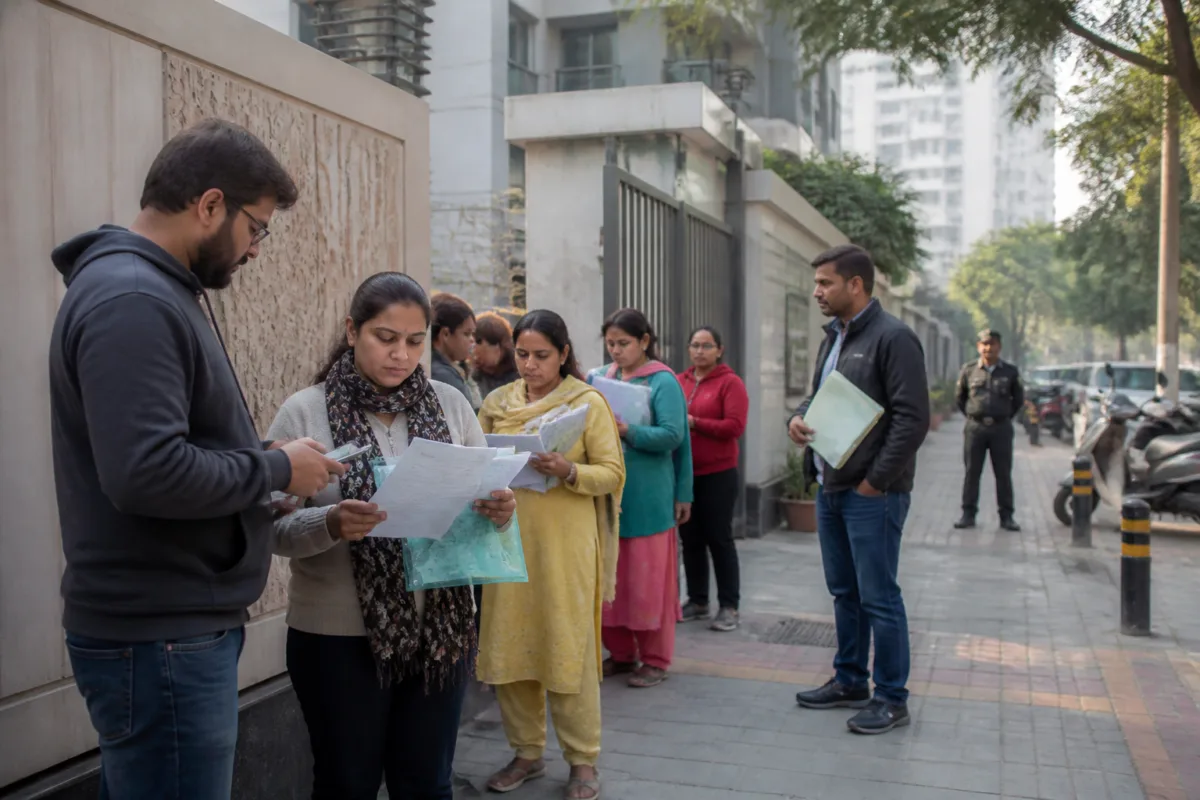
Delhi nursery admissions 2027-28 will place greater emphasis on neighbourhood distance, while private schools will have to disclose their admission criteria and points before applications begin, according to a report by Jagran. The Education Directorate has issued guidelines covering nursery, lower kindergarten, upper kindergarten and Class 1 admissions.
Schools have been directed to upload their admission criteria and the points assigned to each criterion on their websites and the Education Directorate’s portal by 26 November 2026. The report says the admission process is scheduled to begin on 1 December, with applications available through both online and offline modes.
The most significant feature of the reported framework is the weight given to proximity. Schools may use distance from the applicant’s home as a major criterion, although the points can vary between institutions. Vidya Bal Bhavan School in Mayur Vihar, for example, has prepared a 100-point formula that assigns 70 points to neighbourhood proximity. The report says schools in north and south Delhi are also considering neighbourhood allocations ranging from 30 to 70 points.
This approach could give children living close to a school an advantage over applicants from farther away. It also makes the publication of distance categories and other criteria important for parents trying to understand how applications will be assessed. The guidelines reportedly allow schools to decide their admission criteria, but require those criteria to be disclosed in advance.
The reported rules prohibit schools from awarding points for several personal or family characteristics. These include parents’ educational qualifications, employment status, whether both parents work, whether the child is the first-born, food habits, joint-family status, sporting or musical ability and use of school transport. Points cannot be assigned on the basis of parents not consuming alcohol or tobacco, and schools cannot use first-come, first-served admission as a criterion.
Interviews of children or parents are also not permitted, according to the report. Schools may instead use disclosed criteria such as neighbourhood distance, having a sibling already enrolled, being an alumnus’ child and being a single girl child.
Where applications exceed available seats under a particular criterion, schools may use a lottery. A lottery is also to be used when applicants have equal scores and more children qualify than there are seats. This makes the published points structure and the process used to conduct a draw central to the fairness of the admissions process.
The framework includes a monitoring and complaint mechanism. District-level monitoring cells are expected to oversee compliance. Schools that fail to upload their criteria by 26 November may have their admission process stopped until 30 November, the report says.
Parents can raise objections to points awarded by a school between 5 and 11 January. The school must respond in writing or by email. The final points list is scheduled for 12 January, followed by the first selection list on 20 January and the second selection list on 5 February. The report also says principals may allow a child whose age is up to one month below or above the prescribed limit, provided parents submit a written request.
For families, the rules shift attention from informal or subjective attributes towards criteria that schools must publish before the admission cycle. The practical effect will depend on how clearly schools define neighbourhood distances, apply their announced formulas, handle objections and conduct lotteries. The full implementation of these safeguards will therefore remain important as the 2027-28 admission process begins.

