


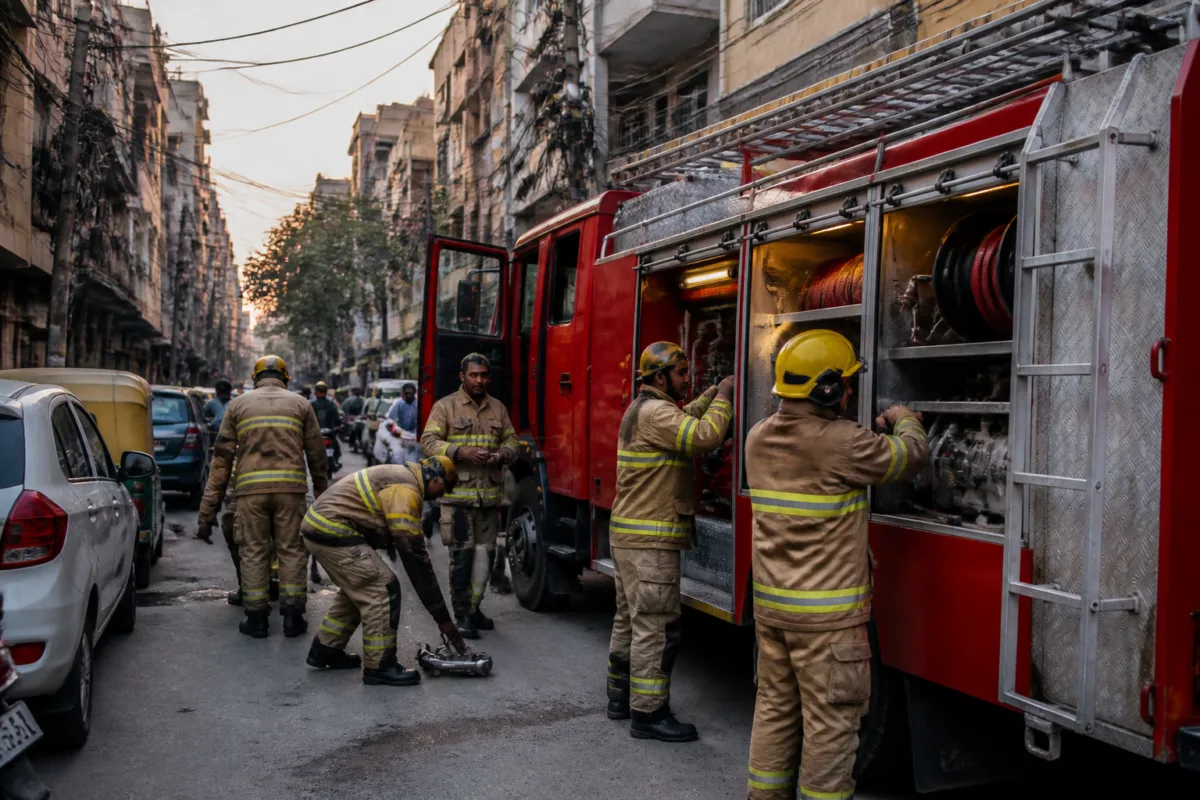
Delhi is set to overhaul its fire service through expanded manpower, new stations, upgraded equipment and tighter fire safety requirements for existing buildings, following a review of the department’s operational challenges by the Delhi government and the Lieutenant Governor’s office.
Delhi Home Minister Ashish Sood outlined the action plan after a review meeting chaired by the Lieutenant Governor at Lok Niwas. The measures are intended to address the conditions that complicate emergency response in the capital, including narrow lanes, high population density, traffic congestion, electrical overloading and the growing presence of synthetic furnishings and plastic materials in residential buildings.
“The safety and protection of every Delhi resident is our highest priority. We are executing a complete, multi-departmental revamping of the Delhi Fire Service, upgrading our technology, expanding frontline manpower, and fixing infrastructure bottlenecks,” Sood said, according to the government’s plan reported by Millennium Post.
A central part of the overhaul will be the expansion of the Delhi Fire Service’s sanctioned strength. Recruitment of station officers and firemen will be expedited in coordination with the Home Department, Services, the Union Public Service Commission and the Delhi Subordinate Services Selection Board. The sanctioned strength will be increased in accordance with a Ministry of Home Affairs report and concurrence from the Administrative Reforms Department.
The plan also includes regular fitness assessments for fire operators. The move is linked to the operational demands placed on personnel responding to emergencies in a densely built and heavily trafficked city, although the government has not specified the number of additional positions or the recruitment timeline in the announcement.
The department is expected to procure specialised firefighting equipment in line with Ministry of Home Affairs norms through its memorandum of understanding with the Delhi Metro Rail Corporation. Its emergency communication system will also be revamped. The announcement did not provide details of the equipment to be purchased, the procurement value or the schedule for deployment.
Delhi will also pursue the creation of additional fire stations. The Delhi Development Authority will allot land for the facilities, while the Public Works Department will undertake construction. The arrangement places land availability and public construction capacity at the centre of the city’s planned expansion of emergency-response infrastructure.
Electrical safety is another focus of the plan. The Power Department will direct distribution companies BRPL, BYPL and TPDDL to address electrical overloading by increasing sanctioned loads and upgrading network capacity. The government has linked overloaded electrical systems to fire risks in the capital, particularly in buildings where dense occupancy and older infrastructure may complicate prevention and response.
The government is considering making sprinkler systems and fire alarms mandatory in existing buildings, bringing them closer to requirements applicable to new construction. Delhi Fire Service rules would also be amended to allow qualified private third-party auditors to conduct fire safety audits.
Implementation will involve several civic and planning agencies. The Municipal Corporation of Delhi, the New Delhi Municipal Council and the Delhi Development Authority will be responsible for incorporating fire safety requirements into building by-laws and acting against unauthorised construction and other violations. The Delhi Fire Service will conduct awareness campaigns in educational institutions, markets and resident welfare associations as part of the plan.

