


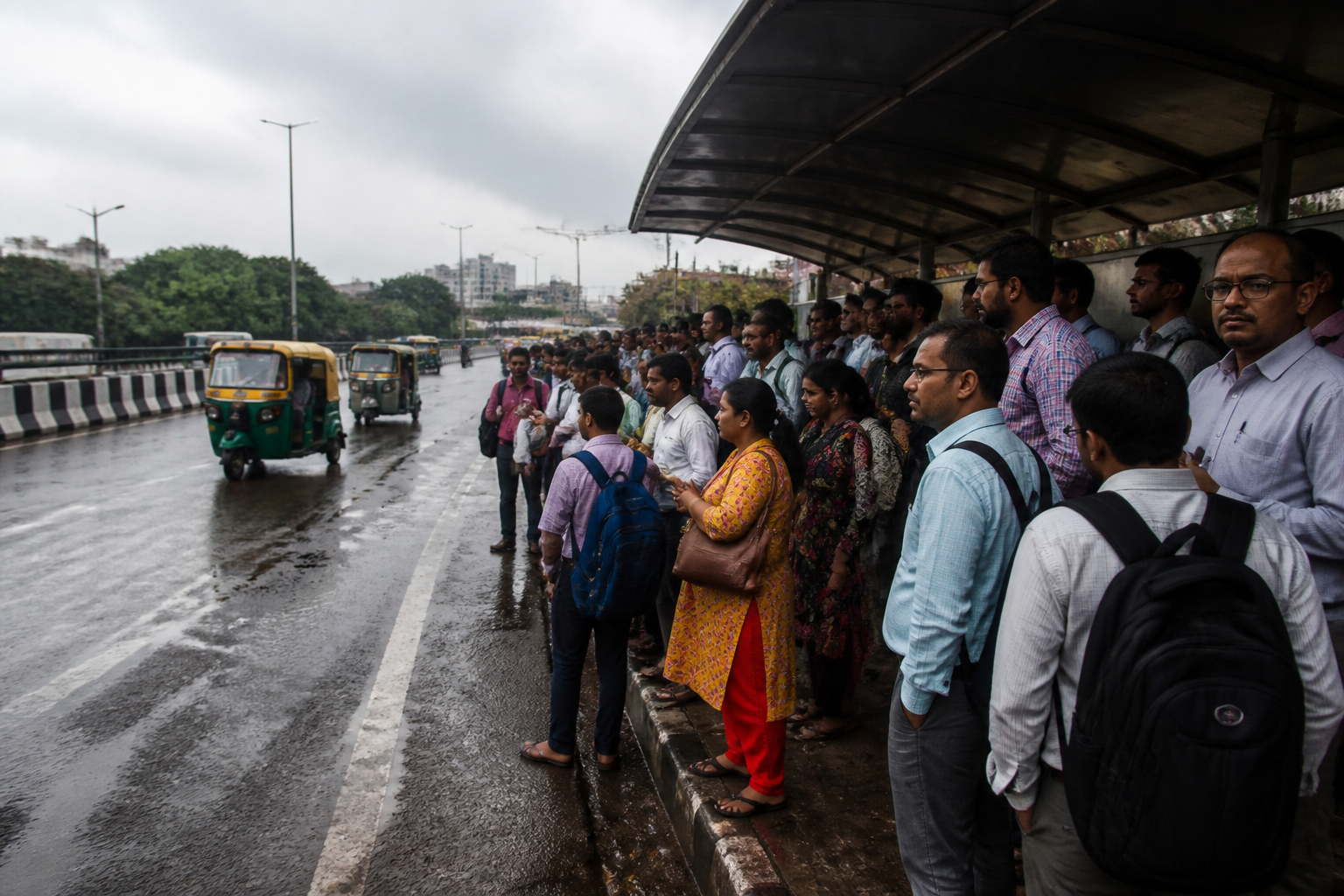
The Delhi bus strike entered its seventh day on Monday, leaving commuters waiting for up to two hours at several bus stops as schools, colleges and offices reopened and passenger demand increased across the capital. The disruption affected buses operated by the Delhi Transport Corporation (DTC) and the Transport Department that rely on privately engaged drivers.
Passengers reported extended waits on multiple routes, with the shortage particularly visible during the day’s peak travel periods. At the Vikas Marg bus stand, commuters were seen waiting for buses, while residents in several parts of Delhi said they had limited alternatives to reach work and educational institutions.
The disruption was also reported in rural Delhi, where the shortage of regular bus services was more severe. Residents in Fatehpur Beri and nearby villages said they had to wait for hours at local bus stops. The affected area includes routes connecting the villages with the Chhattarpur Metro station, an important interchange for residents travelling towards other parts of the city.
According to residents cited in the report, some auto-rickshaw and e-rickshaw operators increased fares during the strike. The fare for an e-rickshaw between Chhattarpur Metro and Fatehpur Beri was reported at Rs 30-40, while auto-rickshaw drivers were allegedly asking for Rs 150-200. Munni Lal, a local resident, said e-rickshaw fares that normally ranged from Rs 10-20 had risen to Rs 20-40, while auto-rickshaw fares had doubled.
A senior DTC official said some privately engaged drivers had begun returning to work. The corporation also deployed permanent and contractual drivers to operate buses on affected routes. About 50-60 per cent of buses were reportedly sent out from depots on Monday, according to the official, as DTC worked to restore regular services.
The strike has therefore created a two-level mobility problem for commuters: fewer buses on the road and higher costs for those forced to shift to autos or e-rickshaws. The impact was amplified when schools, colleges and government and private offices reopened, increasing the number of daily passengers using the bus network.
For residents of peripheral and rural areas, the disruption has narrowed the available transport choices further because local bus routes often provide the connection between villages, metro stations and major city corridors. The reported fare increases have added to the burden for passengers who depend on these links for routine travel.
DTC’s immediate response is focused on increasing bus deployment through returning private drivers and the use of permanent and contractual staff. The corporation has said efforts are continuing to restore normal bus services, but the report did not specify when full operations across all routes would resume.
