


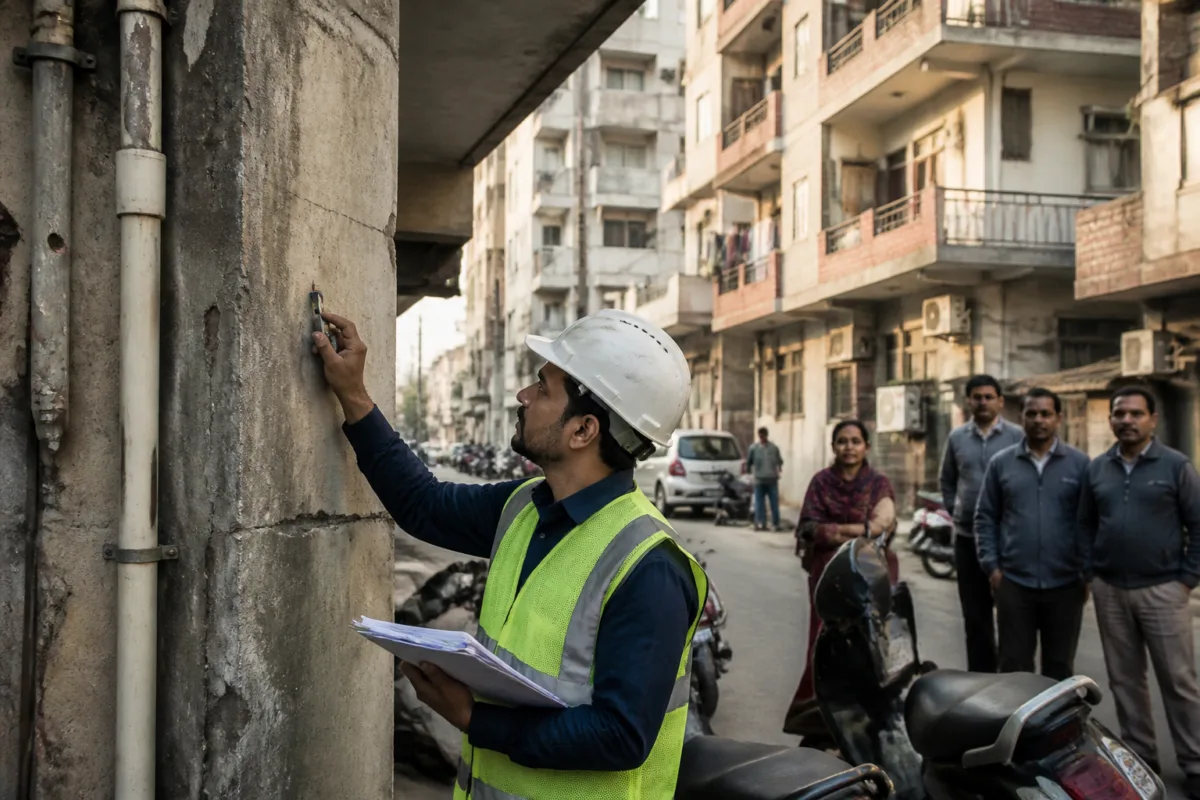
The Municipal Corporation of Delhi (MCD) has said it cannot inspect the structural safety of all buildings in the capital, citing the scale of the task and a shortage of qualified staff. A proposed change to Delhi’s building regulations could consequently place a recurring structural-audit requirement on building owners.
MCD Commissioner Sanjeev Khirwar made the remarks at a meeting of the civic body’s Standing Committee, according to a report by Jagran. He said Delhi has around 40–50 lakh houses, making it impractical for the corporation to visit every property and assess its structural strength. He also said the MCD does not have enough qualified personnel for the task.
Under the proposed arrangement, owners may have to obtain a structural audit of their buildings every 15 to 20 years. The possible requirement is being considered as part of amendments to the Unified Building Bye-Laws, 2016, which govern construction and plan approvals in Delhi, the report said.
The proposal has not yet become a rule. If the amendment is approved, the MCD or another relevant agency could ask owners to produce an audit certificate. A structural audit generally assesses the strength and safety of a building’s structural components, but the report does not specify the proposed eligibility criteria for auditors, the form of certification or the enforcement mechanism.
The issue has gained attention after building collapses and other incidents in Delhi, including the collapse of a building in Satya Niketan. The report said Aam Aadmi Party councillors had earlier protested over building safety by wearing helmets. The subject was subsequently raised at the Standing Committee meeting.
The discussion also highlighted gaps in the MCD’s enforcement capacity. Councillor Praveen Kumar alleged that one junior engineer is sometimes responsible for 10 to 12 wards, making it difficult to identify unauthorised construction and issue notices. He claimed that only one junior engineer was posted across 23 wards in the South Zone, and that several other zones were also operating with very few junior and assistant engineers. These staffing claims were made by the councillor and were not independently quantified in the report.
A shift towards owner-led structural audits could expand the responsibility of residents, housing societies, landlords and other building owners. It could also raise questions about affordability, technical quality and accountability if an audit identifies serious defects. At the same time, the reported shortage of engineers suggests that a certificate-based system would not by itself resolve the MCD’s wider enforcement and monitoring constraints.
The proposed amendment therefore represents a possible change in how Delhi distributes responsibility for building safety: from a system dependent on civic inspections towards one in which owners would have to periodically demonstrate structural safety. The practical effect will depend on whether the building-law amendment is approved and how the audit, certification and enforcement processes are defined.

