


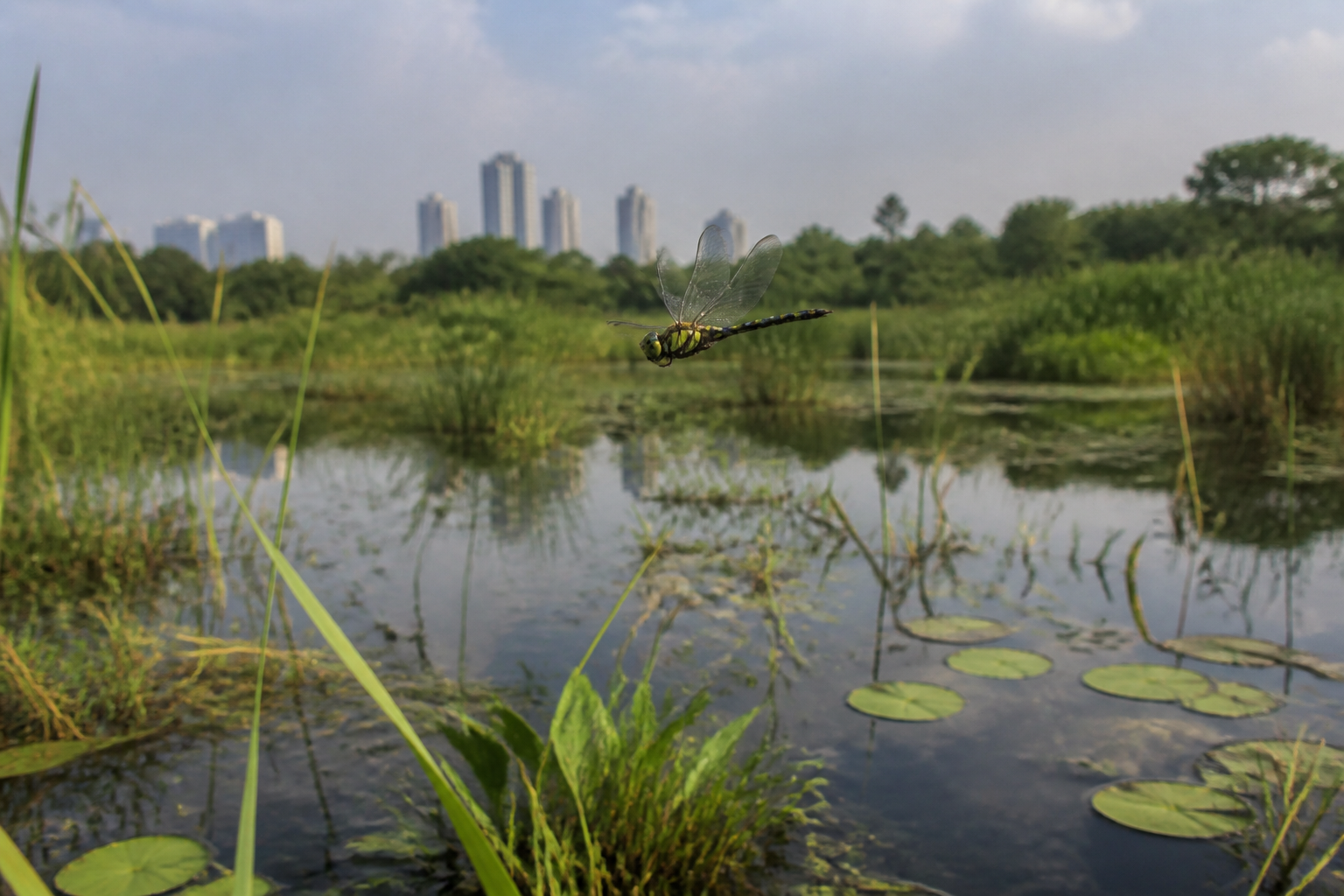
The latest dragonfly and damselfly survey across Delhi’s seven biodiversity parks offers more than a count of insects. It provides a detailed glimpse into how seasonal water, vegetation and restored habitats continue to support ecological networks inside one of India’s most intensely urbanised regions. The survey recorded 11,154 individual dragonflies and damselflies, while also showing that the number of insects and the diversity of species do not always move together.
That distinction is important for understanding urban wetlands. Kalindi Biodiversity Park recorded the highest number of individuals, with 4,234 across 15 species. Yamuna Biodiversity Park, however, recorded the highest diversity, with 23 species among 1,156 individuals. A park with fewer insects overall may therefore support a wider range of ecological conditions than one with a much larger population concentrated among fewer species.
The survey was conducted from September 17 to 19 by scientists, researchers, students and volunteers. It covered Yamuna Biodiversity Park, Kamla Nehru Ridge, Aravalli Biodiversity Park, Kalindi Biodiversity Park, Neela Hauz, Tughlaqabad and Tilpath Valley. Together, these sites form a varied network of floodplain wetlands, seasonal ponds, restored habitats, marshes and man-made tanks rather than a uniform collection of green spaces.
The results show how different urban landscapes perform different ecological functions. Yamuna Biodiversity Park recorded 23 species, followed by Kamla Nehru Ridge with 22 and Aravalli Biodiversity Park with 16. Kalindi recorded 15 species, Neela Hauz 13, Tughlaqabad 12 and Tilpath Valley four. Two species were added to the parks’ records this year: the Yellow-tailed Ashy Skimmer at Aravalli Biodiversity Park and the Blue Grass Dart at Yamuna Biodiversity Park.
These differences reflect the relationship between insect life and water conditions. Dragonflies and damselflies belong to the order Odonata and spend much of their lives as aquatic nymphs before emerging as winged adults. Their dependence on water makes them sensitive to changes in the availability, quality and seasonal performance of ponds, marshes and other wet habitats.
The survey’s total count fell from 13,253 in 2025 to 11,154 this year. Mohammed Faisal, who leads the survey, attributed part of the decline to the formation of fewer temporary water bodies during the monsoon. He said erratic rainfall meant that fewer ephemeral water bodies formed in the biodiversity parks, particularly in areas around the Aravalli Ridge, reducing the habitats available for insects to complete their life cycle.
The decline illustrates why a single annual count cannot be treated as a complete measure of ecological health. Insects that depend on temporary water bodies are influenced by rainfall timing, water retention, vegetation and the persistence of ponds through different stages of the season. A lower abundance may reflect a drier year or reduced habitat availability, while species diversity may remain comparatively strong in parks with a broader mix of permanent, seasonal and restored habitats.
This is also why the distinction between abundance and diversity matters for urban management. Kalindi’s 4,234 individuals indicate a high concentration of insect life, but Yamuna’s 23 species indicate a wider range of ecological niches. The two measurements answer different questions: one concerns how many individuals a habitat can support, while the other concerns how many types of organisms can persist there.
The comparison with earlier years reinforces the importance of looking at longer patterns. Kamla Nehru Ridge recorded 25 species in both 2023 and 2024 and 26 in 2025, before recording 22 this year. Yamuna Biodiversity Park’s 23 species therefore placed it ahead of the Ridge in the latest survey. The figures show annual variation, but they also demonstrate that ecological performance can shift between parks as water and habitat conditions change.
Dr Aisha Sultana, a wildlife ecologist and survey team leader, described the parks as a “highly heterogeneous urban wetland network”. The floodplain wetlands of Yamuna and Kalindi differ from the seasonal water bodies found in Aravalli, Tughlaqabad and Tilpath Valley. This variation gives the wider system resilience by allowing different species to use different habitats and by creating alternatives when a particular water body becomes unsuitable.
The parks are consequently better understood as functioning ecological infrastructure. Their value is not limited to recreation, tree cover or the visual presence of open land. Ponds, marshes, water plants, muddy substrates, leaf litter and dense vegetation collectively provide breeding, feeding and shelter conditions for species with different life cycles. The survey shows that these functions can persist within a landscape otherwise dominated by roads, buildings and transport infrastructure.
Dragonflies and damselflies also offer a practical way to observe changes that may be difficult to capture through conventional urban indicators. Pollution and changes in water quality can affect them during their aquatic and adult stages. Their presence and diversity can therefore provide clues about the condition of the water bodies and surrounding habitats, although the survey itself does not establish a direct cause for every variation in the counts.
The insects also have a role in urban food webs. As predators of mosquitoes and other insects, dragonflies and damselflies contribute to natural biological control. That does not make them a substitute for public-health systems or mosquito-management programmes, but it demonstrates that wetland conservation can have functions beyond biodiversity protection. Healthy habitats support ecological relationships that are often overlooked when urban water bodies are treated only as drainage assets or beautification features.
Delhi is known to have 51 Odonata species, while India has around 600 known species. Most of Delhi’s known species occur across the DDA’s seven biodiversity parks, according to the survey report. The parks therefore represent a significant share of the city’s recorded habitat for this insect group, despite occupying separate locations and differing substantially in topography and water conditions.
The survey also complicates the idea that all species found in the parks are permanent residents. Sultana said the parks support residents, local migrants and migrant species. Some species move between nearby water resources during drier months, while others survive unfavourable conditions as eggs, larvae or immature stages. Certain adults shelter in vegetation or shade, and some species can tolerate declining water levels or persist in muddy substrates and leaf litter.
The Wandering Glider illustrates the wider movement system. It was prominent at Aravalli and Kamla Nehru Ridge and is associated with long-distance migration. Research cited in the source suggests that its migratory circuit can span roughly 14,000 to 18,000 kilometres, including movement across the Indian Ocean. Its presence connects Delhi’s local habitats to ecological processes that extend far beyond the city.
For urban planning, the institutional question is whether biodiversity parks will be managed as isolated sites or as components of a connected wetland network. The survey does not provide a new policy framework or quantify the land, funding or administrative resources required for such management. It does, however, identify the ecological differences that planning decisions must recognise. A floodplain wetland cannot be managed in exactly the same way as a seasonal pond in the Aravalli landscape.
The evidence also points to the importance of maintaining water diversity rather than focusing only on the creation of large, permanent water bodies. Temporary ponds, marshes and shallow habitats may appear less stable from an engineering perspective, but they support species adapted to seasonal conditions. The decline in this year’s insect count, as linked by the survey team to fewer ephemeral water bodies, shows how changes in rainfall and water retention can affect urban biodiversity.
At the same time, the available evidence has limits. The annual survey records abundance and species presence, but the supplied findings do not establish a long-term trend for every park or separate the effects of rainfall, pollution, habitat management and other urban pressures. Sultana also said that greater survey effort is needed. Continued monitoring will be necessary to distinguish normal seasonal variation from sustained ecological decline.
The central lesson from Delhi’s dragonflies is that urban wetlands are active systems rather than decorative remnants. The 11,154 insects recorded this year reveal how water bodies, vegetation and landscape form continue to shape life inside the city. The difference between Kalindi’s high abundance and Yamuna’s high diversity shows why urban ecological performance cannot be reduced to one headline number. What deserves attention next is whether the parks can retain their variety of seasonal and permanent habitats, and whether future surveys show recovery, further decline or changing species patterns.
