


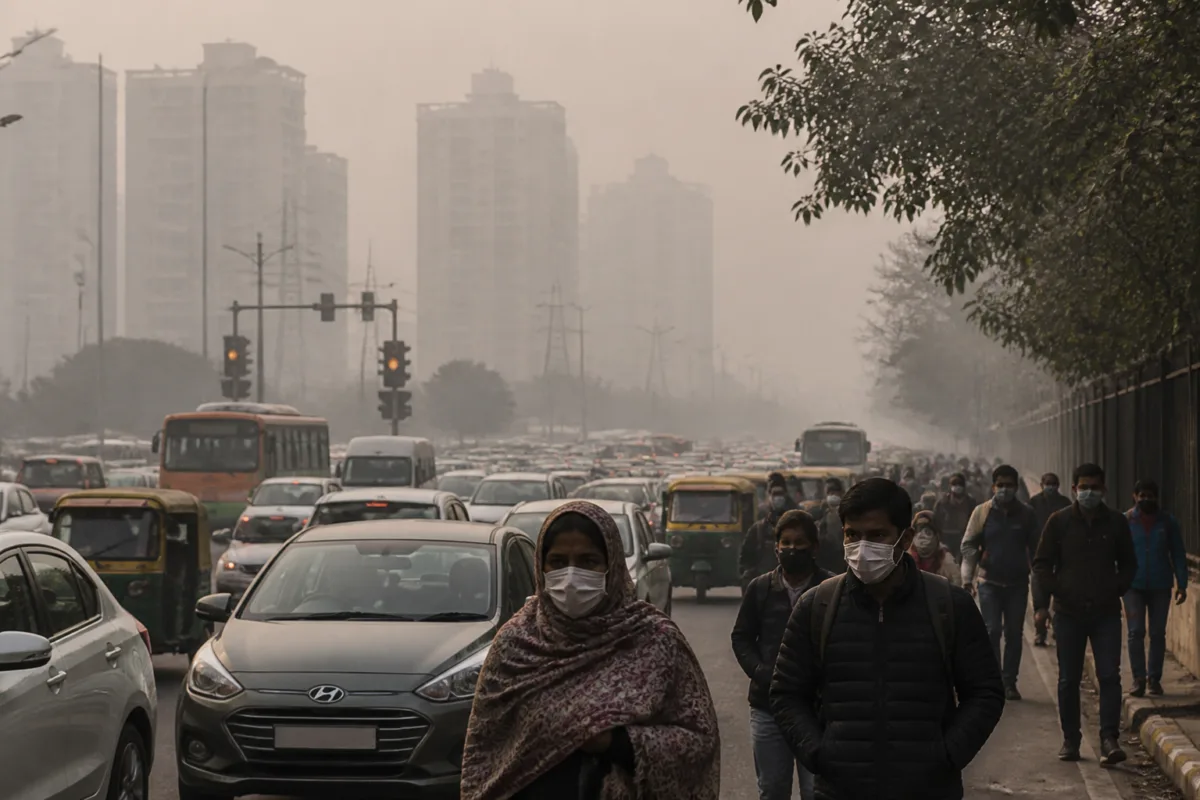
Delhi’s air quality has deteriorated sharply, with Jagran – New Delhi reporting that the city’s Air Quality Index crossed 567 and that several localities recorded extremely high readings. The report says residents are facing severe breathing conditions despite measures announced by the government and administration.
According to the report, Delhi’s AQI had remained at very poor levels for several days without a recorded improvement. It identified Mundka as having an AQI reading of 722, followed by Alipur at 619, Punjabi Bagh at 490, Jhilmil Industrial Area at 479, Rohini at 433, Sonia Vihar at 425 and Mandir Marg at 418. Bawana was reported at 361.
These figures have not been independently confirmed in the supplied material. The report does not identify the monitoring agency, the precise timestamp for each locality reading or the measurement methodology. The reported values, including readings above 500, should therefore be treated as figures cited by Jagran pending confirmation from the relevant air-quality authority.
The report said Delhi’s AQI had stood at 350 on the previous Tuesday, describing it as the worst reading in 267 days. It also said that pollution levels were expected to remain a concern in the days ahead, although the supplied report does not provide an official forecast or a detailed explanation of the factors driving the deterioration.
The deterioration has continued despite the implementation of Stage II of the Graded Response Action Plan, or GRAP-2, according to the report. GRAP is intended to coordinate restrictions and pollution-control measures during periods of worsening air quality. However, the supplied material does not list the specific enforcement actions taken under the current stage or provide official data on their implementation.
The situation highlights a recurring administrative challenge for Delhi: translating emergency pollution-control measures into measurable improvements in neighbourhood-level air quality. A citywide index can conceal sharp variation between localities, while high readings in industrial, residential and traffic-intensive areas can affect exposure differently across the urban region.
For residents, the immediate concern is the reported persistence of hazardous conditions and the lack of visible improvement. The report says government and administrative efforts have not yet produced positive results on the ground, but it does not include responses from the Delhi government, the Commission for Air Quality Management or an independent monitoring body.
The next verified update will need to establish the official citywide and station-level readings, the duration of the reported spike, the agencies responsible for the measurements and the measures being enforced under GRAP-2. Those details will determine whether the reported deterioration reflects a citywide pollution emergency, a cluster of localised spikes or a measurement discrepancy requiring correction.

