


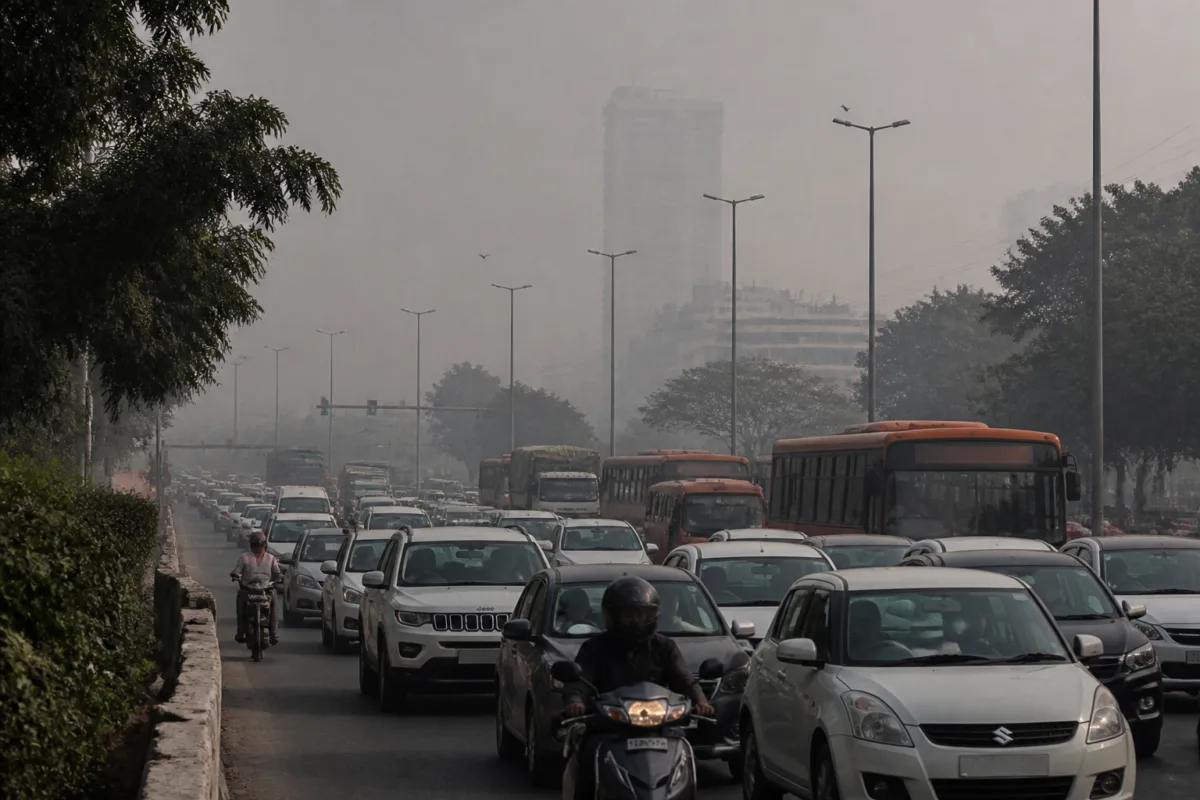
Delhi’s air quality is expected to deteriorate to the Poor category from Wednesday and remain there for the next six days, according to a forecast by the Indian Institute of Tropical Meteorology (IITM), as falling temperatures and weaker winds reduce the dispersion of pollutants.
The Capital’s Air Quality Index rose to 179 on Tuesday from 139 on Monday, although it remained in the Moderate category. PM2.5 was the prominent pollutant on Tuesday, replacing ozone and PM10, which were the main pollutants recorded on Monday.
Air quality was also in the Moderate category in neighbouring cities. Noida recorded an AQI of 161, while Gurugram recorded 184. The readings underline the regional nature of the pollution episode, with conditions across the National Capital Region influenced by weather, emissions and atmospheric circulation.
Transport emissions continued to be the largest contributor among the sources tracked by IITM’s Decision Support System. As of October 19, transport accounted for 23.02% of Delhi’s emissions, while residential sources contributed around 6%. Industries, construction, road dust, waste burning and the energy sector together accounted for around 15%.
The DSS forecast also indicated that the contribution of stubble burning to Delhi’s pollution could rise from around 4% to 12% by Wednesday. Satellite data analysed by the Indian Agricultural Research Institute recorded 1,171 crop-residue-burning events across six states and Delhi between September 15 and October 19. The total included 368 events in Punjab, nine in Haryana, 370 in Madhya Pradesh and 175 in Uttar Pradesh.
The latest available IARI data recorded 98 paddy-residue-burning events across six northern states on Monday. These included 27 in Uttar Pradesh, 25 in Punjab, 24 in Rajasthan and 18 in Uttarakhand. No events were detected in Haryana or Delhi on that day.
Weather conditions are expected to play a significant role in the deterioration. The India Meteorological Department recorded a minimum temperature of 17.7 degrees Celsius and a maximum temperature of 31.8 degrees Celsius at its Safdarjung base station on Tuesday. The maximum temperature was below normal, with no significant change expected over the next 48 hours before a possible rise of 1–3 degrees Celsius.
The IITM air quality bulletin said surface winds in Delhi were expected to weaken to around 10 kmph from the northeast during Tuesday evening and night, after reaching speeds of up to 20 kmph from the northwest in the afternoon. Weaker winds can limit the movement and dilution of pollutants near the surface.
The forecast ventilation index, which indicates the atmosphere’s ability to disperse pollutants, was projected at 13,700 square metres per second on Wednesday and expected to increase to 21,600 square metres per second by Friday. IITM describes a ventilation index below 6,000 square metres per second, combined with average wind speeds below 10 kmph, as unfavourable for pollutant dispersion.
The latest forecast places Delhi’s winter air-quality challenge within a wider urban system involving transport, residential activity, construction, waste burning, regional farm fires and changing weather conditions. The immediate forecast is for the AQI to remain in the Poor category for six days, while the next major indicators will be pollutant levels, wind speeds, ventilation conditions and the contribution of stubble burning.

