


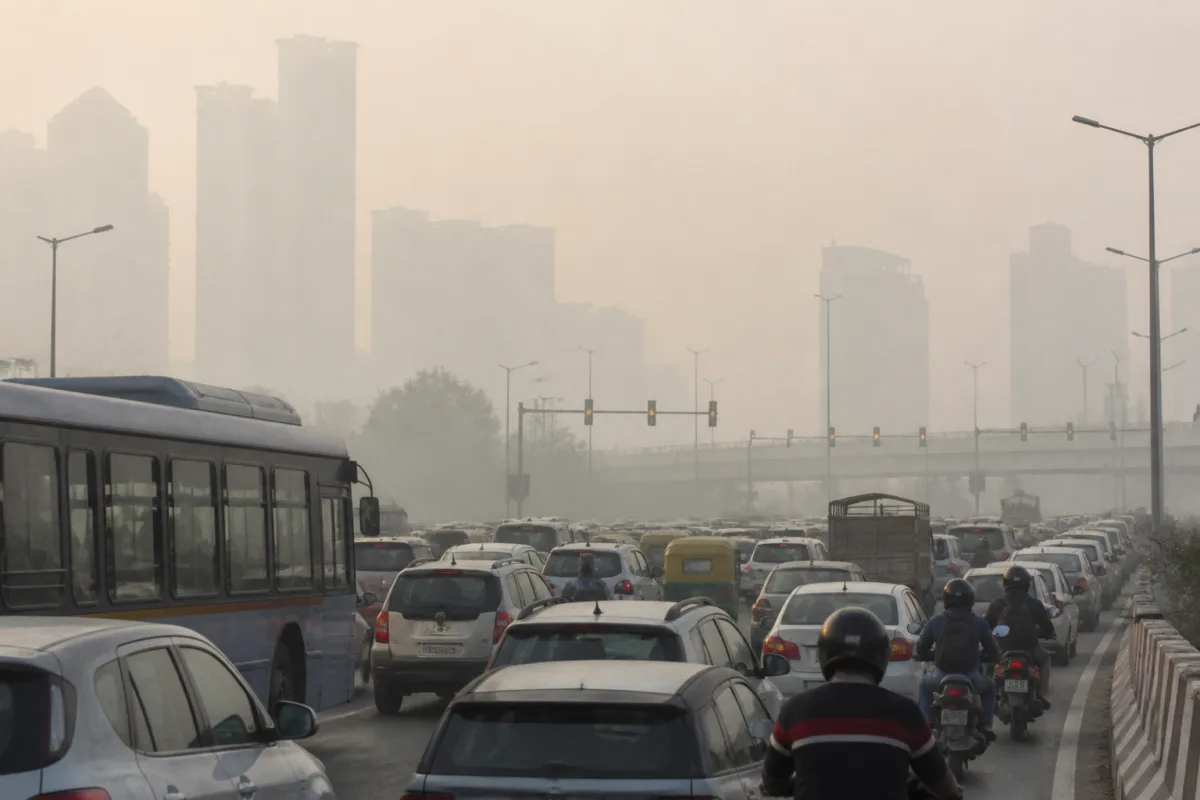
Delhi air pollution worsened to the very poor category on the eve of Diwali, with the Central Pollution Control Board recording an Air Quality Index of 364 at 9 am on Saturday and the city’s deteriorating conditions prompting tighter restrictions across the National Capital Region. IQAir’s live ranking separately placed Delhi as the world’s most polluted major city that morning.
The CPCB recorded Delhi’s AQI at 363 at 10 am, within the very poor category. IQAir reported a reading of 581 on the US Air Quality Index scale at 10:35 am, placing Delhi ahead of Lahore, which had a reported reading of 285. The two figures are not directly comparable because India and IQAir use different scales and methodologies.
The deterioration came a day before Diwali, when the use of firecrackers can add to the pollution burden. The report said schools in Delhi and neighbouring areas had been instructed to operate online classes in response to the worsening conditions, while residents have been encouraged to work from home. Schools for students up to Class 5 must operate in hybrid mode under the latest restrictions, allowing families to choose between online and physical attendance.
The Commission for Air Quality Management has imposed Stage 3 of the Graded Response Action Plan across Delhi-NCR. Under these curbs, diesel vehicles meeting BS-IV or lower emission standards and petrol vehicles meeting BS-III or lower standards are barred from operating in Delhi. The restriction also applies to vehicles registered in other states.
The restrictions cover parts of the wider urban region, including Noida, Ghaziabad, Faridabad, Gurugram and Sonipat. Diesel heavy vehicles and light commercial vehicles that meet BS-IV or lower emission standards are also subject to restrictions. The measures directly affect daily commuting, goods movement and commercial transport across a region whose labour and supply networks extend well beyond Delhi’s administrative boundary.
Delhi Environment Minister Manjinder Singh Sirsa said the restrictions would remain in force for as long as GRAP Stage 3 was active and urged residents to comply with the measures. He said citizen participation was necessary alongside government action to address the pollution emergency.
The minister also cited weather forecasts indicating that conditions could become more adverse from Saturday, with wind speeds expected to approach near-zero levels. Such stagnant conditions can limit the dispersion of pollutants and allow emissions to accumulate over the city and surrounding urban areas.
The deterioration reflects the recurring winter pollution pattern across north India. As temperatures fall, colder and heavier air can trap emissions from vehicles, construction dust and crop-residue burning closer to the ground. The combination of seasonal weather and multiple emission sources has made poor air quality a repeated governance challenge for Delhi-NCR.
Local media reports citing official data said Friday’s air quality was the worst recorded before Diwali in eight years. The latest restrictions will continue until the Commission for Air Quality Management withdraws or modifies GRAP Stage 3, while authorities monitor weather conditions and subsequent AQI readings.

