


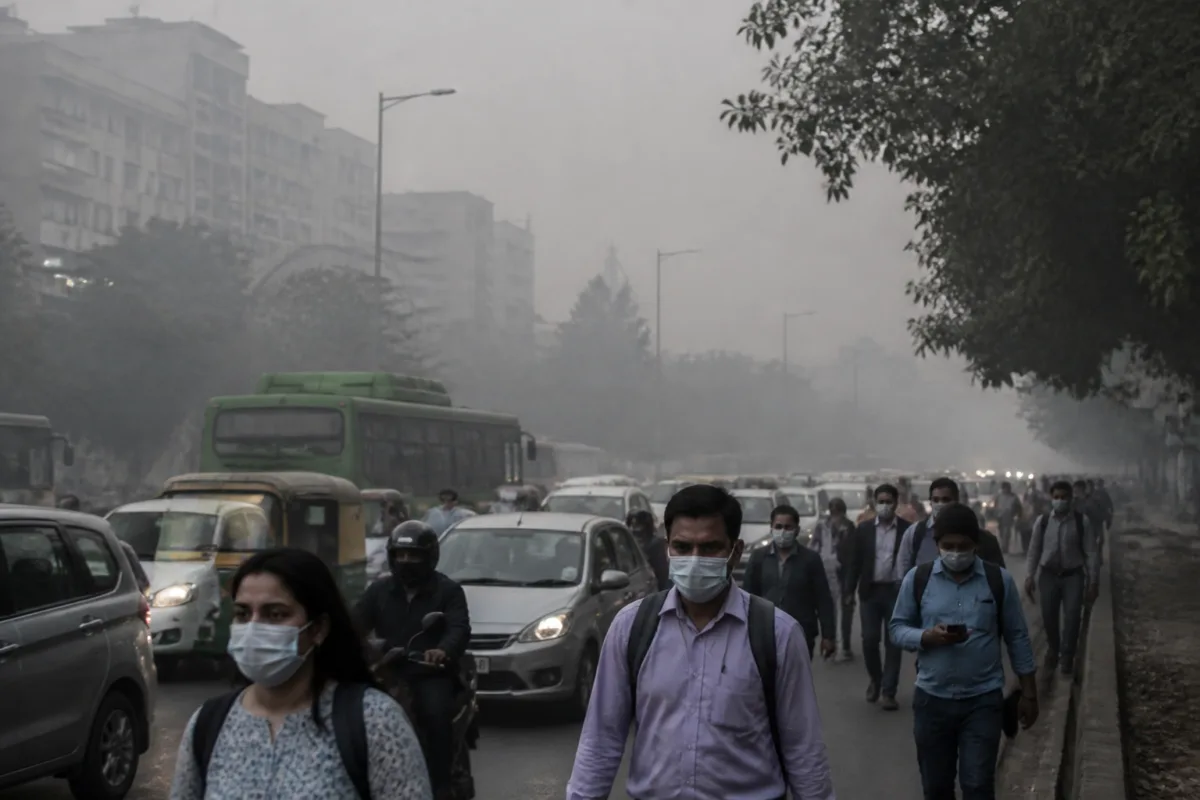
Delhi’s air quality deteriorated sharply on Friday, with the city’s Air Quality Index reported at around 408 and several monitoring locations recording unhealthy readings. The worsening pollution has renewed concerns for residents, particularly children, older people and those living with pre-existing health conditions.
According to a report by Jagran – New Delhi, the national capital’s overall AQI was close to 408 on Friday. The report described conditions across several parts of Delhi as being in the severe range, although the readings cited for individual monitoring stations varied significantly.
The highest location-wise figure mentioned in the report was recorded on Aravindo Marg at 332. Other readings included 340 at Okhla, 328 at Karol Bagh, 278 at Mandir Marg, 271 at RK Puram, 262 at Lodhi Road and 251 near Jawaharlal Nehru Stadium. These figures indicate that pollution levels were not uniform across the city, with some areas recording substantially higher concentrations than others.
The deterioration comes amid repeated increases in Delhi’s pollution levels. The report said the AQI had crossed 400 on some days and had also reached higher levels on other occasions. It did not provide a detailed breakdown of the pollutants responsible for the latest rise or specify the monitoring agency behind the city-level figure.
The immediate impact is being felt at street level, as residents continue to travel, work and attend school despite the poor air quality. The report said children, older people and people already suffering from health problems were facing greater difficulty in the polluted environment. It also said these groups were being advised to avoid going outdoors.
The situation highlights the gap between pollution-control measures announced by authorities and the conditions experienced by residents. The report referred to government claims that several steps were being taken to control air pollution, but did not identify the specific measures, their implementation status or the agencies responsible for enforcing them.
For Delhi’s municipal and pollution-control institutions, the immediate challenge is not only to issue health advisories but also to identify the sources driving the sharp variation between monitoring locations. Without source-specific information, residents have limited guidance on whether the pollution is being driven primarily by traffic, construction, local emissions or regional factors.
The report also mentioned a traffic advisory for areas associated with Chhath Puja, indicating that movement and outdoor exposure were additional concerns during the period. No further operational restrictions, school directions or emergency pollution-control orders were identified in the supplied report.
The AQI readings and health advisories underline the need for residents to follow official guidance while authorities continue monitoring conditions across the capital. Further updates would be required to establish whether the reported rise is sustained and what enforcement measures are being implemented.

