


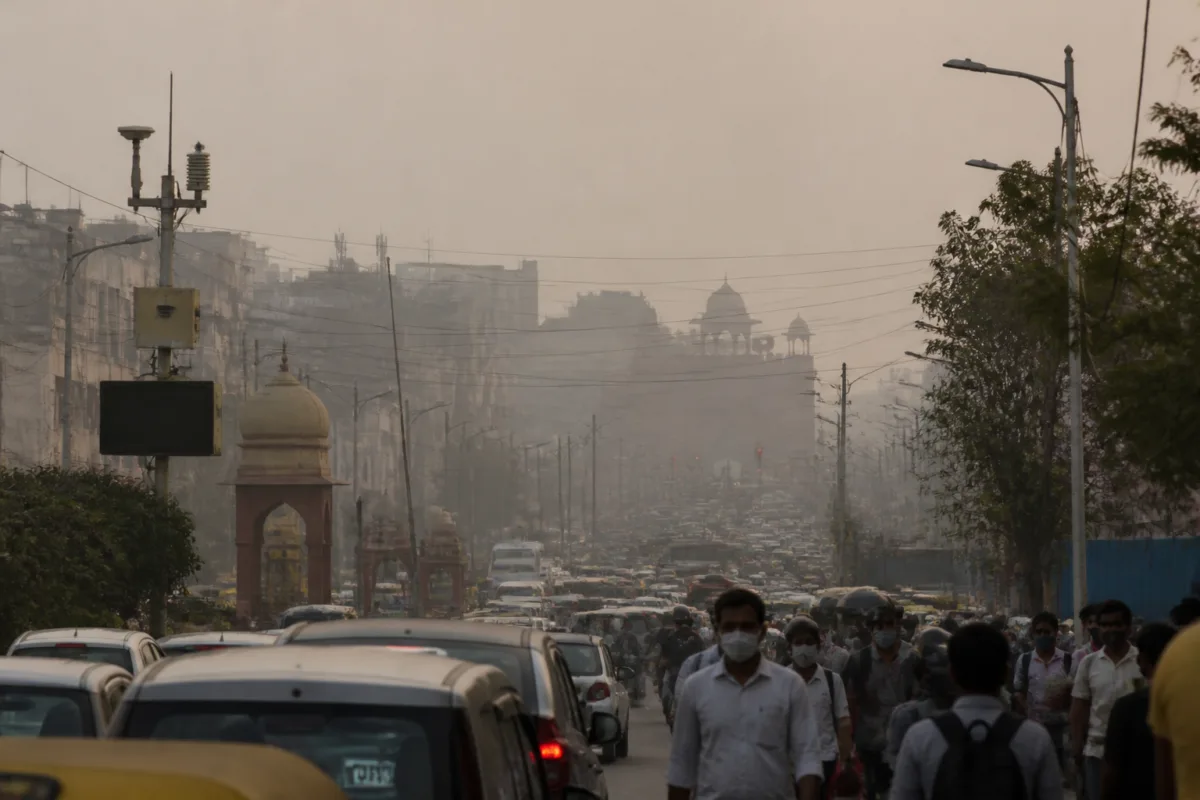
The Supreme Court’s latest criticism of the Delhi government and the Commission for Air Quality Management (CAQM) over festival-related pollution has exposed a familiar weakness in the capital’s environmental governance: orders can be issued, enforcement teams can be formed, and restrictions can be announced, but the system still struggles to demonstrate what happened on the ground.
A bench of Justices M.M. Sundresh and P.B. Varale questioned the authorities after finding that directions intended to control pollution from fireworks during festivals had not been implemented effectively. The court said the apparent non-compliance made its orders seem merely “bookish” and warned that repeated violations risk turning judicial directions into a “joke”.
The significance of the hearing lies in the questions the bench asked. The court did not restrict its concern to whether restrictions existed on paper. It asked what enforcement teams created under earlier directions had actually done, whether they had visited identified areas, when those visits took place, and what data they collected. It also sought to know whether authorities had assessed locations where the Air Quality Index rose sharply and compared them with areas where it did not.
Those questions point to the difference between administrative compliance and operational compliance. An agency may report that a team has been constituted or that an order has been circulated. That, however, does not establish that personnel reached the affected locations, identified violations, recorded evidence, acted against offenders or produced information that could be used to assess the result. The court’s intervention suggests that this chain of accountability was not adequately demonstrated during the hearing.
For Delhi and the wider National Capital Region, the issue is particularly important because festival-related pollution is managed through a complex institutional arrangement. The Supreme Court issues directions, the CAQM is responsible for coordinating air-quality management across the region, and governments and local enforcement authorities are expected to translate restrictions into action. The effectiveness of the system therefore depends not on one order or one agency, but on coordination across several levels of administration.
The source report does not provide a complete account of the enforcement data submitted to the court, nor does it specify the number of teams, inspections, violations recorded or cases initiated. That absence is itself central to the court’s concern. Without location-specific records and time-bound reporting, it becomes difficult to establish whether a restriction was implemented, whether it changed behaviour, or whether pollution levels were affected by the intervention.
The court’s questions also underline why air-quality enforcement cannot be assessed only through broad city-level readings. The bench asked authorities to distinguish between areas where the AQI increased substantially and those where it did not. Such a comparison would require officials to connect the timing and location of enforcement activity with local pollution conditions. It would also require clarity about the other factors operating at the same time. The hearing, as reported, does not establish that such a detailed assessment was available.
This is a recurring problem in urban environmental governance. Pollution is experienced locally, but regulation is often reported institutionally. Authorities may announce a city-wide measure, while residents experience its success or failure on particular streets, neighbourhoods and public spaces. A system that records only the issuing of directions can therefore appear active even when residents receive little protection from the underlying hazard.
The Supreme Court also made clear that it was not seeking to disregard the religious and cultural significance of festivals. The bench said it understood people’s sentiments and did not intend to interfere in religious aspects. At the same time, it insisted that authorities must find a practical way to celebrate festivals without causing harm to others. This framing places the administrative responsibility on the state: public policy must address both the social practice being regulated and the health consequences of pollution.
That balance cannot be achieved through legal directions alone. It requires advance planning, clearly assigned responsibilities, local enforcement capacity and reliable evidence. Authorities need to know which areas require attention, who will act there, what constitutes a violation, how incidents will be recorded and which agency will consolidate the results. The court’s questions indicate that the problem may not be the absence of formal instructions, but the weakness of the system that converts those instructions into verifiable action.
The role of CAQM is significant in this structure because air pollution in the National Capital Region does not follow municipal boundaries. A festival-related pollution event in one locality can form part of a wider regional air-quality problem. Yet regional coordination also creates the risk that responsibility becomes dispersed. If several authorities are involved, each can point to the existence of a broader mechanism without clearly accounting for its own operational performance.
The hearing raises a further institutional issue: whether enforcement is being designed as a one-time response to a recurring event. The bench referred to directions issued the previous year and asked what the enforcement teams had done under those orders. That suggests the court was examining not merely the current festival period but the continuity of the administrative system. If the same questions arise each year, the issue is no longer a temporary enforcement lapse. It becomes a question of whether lessons are being recorded and incorporated into the next cycle.
The lack of publicly detailed information in the supplied report means that no conclusion can be drawn about the precise causes of the pollution levels or the relative contribution of fireworks. It also does not establish the full extent of non-compliance by residents, businesses or enforcement bodies. What it does establish is that the Supreme Court found the authorities’ explanation insufficient to show what had been done and what effect it had produced.
That distinction matters for urban policy. A court order can compel authorities to act, but it cannot substitute for a functioning monitoring and enforcement architecture. Judicial oversight may expose gaps, demand reports and keep the issue on the administrative agenda. The day-to-day responsibility, however, remains with the agencies that control field operations, coordination and data collection.
For citizens, the practical question is whether restrictions on pollution-producing activities are credible. Credibility depends on visible and consistent enforcement, but also on whether authorities can explain the basis of their decisions and demonstrate the results. When rules are repeatedly announced without transparent evidence of implementation, public compliance can weaken and institutional trust can suffer. The Supreme Court’s reference to orders becoming “bookish” captures this gap between formal authority and lived urban governance.
The larger urban question is whether Delhi’s air-quality system can move from episodic intervention to measurable environmental administration. That would require the state and regional agencies to show not only that directions were issued, but where teams went, what they observed, what action followed and whether conditions changed. The source report does not indicate that the court received all of this information.
The next stage will depend on the authorities’ response to the court’s demand for concrete compliance and impact data. Until that evidence is placed on record, the hearing leaves one conclusion firmly established: Delhi’s pollution-control framework is being judged not by the existence of its orders, but by its ability to enforce them and demonstrate the results.

