


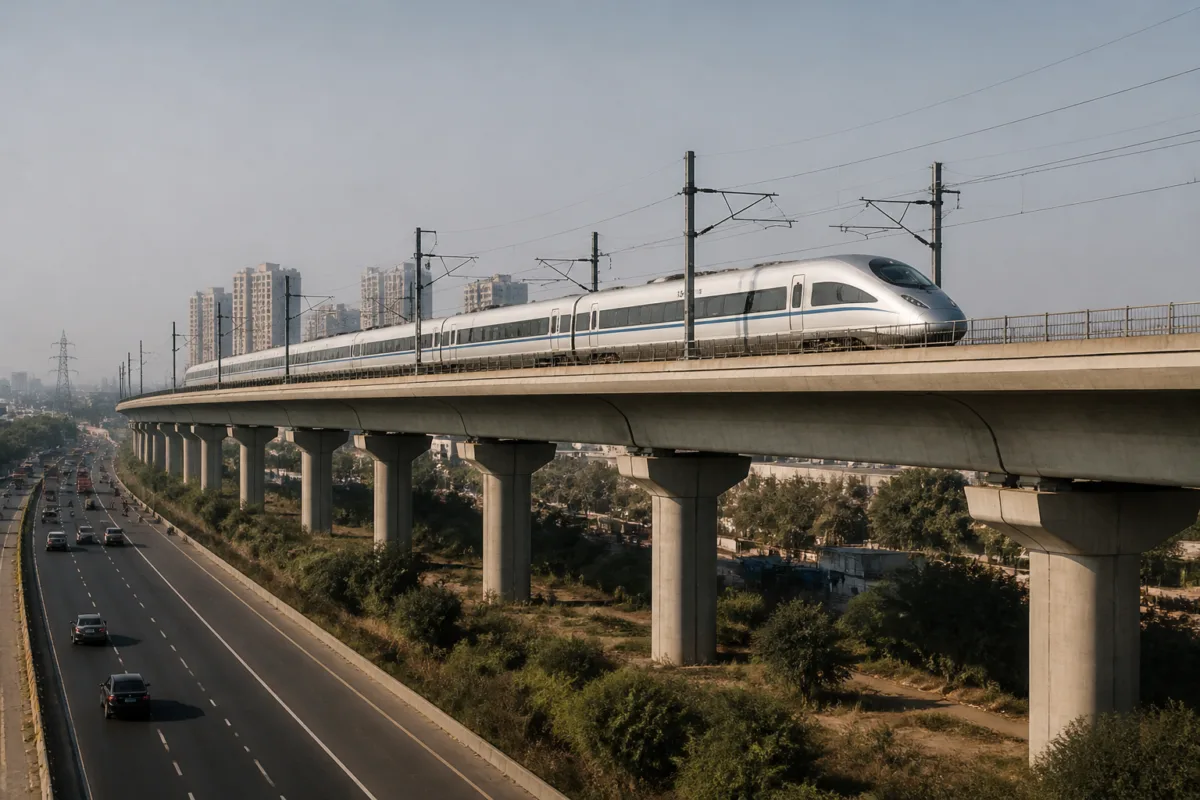
A proposed 886-km high-speed rail corridor linking Delhi and Ahmedabad remains at the planning stage, leaving a major gap in any future direct bullet train connection between Delhi and Mumbai. The Delhi-Ahmedabad project has a detailed project report but has not received project sanction or entered construction, according to an Economic Times report.
The proposed corridor would connect Delhi, Haryana, Rajasthan and Gujarat through 15 stations. If it is approved, built and integrated with the under-construction Mumbai-Ahmedabad High-Speed Rail project, it could create a faster passenger rail link between some of India’s largest government, commercial, manufacturing and financial centres.
The possible Delhi-Mumbai journey time of less than six hours is not an officially announced target. It is a longer-term possibility dependent on the completion of both corridors and the creation of compatible operations between them. The proposed Delhi-Ahmedabad section itself is expected to reduce travel time between the two cities to less than four hours, based on the project details cited in the report.
The proposed route would begin at Dwarka Sector 21 in Delhi and enter Haryana through Chauma in Gurugram. It would run along the Dwarka Expressway towards Ramprastha City in Sector 37D before turning towards the Delhi-Jaipur railway line. The alignment is planned to cross the Kundli-Manesar-Palwal Expressway and connect with the Delhi-Jaipur highway near the Shahjahanpur toll plaza, close to the Haryana-Rajasthan border.
The 15 proposed stations are Dwarka in Delhi; IMT Manesar and Rewari in Haryana; Behror, Shahpura, Jaipur, Ajmer, Vijaynagar, Bhilwara, Chittorgarh, Udaipur and Dungarpur in Rajasthan; and Himmatnagar, Gandhinagar and Ahmedabad in Gujarat.
According to the report, the entire corridor is proposed to be elevated. Its alignment has been planned along existing rail and highway corridors to reduce the need for acquiring privately owned land. An official of the National High Speed Rail Corporation Limited, cited in the report, said that limiting private land acquisition was important because it can consume substantial time in large infrastructure projects. However, land acquisition for the proposed corridor has not yet begun.
The project’s administrative status differs sharply from that of the Mumbai-Ahmedabad High-Speed Rail corridor. The Mumbai-Ahmedabad project, India’s first dedicated high-speed rail corridor, is under construction with technical and financial assistance from Japan. It spans approximately 508 km and is planned to have 12 stations across Maharashtra, Dadra and Nagar Haveli, and Gujarat.
The trains on the Mumbai-Ahmedabad corridor are designed to operate at speeds of up to 320 kmph, with a maximum design speed of 350 kmph. The fastest services are expected to cover the route in about two hours. The government indicated in July 2026 that the first service was expected to begin in August 2027 on the Surat-Vapi section, while construction of the remaining sections is scheduled over a longer period.
The project has faced delays linked particularly to land acquisition in Maharashtra, and its estimated cost has risen substantially from the original projections. It nevertheless remains the only sanctioned high-speed rail project in India currently under execution, according to the report.
The proposed Delhi-Ahmedabad corridor was not included among the seven new high-speed rail corridors announced in the Union Budget 2026-27. Delhi-Varanasi was among the announced routes. The omission does not establish that the Delhi-Ahmedabad proposal has been abandoned, but it indicates that the project has not yet received the administrative and financial backing needed to move into implementation.
The Railway Ministry’s stated approach, as reported by Economic Times, is to assess high-speed rail proposals on the basis of detailed project reports, technical and economic feasibility, and the availability of financial resources. The newly announced corridors would also need to pass through these approval processes before construction could begin.
For the proposed Delhi-Ahmedabad route, the next decisive steps would therefore be project approval, financing, land acquisition and construction planning. A future Delhi-Mumbai bullet train service would require more than the completion of the Mumbai-Ahmedabad corridor. The Delhi-Ahmedabad section would also need to be sanctioned, built and operationally integrated with the western corridor.
The corridor’s wider value would depend on more than line speed. Ticket prices, service frequency, station access and integration with local transport systems would influence whether residents of intermediate cities can use it for work, education and business travel. The proposal could improve links between Rajasthan, Haryana and Gujarat and larger employment, commercial and educational markets, but those benefits cannot be assessed fully until the project receives approval and its operating arrangements become clear.
For now, the Delhi-Ahmedabad bullet train remains a detailed proposal rather than an approved construction project. Its progress will depend on whether the government provides the required sanction, funding and implementation priority.

