


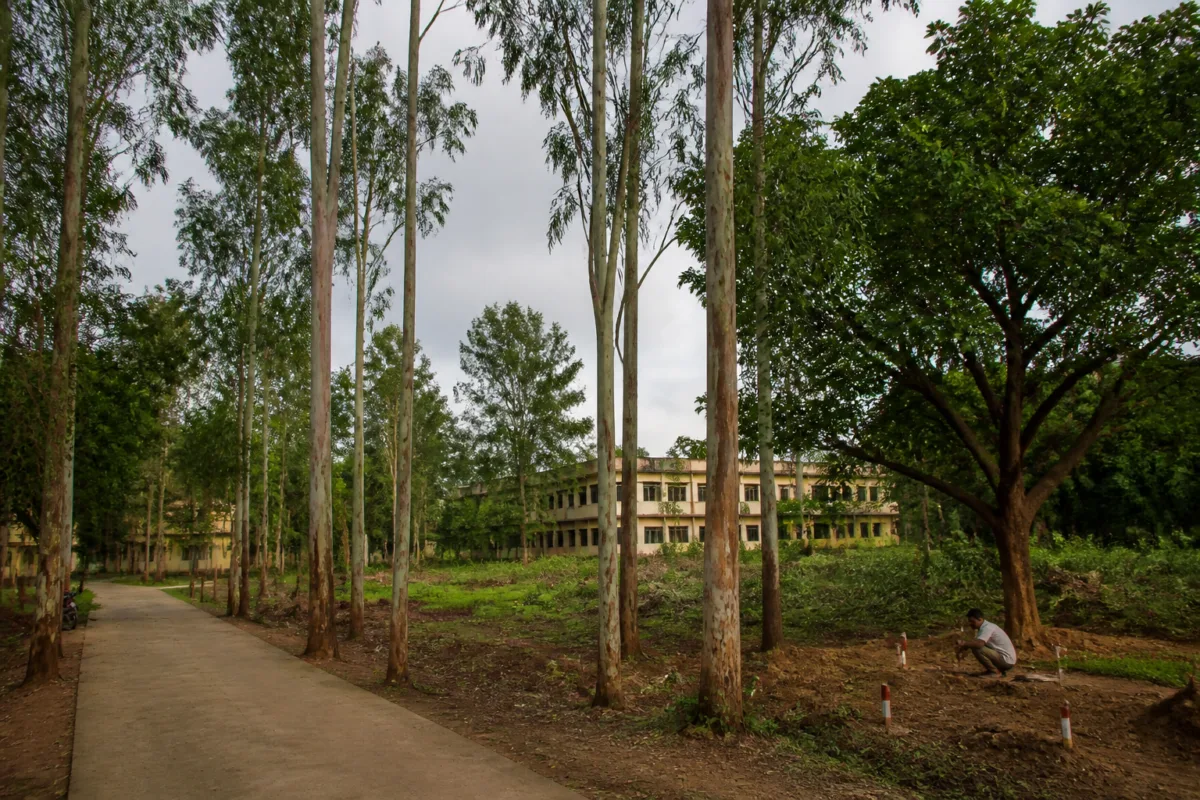
A proposed girls’ hostel at Ganesh Lal Agarwal College in Daltonganj has brought a familiar urban question into focus: how should public institutions expand essential facilities without treating existing green cover as disposable land? Forest officials have identified 118 trees for possible felling at the site, while the project remains subject to approval from a high-powered committee in Ranchi and a requirement for compensatory afforestation.
The proposed facility is intended to address a practical accommodation gap. The college, affiliated with Nilamber Pitamber University, plans a 100-bed hostel under the Pradhan Mantri Uchchatar Shiksha Abhiyan scheme. According to Vice-Chancellor Dinesh Kumar Singh, Jharkhand State Building Construction Corporation Ltd will construct the three-storey building, which is planned to contain 50 rooms with two beds in each room.
The immediate dispute is not over whether the college requires accommodation, but how the project should be located and approved. Student and non-student organisations have opposed the proposal because of the potential loss of green cover. At the same time, sources cited in the report said women from outside Daltonganj who enrol in undergraduate and postgraduate courses face difficulty finding safe accommodation because the town has few private girls’ hostels and paying guest facilities.
That tension makes the site decision more consequential than a routine tree-felling application. A hostel can improve access to higher education for students who cannot commute or secure accommodation independently. But the project’s current footprint also raises questions about whether an institutional expansion plan has adequately considered existing vegetation, alternative sites and the long-term environmental value of the campus.
The sequence of the proposal shows how such conflicts often emerge late in the development process. In July 2026, then professor in-charge Jasbir Bagga sought permission from Medininagar divisional forest officer Satyam Kumar to remove 275 trees from the proposed hostel site. A survey by a team led by Kundri range officer Mahender Prasad in August identified 118 trees, substantially fewer than the number mentioned in the initial request.
Prasad’s inspection report classified the identified trees as fit for felling and unsuitable for replantation. The list comprised one teak tree and 117 eucalyptus trees. The report, as cited by the source, does not establish that the trees have already been approved for removal. It records an assessment of the trees and their suitability for replantation; the final permission remains pending.
The distinction matters because the project has not yet crossed the principal administrative gate. Forest officials said construction work could begin only after approval from a high-powered committee in Ranchi. The forest division is expected to submit land records, relevant documents and an assessment of the minimum loss of green cover. Permission would also require compensatory afforestation.
The approval process therefore places the hostel within a broader system of land, construction and environmental administration. The college and the building corporation have separately sought permission for felling, while the higher education department has conveyed the proposal to the college. Multiple institutions are involved: the college as the project site holder, the higher education system as the sponsoring administrative authority, the building corporation as the implementing agency and the forest division as the authority assessing the vegetation loss.
This division of responsibility can protect public assets, but it can also create a sequencing problem. If tree assessment begins only after a building location has effectively been selected, environmental considerations become a permission hurdle rather than an input into design. In this case, forest officials have asked the authorities to explore whether the project can be realigned to save trees. That request indicates that the site layout is not necessarily beyond revision, although the supplied report does not say whether a revised design has been prepared.
The project also illustrates the limits of compensatory afforestation as a complete response to the loss of established campus trees. The official requirement is intended to address green-cover loss, but the supplied information does not specify the location, number, species or timeline of replacement planting. It also does not establish whether compensatory plantations would provide the same immediate shade, ecological function or campus-level benefits as the existing trees. Those details would be important in assessing whether compensation is merely procedural or forms part of a credible environmental plan.
The available evidence does not support reducing the issue to a choice between students and trees. The accommodation need described in the report is a genuine institutional concern, particularly for women arriving from outside Daltonganj. A lack of safe and affordable accommodation can affect who is able to enrol, remain in college and complete a course. A hostel funded through a national higher-education scheme can therefore serve an access objective that extends beyond the college’s built footprint.
But access infrastructure is also shaped by its physical setting. A three-storey hostel with 50 double-occupancy rooms must be assessed not only in terms of bed capacity, but also in relation to the land it occupies, the trees it displaces and the possibility of retaining vegetation through a different building alignment or a more carefully planned construction boundary. The current report gives no information on the availability of other college land, the size of the proposed plot, the building’s exact footprint or the feasibility of shifting the structure.
The numbers reveal both the scale of the demand response and the unresolved environmental cost. The hostel is planned for 100 students, while the forest survey identified 118 trees for felling. The initial request referred to 275 trees, meaning the proposal changed materially between the first application and the later field survey. Yet the report does not explain whether the lower count resulted from a narrower project boundary, a different survey method or another change in the plan.
That missing explanation is significant for public scrutiny. A transparent project record would need to show the surveyed land parcel, the tree inventory, the proposed construction footprint and the basis for concluding that the identified trees cannot be retained or replanted. It would also need to clarify how many trees would be planted under compensatory afforestation and where that planting would take place. None of those details is established in the supplied material.
The pending committee review is consequently the next decisive stage. The committee will have to consider the documents submitted by the college and the building corporation, the forest division’s assessment of minimum green-cover loss and the possibility of realigning the project. The process will determine whether the hostel proceeds on the current site plan, is redesigned to retain more trees or requires further administrative examination.
For Daltonganj, the case is a small but revealing test of how public institutions manage competing forms of social infrastructure. Student housing addresses safety and educational access; campus trees provide an environmental asset that is difficult to replace immediately. The evidence confirms the need for a hostel proposal and confirms that 118 trees have been identified for possible felling, but it does not yet establish that removal is unavoidable. That question now rests on the committee’s review, the quality of the submitted land and tree records, the feasibility of realignment and the details of any compensatory afforestation plan.

