


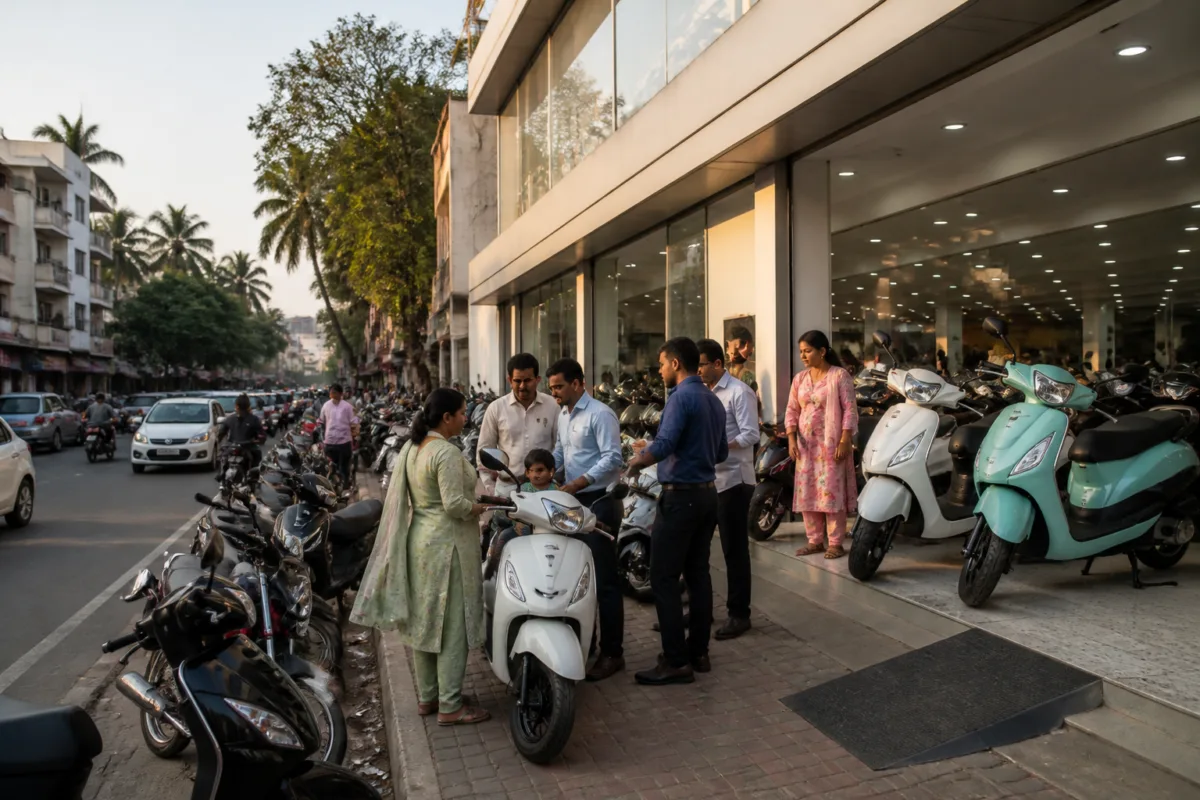
Vehicle registrations in Dakshina Kannada rose sharply during the festive season, with more than 13,800 cars, two-wheelers, autorickshaws, buses and goods vehicles registered across the district in the two months covered by the report. The surge, driven by festive buying, discounts and loan offers, offers a useful view of how household consumption and everyday mobility are changing in one of coastal Karnataka’s most economically active districts.
The figures reported by Prajavani cover September and October, with some registration details extending to October 30. The largest demand was for two-wheelers, including electric scooters, followed by cars. More than 3,100 cars were registered through the Mangaluru, Puttur and Bantwal regional transport offices during the period, according to the report. Mangaluru led the three offices in overall registrations.
This is not merely a seasonal retail story. Vehicle registrations are also a proxy for how residents access jobs, education, markets and services in a district where urban activity is concentrated around Mangaluru but extends through towns such as Puttur and Bantwal. A rise in registrations can indicate stronger purchasing power, but it can also point to the continuing dependence on privately owned vehicles where public transport does not fully match the geography or timing of daily travel.
The report attributes the festive rise to several overlapping factors. Automobile companies offered discounts, banks promoted loan schemes, and families treated vehicle purchases as part of the celebration around Ganesh Chaturthi, Dasara and Deepavali. A showroom employee quoted in the report said vehicle buying typically increases from Ganesh Chaturthi through Dasara and Deepavali, with some customers also waiting for year-end discounts in December. The employee described the 2026 festive period as the strongest sales season in the recent period referred to in the report.
The timing of demand is significant because it concentrates a large number of private vehicle purchases within a short period. The Mangaluru Regional Transport Office reportedly saw registrations double in October compared with September. The report also said Dasara generated the highest registration activity during the period. This pattern links cultural calendars with commercial incentives and household finance, creating a predictable seasonal cycle for dealers, lenders and transport authorities.
The two-wheeler market remains the most visible part of this shift. Prateek Kamath, general manager of Kanchan Honda’s Mangaluru outlet, said about 1,500 scooters and more than 100 Honda Big Wing motorcycles were sold during Dasara. He said scooter sales were around 300 higher than the previous year. The dealership expected another 500 two-wheelers and more than 60 Honda motorcycles to be sold during Deepavali.
These figures describe one dealership’s performance and cannot be treated as the district-wide two-wheeler market. They nevertheless show why two-wheelers remain central to mobility in the region. They are generally easier to purchase than cars, require less parking space and can serve trips across dispersed settlements. The source does not provide household income data, average loan sizes, travel distances or public transport usage, so it cannot establish whether the increase reflects a broad-based rise in mobility access or a stronger concentration of purchases among higher-income households.
Cars formed the second-largest category, with more than 3,100 registrations across the three regional transport offices during September and October. The report said registrations of expensive luxury cars also increased, particularly in Mangaluru. That combination suggests that the festive market was not uniform: it included mass-market two-wheelers as well as higher-value car purchases. The available material does not provide the price-wise distribution of cars or the share financed through loans, limiting what can be concluded about the economic profile of buyers.
The registration data also captures vehicles used for commercial and productive activity. During the two-month period, the district recorded registrations of 30 buses, 390 goods carriers, 30 maxi cabs and 112 motor cabs, according to an official quoted in the report. These categories connect the sales surge to more than personal consumption. Goods carriers support local distribution and trade, while buses and cabs are part of the passenger transport system serving towns, workplaces and institutions.
Commercial vehicle purchases can therefore provide a partial signal of economic activity, but the source does not identify whether the vehicles are replacements or additions to existing fleets. It also does not state how many are intended for operations within Mangaluru, for inter-town travel or for rural routes. Those distinctions matter because the same registration number can represent very different effects on congestion, freight movement and public transport availability.
Electric vehicles appear in the report, but the evidence points to an early and uneven transition rather than a wholesale change in the district’s vehicle market. An official from the Mangaluru Regional Transport Office said interest in electric vehicles had increased in recent years, particularly for autorickshaws and two-wheelers. The report separately states that 28 electric vehicles were registered over the two months, with motorcycles forming the largest group. Registration details cited for Bantwal, however, mention 18 electric cars and 163 electric two-wheelers during the period. Because the source presents these figures in different parts of the report and does not clearly reconcile them, they should not be combined or treated as a single district-wide total.
The available information still identifies the direction of change. Electric two-wheelers are entering the same festive market as conventional scooters, supported by consumer interest and dealership activity. Yet the report contains no information on charging infrastructure, electricity tariffs, battery replacement, operating costs or the availability of service networks. Without those details, registrations alone cannot show whether electric vehicles are becoming a dependable alternative for daily travel or remain a limited purchase category.
The three regional transport offices provide an important administrative lens. Vehicle registration is not only a retail transaction; it is the point at which the transport administration records a new vehicle entering the road system. The offices therefore sit at the intersection of consumer demand, regulatory compliance and road-use growth. The report identifies Mangaluru as the leading office among the three, while Bantwal officials said their jurisdiction recorded its highest level of registrations compared with the previous year.
The geographic distribution matters because the district’s mobility needs are not confined to one urban core. Mangaluru has the largest concentration of reported registrations, while Puttur and Bantwal represent other urban and semi-urban centres with their own commuting, commercial and service networks. A district-wide rise can consequently increase pressure on roads and parking in multiple places, not only in Mangaluru. The supplied report does not include road capacity, parking supply, congestion measurements or accident data, so the direct infrastructure effect cannot be quantified from these figures alone.
The numbers also need careful handling. The report gives a headline figure of more than 13,800 registrations and provides office-level and vehicle-category details, but parts of the published table are difficult to read and do not present every category in a fully consistent format. The clearest conclusion is therefore that registrations rose substantially during the reported festive period, that two-wheelers dominated, that cars were a major secondary category and that commercial vehicles formed a smaller but significant component. A precise category-by-category district total would require the underlying transport-office records.
For urban policy, this distinction is important. Rising vehicle ownership can improve access for families and businesses, particularly where public transport is limited or unsuitable for dispersed travel. At the same time, a sustained increase in private vehicles can create additional requirements for road space, parking management, traffic enforcement and safe movement for pedestrians and cyclists. The source does not claim that the festive sales surge has caused congestion or safety problems, and those outcomes should not be inferred without supporting evidence.
The report instead shows how mobility demand is being expressed through the market. Families are buying vehicles for convenience, status, work and personal travel; dealerships are using discounts and seasonal demand; banks are supporting purchases through loan offers; and transport offices are recording the resulting expansion of the vehicle fleet. The system is distributed across private companies, financial institutions, consumers and government transport offices rather than being controlled by a single urban agency.
That institutional structure also explains why registration data is useful but incomplete. Regional transport offices can show how many vehicles have entered the registered fleet, but they do not by themselves explain where those vehicles travel, how often they are used, whether they replace older vehicles or how much road space they occupy. Those questions require additional information from traffic authorities, public transport operators, parking agencies and household travel surveys, none of which is provided in the report.
The larger urban question for Dakshina Kannada is whether new vehicle ownership is expanding mobility without a corresponding expansion of transport choices. The festive surge shows that demand for individual mobility is strong. It also shows that the district’s towns are absorbing different types of vehicles, from scooters and cars to buses, cabs and goods carriers. What remains uncertain is how this growth is distributed across income groups and locations, and how much of it reflects unmet demand for reliable public transport.
The evidence confirms a strong seasonal increase in vehicle registrations, led by two-wheelers and followed by cars, alongside registrations of commercial vehicles and some electric vehicles. It does not establish the long-term annual trend, the impact on congestion or the future pace of electric adoption. Those are the indicators that merit monitoring as the district’s transport offices complete the festive-season record and as buyers, dealers and authorities respond to the next phase of vehicle demand.

