


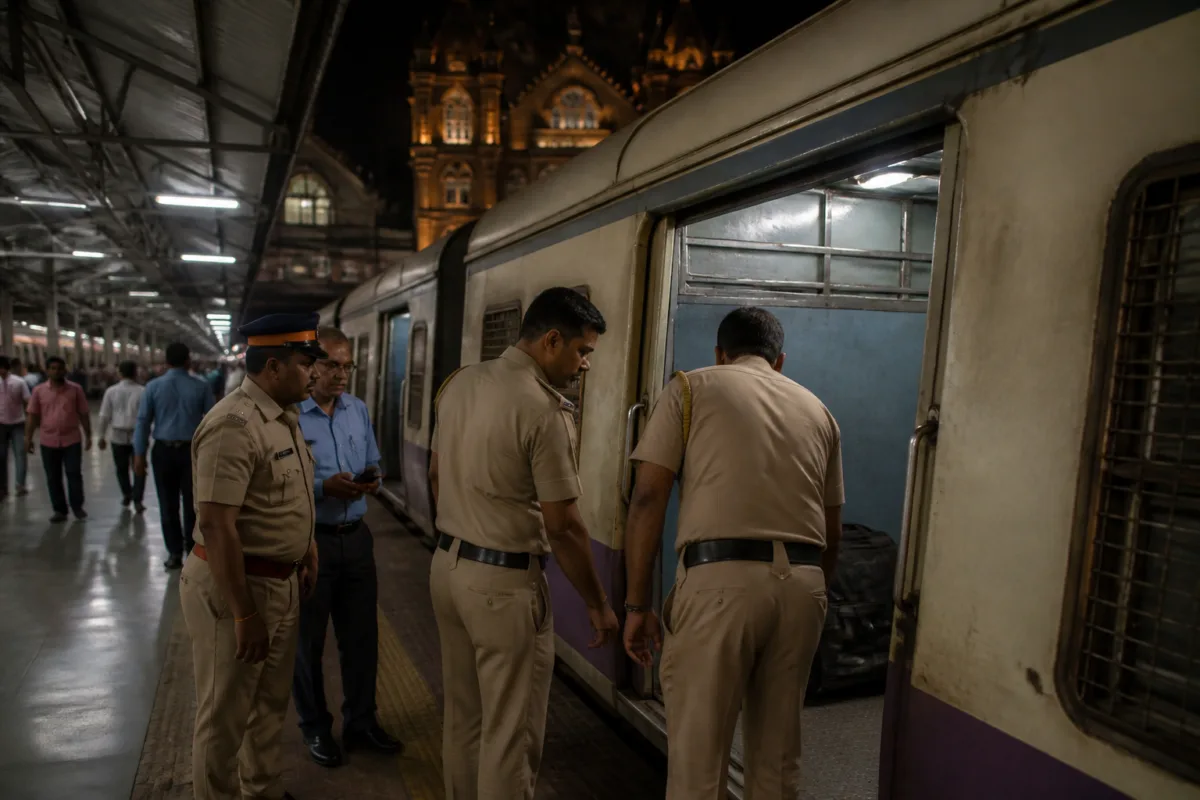
The acquittal of Mohammed Shaikh in the CSMT train murder case has brought the focus back to a less visible part of Mumbai’s railway system: the chain of investigation that begins on a crowded suburban network and ends in court. The sessions court found that the prosecution had failed to establish a reliable chain of circumstances linking Shaikh to the death of commuter Niraj Jaiswar, while also pointing to serious deficiencies in the handling and identification of CCTV evidence.
The ruling, reported by the Times of India, does not dispute that Jaiswar died an unnatural death. Medical evidence established that he suffered multiple stab injuries and died of shock before admission to Sion Hospital. The central failure was different: the prosecution could not prove beyond reasonable doubt that Shaikh was responsible for the assault, robbery and alleged destruction of evidence.
That distinction matters in a railway environment where investigations often depend on reconstructing movement across stations, trains, platforms and adjoining public spaces. The prosecution case relied on footage from Govandi, Kurla and Dockyard Road railway stations, as well as video from a tea stall near GTB station. It also relied on the alleged recovery of a knife, clothes, a wallet and identity documents, along with forensic material. The court found that these pieces did not form a legally dependable chain.
The case arose from events on March 29, 2021. According to the prosecution, a local train from Panvel arrived at CSMT at about 10.47 pm with an injured man in its luggage compartment. Before railway staff and police could attend to him, the train departed towards Panvel. A station official alerted Wadala railway station, where constable Ranjit Mane entered the luggage compartment, found the injured man and moved him to Sion Hospital. He was declared dead before admission.
The prosecution alleged that Shaikh had robbed Jaiswar of his mobile phone and wallet, attacked him with a knife and later attempted to clean the weapon and remove blood from his clothes. But the court said the case was entirely circumstantial and did not satisfy the established test for conviction based on circumstances. There was no direct eyewitness who saw the two men board the same train or travel together. The court also found that no witness established a last-seen circumstance connecting Shaikh with Jaiswar immediately before the death.
The timing of the CCTV material became particularly important. One part of the prosecution case placed Shaikh cleaning a knife between 10.07 pm and 10.55 pm. Other material indicated that Jaiswar was alive at Kurla around the same period and even later. The court observed that the prosecution’s own material showed that Jaiswar was alive between 10.07 pm and 10.21 pm, when Shaikh was allegedly seen cleaning the knife. This inconsistency weakened the sequence that the prosecution needed to establish.
The court also questioned the method used to identify people in the footage. The CCTV material was not shown to family members of the deceased, family members of the accused or an independent witness for identification. Merely recognising individuals in footage, without a reliable identification procedure, was held insufficient. In a city where railway cameras may capture thousands of commuters in a single evening, the difference between recording an image and proving a person’s identity is fundamental.
The ruling also raises questions about the evidentiary chain created after an alleged recovery. Articles connected to the case, including a knife, were allegedly recovered from the house of Shaikh’s brother. Yet the brother was not examined as a witness and his statement was not recorded. The judge observed that he would have been the best witness to establish Shaikh’s knowledge, conscious possession or control over those articles.
Electronic evidence presented another institutional weakness. Except for a certificate relating to the tea stall footage, the prosecution had not produced mandatory certificates for CCTV footage retrieved from Govandi, Kurla and Dockyard Road stations. It also lacked certificates for copying data from pen drives into DVDs. The court’s observation is significant because railway investigations increasingly depend on digital records, but the usefulness of a recording depends not only on its existence. The process of retrieval, copying, certification, preservation and presentation must also be established.
The court’s criticism therefore extends beyond one disputed video clip. It concerns the administrative path through which evidence moves from railway premises to a police file and then to a courtroom. A camera may record an event, but investigators still have to demonstrate when and how the footage was obtained, whether it is complete, whether it has been altered, who identified the persons shown and how the digital copy was created. The judgment, as reported, indicates that these procedural steps were not adequately documented for much of the CCTV material.
For Mumbai’s suburban railway, this is a particularly important issue. The railway is both a transport network and a series of highly surveilled public spaces. Stations such as CSMT, Kurla, Govandi and Dockyard Road connect large commuter flows, multiple jurisdictions and different operational authorities. When an incident occurs across that network, responsibility for securing footage, recording witnesses and preserving physical evidence must operate quickly and consistently.
The case also shows the limits of forensic material when it is not supported by other evidence. The doctor who examined the knife could not absolutely confirm that it was the weapon used in the offence. Blood grouping on the knife was inconclusive and there was no conclusive DNA report. A forensic report also found no blood on the cloth allegedly used by Shaikh to clean the knife. The court said the investigating officer’s admission about the absence of blood went to the root of the case.
Medical evidence proved the nature of Jaiswar’s death, but it did not identify the person responsible. This is a crucial distinction in circumstantial cases. Each individual fact may appear suspicious, but the prosecution must show that the facts fit together and exclude reasonable alternatives. Here, the court found that the circumstances did not complete that chain.
The acquittal came after Shaikh had spent more than five years in jail. The defence, led by advocate Wahab Khan, argued that he had been falsely implicated. The sessions court acquitted him of robbery, murder and destruction of evidence, stating that the investigation appeared to have been conducted in a manner that raised suspicion and seemed aimed at implicating the accused.
That observation places the case within a wider governance problem: public safety depends not only on preventing crime but also on producing investigations that can withstand scrutiny. A railway police system may respond quickly at the scene and still fail later if witness statements are incomplete, digital evidence is improperly certified or physical recoveries are not tied to a clearly documented chain of possession.
The available material does not establish whether the deficiencies identified by the court reflect a wider pattern across railway investigations in Mumbai. It does, however, identify specific points at which the case broke down: inconsistent timings, weak identification of CCTV subjects, missing electronic-evidence certificates, the non-examination of a material witness, inconclusive forensic findings and the absence of a direct or last-seen witness.
The larger urban question is how a city can make its transport infrastructure safer while ensuring that surveillance and investigative systems remain legally reliable. Cameras, station records and forensic tools are often treated as automatic solutions. This judgment demonstrates that they are only as effective as the procedures governing their collection, interpretation and presentation.
What the acquittal confirms is that the death of a commuter was established, but the prosecution did not establish Shaikh’s guilt to the required standard. What remains unresolved in the supplied material is whether the investigative failures were corrected institutionally after the case. For Mumbai’s railway network, the next important measure will not simply be the number of cameras or recordings available, but whether evidence from those systems can be preserved, identified and proved through a transparent chain from station to courtroom.

