


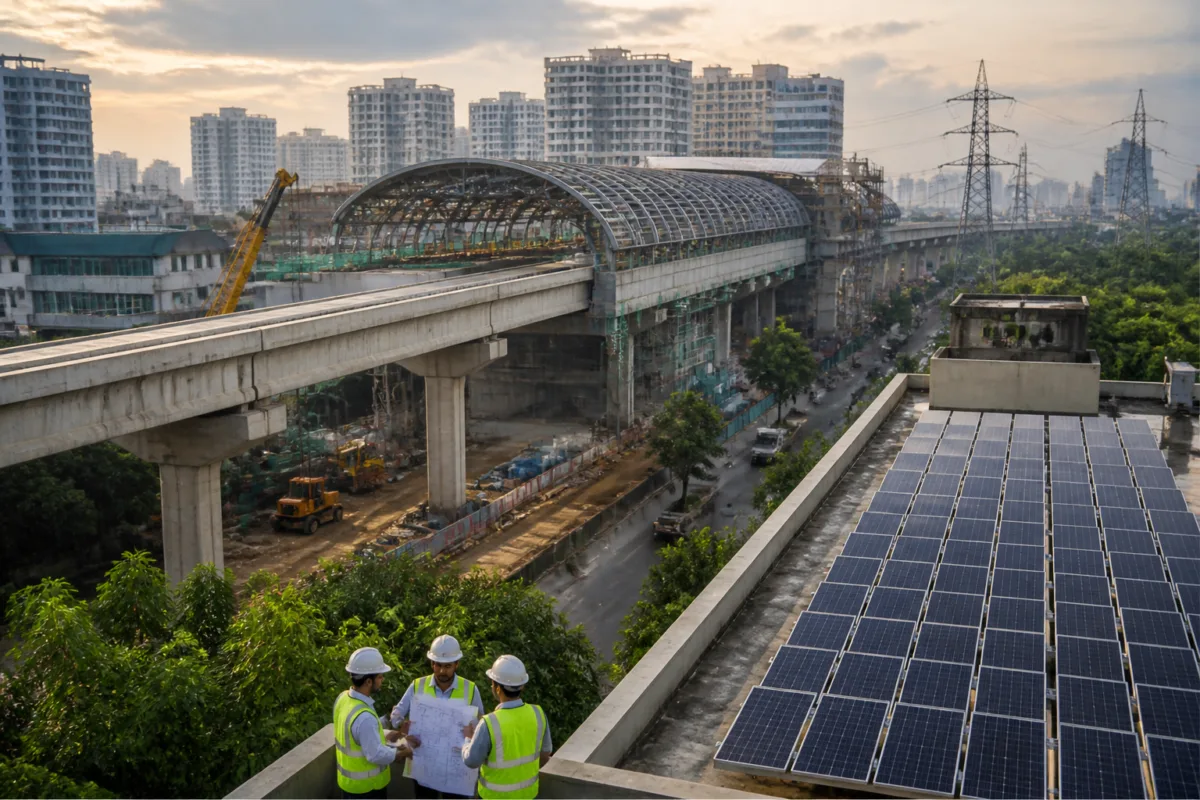
India’s ability to finance infrastructure, renewable energy, housing and climate resilience will depend on a much larger pool of long-term capital, according to a reform proposal submitted by the Confederation of Indian Industry (CII) as a government-appointed banking committee began consultations with stakeholders.
CII said India would need close to $106 trillion in financial assets by 2047 to support a projected $26.5 trillion economy. That compares with approximately $7 trillion in financial assets today, according to the industry body’s internal analysis. The estimate covers institutional credit and securities, including banking, insurance, pension and corporate bond assets.
The scale of the proposed expansion has direct implications for the built environment. Infrastructure projects, renewable-energy facilities, housing finance and urban services typically require capital that is available over longer tenors than conventional short-term lending. CII said Indian banks, insurers, pension funds and the corporate bond market would all need to grow faster to meet that requirement.
The recommendations were made as the high-level committee on banking for ‘Viksit Bharat’ started consultations. The government constituted the panel last month to consider structural, institutional, regulatory and legislative reforms intended to create a financially inclusive and resilient sector by 2047.
CII proposed 15 priority reforms spanning banking, non-banking finance companies (NBFCs), capital markets, insurance and financial technology. Several of the proposals could affect how projects and smaller businesses access finance, although they remain recommendations and are not government decisions.
For renewable energy, CII called for the priority-sector lending limit to be raised from ₹35 crore to ₹100 crore per borrower. It said the change would allow medium-sized projects to qualify for the framework. The industry body also recommended including circular-economy activities such as recycling and battery reuse within priority-sector treatment.
These measures could broaden formal lending for projects that support energy transition and resource recovery. However, the source report does not indicate whether the government or the Reserve Bank of India has accepted the proposals, or how eligibility and risk would be assessed if the limits were changed.
CII also sought reforms to encourage long-term capital for infrastructure and widen the investor base for corporate bonds. A deeper bond market could offer project sponsors an alternative to bank loans, but the proposal would require changes in investor participation, regulation and risk assessment. The report does not specify the implementation mechanism or a timetable.
Housing finance companies and other NBFCs were another focus. CII proposed a permanent, rule-based liquidity and refinance window for well-governed NBFCs, with access linked to compliance status, collateral standards and eligibility filters. It said NBFCs account for about 23% of credit and that roughly 45% of their borrowings come from banks.
According to CII, a standing facility could reduce rollover pressure during periods of market stress and help prevent a contraction in credit to micro, small and medium enterprises and retail borrowers. The proposal is particularly relevant to housing and smaller urban businesses because NBFCs and housing finance companies are important channels for borrowers that may not rely exclusively on conventional bank lending.
The industry body also recommended restoring input tax credit for insurers and creating a national catastrophe and climate risk pool. The proposed pool would pre-fund disaster losses rather than leaving public finances to absorb the costs after an event. CII did not provide an estimated size for the pool or specify which disasters, assets or levels of government would be covered.
Such a mechanism would place climate and disaster risk closer to the point of financial planning for infrastructure and urban development. Its effectiveness would depend on the design of premiums, public guarantees, payouts and project-level risk standards, none of which were detailed in the report.
CII further urged the government to finalise a climate-finance taxonomy based on the draft framework released in May 2025. It said a common classification would give lenders and exporters a reference for climate-related finance as carbon-border measures take effect in key markets. The source does not state when the taxonomy may be finalised.
On digital public infrastructure, CII proposed extending the account-aggregator framework to public datasets such as land records, e-Mandi transactions and ration-card data, subject to safeguards. Wider use of such datasets could affect property, agricultural and credit-related services, but the proposal raises questions about consent, data quality, institutional responsibility and access controls that the report does not resolve.
The recommendations also include a certified automated video know-your-customer process instead of requiring an official’s physical presence at every session. CII said this could lower onboarding costs in underserved areas. Other proposals cover business-interruption protection in government-guaranteed MSME loans, wider priority-sector treatment for export credit and changes to bank ownership and voting rights.
CII director general Chandrajit Banerjee said the reform task was to build a system capable of financing an economy several times its current size, with longer-tenor capital, credit for growth sectors and regulation that keeps pace with financial technology. The government-appointed committee’s consultations will determine which, if any, of the industry body’s proposals are taken forward.

