


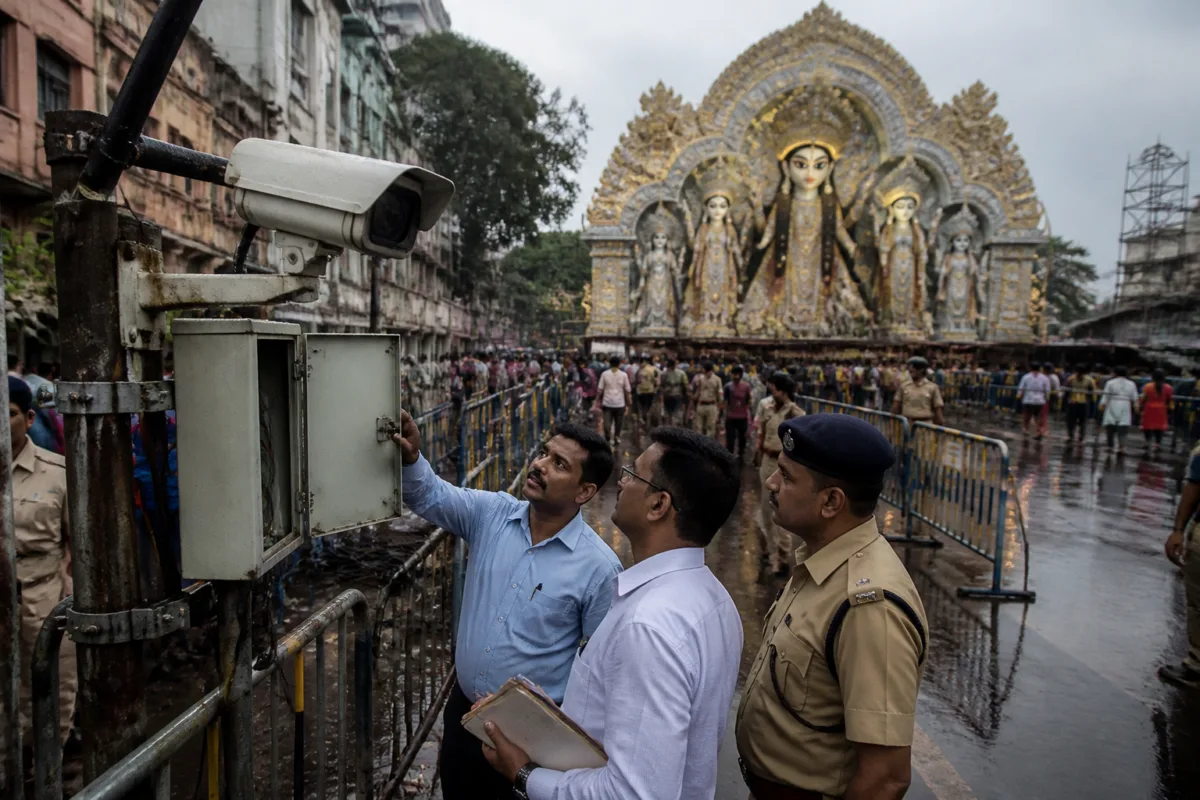
The investigation into the Chorebagan stampede, in which 19 people died and 25 were injured on October 17, has been complicated by the unavailability of footage from 16 of the 32 CCTV cameras installed around the Durga Puja pandal. Police say the missing recordings are important to establish how the crowd surge developed and what triggered the tragedy.
A senior police officer told PTI that investigators had not been able to locate footage from half of the cameras installed at and around the venue. Police are making efforts to obtain the recordings, which could help reconstruct the sequence of events before and during the stampede-like situation.
The case exposes a basic weakness in the management of high-footfall public venues: surveillance systems may be installed, but their value depends on continuous recording, secure storage and rapid access after an incident. In this case, the unavailable footage has become a central investigative issue because the reported trigger was not a single physical obstruction but a chain of crowd reactions around a warning that the pandal was allegedly collapsing.
According to the police account cited in the report, an announcement urged people to leave the pandal and warned those outside not to approach it. Videos from the venue reportedly captured repeated appeals for the exit gates to be opened. The announcement is now being examined to determine who made it and what information prompted it.
The reported crowd conditions help explain why the announcement may have produced a dangerous movement pattern. People inside the pandal were said to have remained there to avoid the rain, while the queue outside continued pressing forward. This created pressure from both sides. Police have also said that the gates and approach road were too narrow, security personnel were inadequate and there was no clear plan to manage the large number of visitors.
These details place the investigation beyond the question of who made the announcement. They raise questions about the entire crowd-management system: the design of entry and exit routes, the separation of incoming and outgoing movement, the authority to issue emergency instructions, the staffing of private security and civic personnel, and the ability of organisers and police to communicate consistently during a crisis.
Police have summoned pandal designer Sushanta Shibani Pal and 12 personnel deployed at the venue on the night of the incident. Investigators are expected to question Pal about the pandal’s design and construction, arrangements for visitors and the layout intended to facilitate crowd movement. Personnel stationed outside the pandal and near its entry and exit points have also been asked to appear before investigators.
Three eyewitnesses were summoned to record their statements, while police have so far recorded statements from around 60 people. The witnesses include injured visitors, home guards, civic volunteers, private security personnel and local residents. Nine people have been arrested in connection with the stampede, according to the report.
The composition of the evidence is significant. CCTV footage could provide an objective timeline of crowd movement, gate operations and the actions of security personnel. Eyewitness statements can fill gaps in the recordings, but they may differ because people experienced the incident from different locations and under highly stressful conditions. The investigation will therefore depend on how the police reconcile video, testimony, call or announcement records and the physical layout of the venue.
The West Bengal government has constituted a six-member Special Investigation Team headed by retired Justice Anindita Roy Saraswati. The team has been asked to submit its findings and recommendations within three months. The inquiry is expected to examine both the immediate trigger and the organisational decisions that shaped visitor movement at the pandal.
The administration has also asked several major Kolkata puja organisers, including Tala Pratyay, Alipore Sarbojanin, Chetla Agrani and Ballygunge Sarbojonin, to temporarily stop admitting visitors. That step indicates that the incident has prompted scrutiny of crowd-control arrangements beyond the Chorebagan venue, although the supplied report does not specify the duration or detailed conditions of the restriction.
The report also records an announcement of compensation of Rs 25 lakh and government jobs for the families of those killed, along with Rs 5 lakh for each injured person. It states that the government would bear the medical treatment costs of the injured. However, the report attributes these announcements to Suvendu Adhikari while identifying him as chief minister. That attribution requires confirmation before the political and administrative responsibility for the compensation and inquiry can be stated as settled fact.
The Chorebagan case shows why public-event safety cannot rely only on visible barricades, installed cameras or the presence of security personnel. A functioning system must also define who can alter crowd movement, how emergency announcements are authenticated, how gates are opened, and how video evidence is preserved. The supplied police account points to weaknesses across these operational layers, but the final findings of the SIT will be needed to establish responsibility.
For Kolkata’s large public gatherings, the unresolved issue is not merely whether a stampede was caused by a particular announcement. It is whether organisers and authorities had a tested, documented and coordinated plan for managing visitors when weather, congestion, rumours and emergency instructions interacted. The unavailable CCTV footage makes that question harder to answer and increases the importance of the remaining evidence.
The next formal milestone is the SIT’s report, which is due within three months. Until then, the investigation must establish the source of the announcement, reconstruct crowd movement, determine why 16 camera feeds were unavailable and verify the roles of organisers, security personnel and officials present at the venue.

