


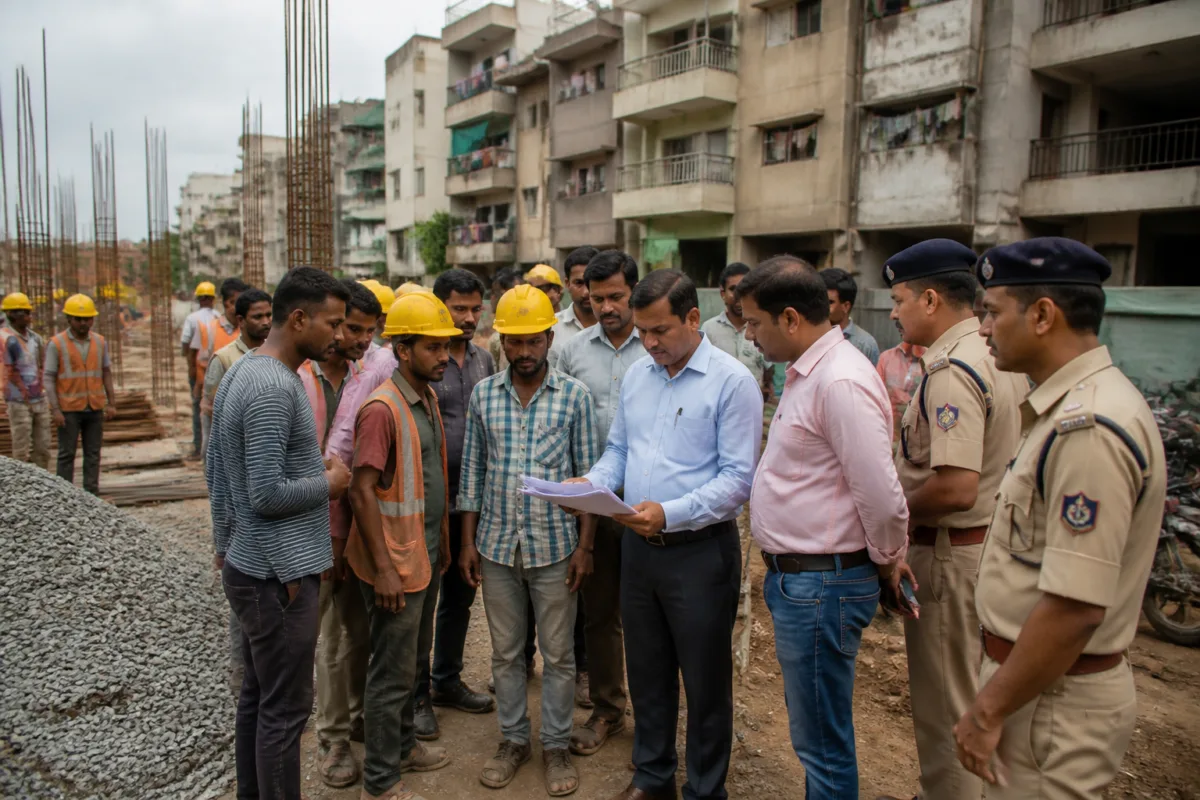
Chhattisgarh’s immigration drive, announced for November 15 to January 15, is not limited to identifying suspected undocumented foreign nationals. It also creates a wider administrative exercise across industrial centres, construction sites, rented homes, hotels, lodges and local government networks. Police have been asked to examine the role of employers, labour contractors, landlords and agents who may have facilitated employment, accommodation or access to forged identity documents.
That design makes the drive significant for the way Chhattisgarh’s cities manage informal labour and temporary housing. The state government has identified Raipur, Korba and Raigarh for particular attention, citing concerns about contractors in industries, road and building construction, cottage industries and jaggery manufacturing units. The proposed process therefore reaches into sectors that depend on mobile workers and intermediaries rather than relying only on conventional police investigation.
The announcement by Deputy Chief Minister and Home Minister Vijay Sharma places nationality verification at the centre of the exercise. Sharma said that prolonged residence in India does not automatically establish citizenship and that Aadhaar, PAN and ration cards are not proof of citizenship. Officials have been directed to verify nationality and legal status in accordance with Union home ministry guidelines and existing laws.
That distinction is administratively important. The documents named by the minister are widely used to access services, establish identity or transact with institutions, but the state government’s stated position is that they cannot by themselves settle the question of citizenship. The drive will consequently require officials to examine the underlying documents and findings of inquiries rather than treating possession of an identity document as conclusive proof of nationality.
The evidence-gathering structure will extend beyond police stations. In rural areas, gram sabhas will collect information about suspected illegal immigrants, while municipal councillors will be involved in towns and cities. The government also plans meetings with councillors and has asked citizens to share information through a toll-free helpline. Officials have said that information received through the helpline will be examined by the appropriate agencies.
This creates a broad reporting chain in which local representatives, residents, employers and accommodation providers become potential sources of information for police verification. The supplied announcement does not specify the evidentiary threshold for opening an inquiry, the safeguards against mistaken identification or the process through which a person can challenge an incorrect allegation. It does, however, direct officers to ensure that investigations are evidence-based and comply with legal provisions.
The most immediate urban consequence may be felt in the labour market. The government has asked employers and contractors to verify workers’ documents before engaging them and has directed police to examine whether labour contractors and middlemen are bringing suspected undocumented workers from other states and arranging employment or accommodation for them. This places additional responsibility on industries and construction-linked businesses that recruit through layered contracting arrangements.
The announcement does not provide figures on the number of suspected undocumented foreign nationals in Chhattisgarh, the size of the workforce that may be screened or the number of employers and worksites expected to fall within the exercise. It refers to suspected involvement in theft cases in Mungeli and Bemetara districts and nine other criminal cases, but it does not establish a general link between suspected illegal immigration and crime. That distinction matters because a verification exercise and a criminal investigation are separate administrative and legal processes.
For construction and industrial employers, the operational question will be how document checks are conducted and recorded. The government has not announced a single standard form, deadline or compliance mechanism for employers beyond the direction to verify documents before engagement. Nor has it stated how responsibility will be divided between principal employers, labour contractors and intermediaries when workers are hired through multiple layers.
The same uncertainty applies to rental housing. Landlords have been directed to obtain and verify tenants’ identification documents before renting out properties. A tenant-verification app developed for sharing such information with police will be activated and used more extensively. The proposed system could create a common channel between landlords and police, but the supplied announcement does not explain what information the app will retain, who can access it, how long records will remain available or how incorrect entries will be corrected.
Hotels, lodges, dharamshalas and other accommodation providers will also come under scrutiny. Legal action is proposed against those knowingly sheltering undocumented foreign nationals. The word “knowingly” is important because it indicates that the government’s stated focus is not simply on the existence of a person’s accommodation, but on whether the provider was aware of and facilitated an unlawful stay. The announcement does not specify the penalties or the procedure for determining that knowledge.
The planned software for cross-district records is another important part of the initiative. It is intended to maintain information about individuals under verification, their documents and the findings of inquiries conducted by different police units. Police in one district will be able to access verification details recorded elsewhere, with the stated goals of reducing duplication and helping investigators trace networks allegedly involved in facilitating illegal migration.
In administrative terms, this would shift the exercise from isolated district-level checks to a shared state database. That may help investigators avoid repeating the same inquiry when a person moves between districts or when multiple units examine the same contractor or accommodation network. At the same time, the announcement does not establish how records will distinguish between an unresolved suspicion, an ongoing inquiry and a legally established violation. That classification will determine how information is interpreted by police and other agencies.
The proposed system also reveals the state’s understanding of the problem: not only as a question of individual entry or residence, but as a network involving recruitment, transport, employment, housing and identity documents. The focus on contractors, agents, landlords and employers means enforcement is being designed around the institutions that connect mobile workers to urban economies. Raipur, Korba and Raigarh have been identified because of their industrial and construction activity, although the drive itself is statewide.
The involvement of gram sabhas and municipal councillors adds a local-government layer to what is otherwise a police-led verification process. In cities, councillors may have access to neighbourhood-level information about rented accommodation and temporary settlements, while rural gram sabhas may provide community-generated information. The supplied material does not state whether these bodies will conduct verification themselves or only pass information to police. It also does not describe the training or documentation that will guide their participation.
That institutional boundary will matter. The announcement assigns police responsibility for investigation and directs officials to follow Union home ministry guidelines and existing laws, but it also relies on community information and private actors such as landlords and employers. Without clear separation between reporting, verification and enforcement, an allegation collected at the local level could travel through several administrative channels before its accuracy is established. The government’s instruction that investigations be evidence-based is therefore central to the credibility of the exercise.
The drive also brings a question of proportionality into everyday urban administration. Document checks at worksites, rental properties and accommodation facilities can affect people who are not the subject of a criminal case but who share workplaces, homes or neighbourhoods with those under scrutiny. The source material does not provide details about protections for residents, workers or tenants who are wrongly identified, nor does it specify whether affected individuals will receive written reasons for adverse findings.
What is established is the scope and architecture of the government’s plan. A two-month campaign will begin on November 15. Police will identify hotspots, examine suspected networks, verify documents and maintain records across districts. Employers, contractors and landlords will face stronger verification responsibilities. Hotels and other accommodation providers will be examined, while gram sabhas, municipal councillors and citizens will be drawn into information gathering.
What remains unclear is how the state will measure the campaign’s results. The announcement does not set out targets, publish a baseline, identify the number of personnel involved or define the expected number of inquiries. It also does not explain how the planned software will be governed or how records will be closed once verification is complete. Those details will determine whether the exercise becomes a focused investigation into documented cases or a broad, continuing layer of screening across urban labour and housing systems.
The next milestones are the start of the statewide drive on November 15, the wider activation of the tenant-verification app and the development of the cross-district police software. The government has said the campaign will continue until January 15, with investigations conducted under existing laws and applicable Union home ministry guidelines.

