


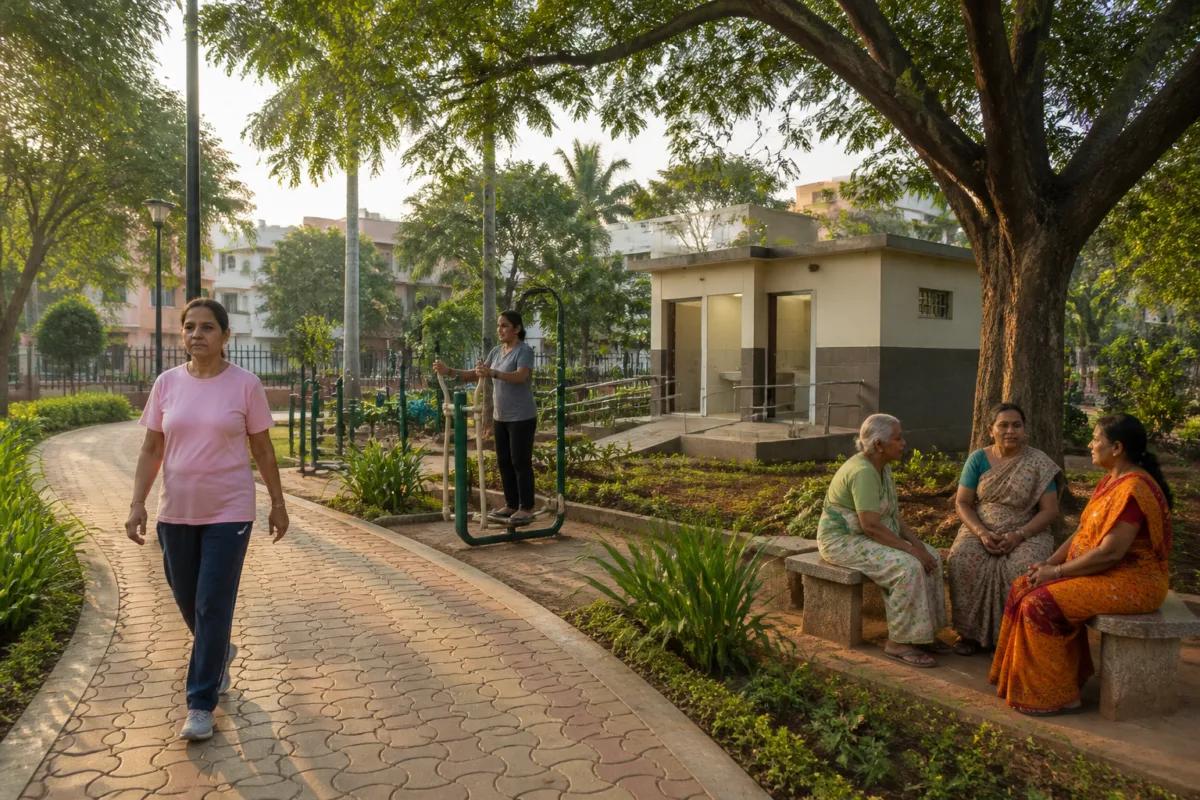
Chennai is preparing to add 36 parks and 11 playgrounds, but residents and urban practitioners say the city’s recreational infrastructure must be judged not only by how many spaces exist, but by who can use them safely, comfortably and consistently.
The 2025 City Biodiversity Index counts 908 parks under different government agencies, covering a combined 213.05 hectares. That inventory records the extent of green space, but does not show whether women feel comfortable using outdoor gym equipment, whether older residents can reach a toilet or whether girls can access playgrounds and sports grounds.
The Greater Chennai Corporation (GCC) is processing tenders for the new parks and playgrounds under the Chief Minister’s Integrated Urban Development Mission. Announced on October 31, the first phase is estimated to cost Rs 43.97 crore. The projects will cover nine zones for parks and four zones for playgrounds.
The expansion comes as the city’s existing parks remain predominantly small neighbourhood spaces. An analysis of park-wise area figures in the 2025 City Biodiversity Index found that half of Chennai’s 908 parks measure less than 0.13 hectares, while 92% occupy less than half a hectare. Only 30 parks measure one hectare or more. Secretariat Park is among the larger spaces, covering approximately 6.08 hectares.
For many women, these smaller parks provide low-cost places to exercise, rest and meet others close to home. Greeshma Kuthar, a journalist who has lived in several Chennai neighbourhoods, said parks were important for exercise before she could afford a gym. She described them as demarcated spaces where people could work out without paying for a gym, while also offering shade and opportunities for social interaction.
Shailaja, a teacher who has lived in Chennai for almost 15 years, said visiting neighbourhood parks had become part of her morning routine. She told The New Indian Express that women of different age groups, including some over 80, were among her companions. For her, parks offered exercise, fresh air and a break from daily pressures.
Access to open space, however, does not automatically mean equal access to every activity. Kuthar said she had tried to organise a game of kho-kho with friends but found it difficult to identify a Corporation ground where women could occupy the space. She suggested reserving some time for women or creating Corporation grounds for women in different parts of the city.
Vanessa Peter, founder of the Information and Resource Centre for Deprived Urban Communities, opposed exclusive parks as a general solution. She argued that parks should be accessible to everyone, while taking account of age, disability and other differences in need. Her position points to a wider design question: improving access may require better facilities and management across ordinary neighbourhood parks, rather than relying only on separate spaces.
GCC’s own data indicates a difference in how men and women use parks. A month-long online survey by the Corporation’s Gender and Policy Lab, with 567 respondents, found that 43% of male respondents visited parks daily, compared with 29% of female respondents. The Corporation’s Inclusive Design Manual, published in May 2025, records women as 30% of park users and men as 70%. It also says men predominantly visit between 6 am and noon, while women tend to visit after 6 pm.
Those patterns make lighting, seating, security and accessible facilities central to park planning. They also show why counting parks alone cannot establish whether the city’s public-space network serves residents equitably. A park that is technically nearby may still be difficult to use if its toilets are poorly maintained, its equipment is not functional or its approach is uncomfortable after dark.
Maintenance is another important gap. The inventory lists 161 parks directly managed by the GCC, 621 outsourced to third parties and 120 maintained through adoption. Three are maintained by self-help groups and two by Chennai Metro Rail Limited. However, the inventory does not state how many outdoor gym machines are functional, how frequently they are inspected or how many women and people with disabilities use them.
Residents also described differences between neighbourhoods. Peter said parks in low-income areas such as Kannagi Nagar were often less maintained than those in affluent areas such as T Nagar and Mylapore, based on an audit she conducted in the resettlement site. Kuthar emphasised that parks are particularly important for families who cannot spend money at cafés, restaurants or gyms.
The challenge for the GCC, therefore, extends beyond building the 36 proposed parks and 11 playgrounds. The reported evidence suggests that the usefulness of each space will depend on design, maintenance, operating practices and the ability of different groups to share it. Toilets, seating, lighting, functioning equipment and grounds that women can occupy are not secondary additions; they determine whether public recreational infrastructure works in daily life.
The New Indian Express said it contacted the GCC Parks and Playfields Department for details on maintenance and plans to improve women’s access to recreational spaces, but the department did not respond before publication.

