


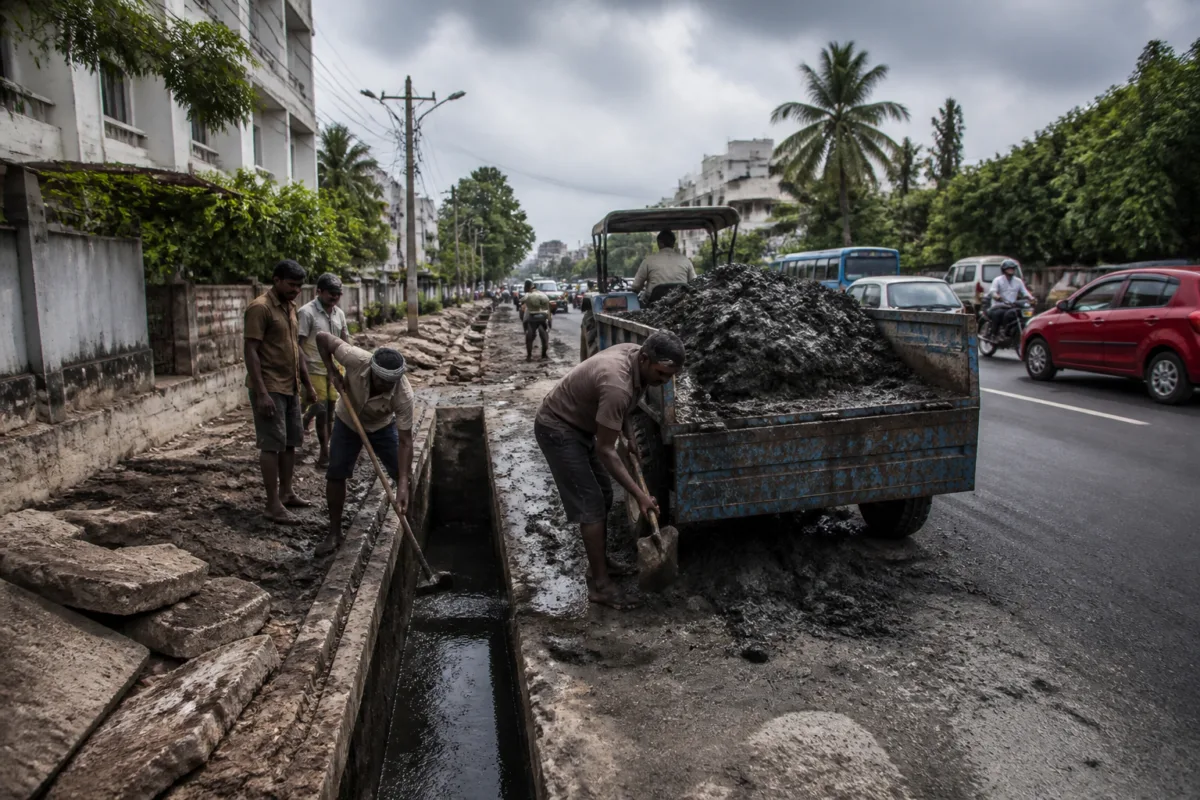
Chennai’s monsoon preparedness has exposed a familiar urban failure: the city’s ability to withstand heavy rain depends not only on stormwater infrastructure, but also on whether departments plan, fund and complete routine maintenance before the weather turns difficult. In comments reported by The Hindu, Chennai Mayor R. Priya said the major review meeting for monsoon preparedness was held only in October, while desilting began towards the end of August instead of starting in June.
The concern is not limited to a missed meeting or a delayed work order. It points to a short preparation window in which several activities—drain desilting, road repairs, road-cutting controls and inter-departmental coordination—must be completed together. If one part of that chain is delayed, the effectiveness of the others can be reduced. A drain that has been desilted but is blocked again by dumped material, for example, cannot perform as intended when rain arrives.
The mayor told The Hindu that monsoon preparedness meetings were usually held in July or August in previous years. Her contention is that a major review in October leaves too little time before the northeast monsoon, when Chennai typically faces heavy rainfall. The timing matters because preparedness is not a single construction activity. It requires identifying vulnerable locations, mobilising funds, coordinating agencies and completing works before road access and working conditions become more difficult.
The city’s drainage system therefore has to be understood as an operational network rather than a collection of isolated projects. Desilting, disposal of excavated silt, road restoration and monitoring of road cuts are linked tasks. The report shows how weaknesses in one stage can undermine the public value of another. When silt removed from stormwater drains is left on roads, rain can wash it back into the drains or spread it across roads and surrounding areas, according to the mayor. The result is a cycle in which maintenance activity itself can create a fresh obstruction.
The issue also illustrates why deadlines are important but insufficient. Residents in Choolaimedu and Pulianthope had complained about excavations continuing beyond the September 30 deadline. The deadline is intended to ensure that road-cutting work is completed before the rains. The mayor acknowledged that extensions may sometimes be granted through special approval, but said works should not routinely continue into the monsoon.
This distinction is central to municipal administration. A deadline is meaningful only when there is monitoring, a clear approval process for extensions and an accountable mechanism for restoring roads. Without those elements, the date becomes an administrative target rather than an operational safeguard. For residents, the consequences are practical: unfinished excavations can affect road usability, drainage performance and access during heavy rain.
The funding question adds another layer to the problem. The mayor said inadequate allocation for civic maintenance was a major concern and noted that even temporary road patchwork requires materials such as bitumen. Officials, she said, were concerned about undertaking work without clear funding allocations because of the possibility of audit objections later.
This is an institutional constraint that routine monsoon coverage often misses. Municipal maintenance is not simply a matter of identifying a damaged road or a clogged drain. Officials must also have an authorised budget, procurement access and administrative clarity about who can approve and execute the work. When funds are uncertain, even relatively small interventions can be delayed. The effect is cumulative: a series of minor unfinished works can reduce the city’s ability to respond when rainfall intensifies.
The report does not establish the total amount of funding required, the number of drains left incomplete or the precise extent of road damage. Those gaps are important because they limit how far the problem can be quantified. The available evidence, however, identifies a sequence of reported administrative weaknesses: late review, delayed desilting, improperly handled silt, unfinished road-cutting works and uncertainty over maintenance funding.
The sequence also shows why monsoon preparedness cannot be treated as an annual emergency exercise. Planning begins before the first major rainfall, but implementation requires coordination across functions that may operate under different authorities and timelines. Drainage work, road restoration and excavation control may involve separate officials, contractors or agencies. The mayor’s call for advance planning and inter-departmental coordination highlights the need to align these responsibilities before the deadline pressures become acute.
The September 30 road-cutting deadline provides one example of this coordination challenge. It is designed around the weather cycle, but its effectiveness depends on whether agencies and contractors complete works in time and whether exceptions are tightly controlled. If road cuts continue beyond the deadline, the city must manage not only the original infrastructure work but also its interaction with rainfall, traffic and drainage. The report does not specify how many extensions were granted or which agencies were responsible for the works, leaving those questions open.
The same problem applies to desilting. Starting work late reduces the time available for completion, but completion alone is not enough. Silt must be removed from the drainage system and placed where it will not return to the network or obstruct roads. This makes disposal and post-work monitoring part of preparedness, not peripheral tasks. The mayor’s account suggests that the quality of execution and supervision is as important as the announcement of a desilting programme.
Chennai’s monsoon preparedness therefore offers a broader lesson about urban resilience: resilience is built through ordinary maintenance systems. Major drainage projects may attract attention, but the city’s immediate performance during heavy rain can also depend on whether existing drains are cleared, roads are restored and construction-related obstructions are removed. These activities are less visible than new infrastructure, yet their timing and execution determine whether the existing network remains usable.
The evidence also places municipal finance at the centre of climate resilience. A city may have identified the work required, but without timely allocations it cannot reliably purchase materials, pay contractors or complete repairs. At the same time, officials must be able to demonstrate that spending is authorised and properly documented. The mayor’s reference to audit objections shows how financial accountability and operational urgency can come into tension when routine maintenance is not funded clearly in advance.
For residents, the institutional distinctions are largely invisible. They experience the combined outcome: water moving through or backing up from drains, roads remaining usable or becoming hazardous, and excavations being closed or left open during rain. That is why monsoon preparedness is ultimately a test of administrative coordination rather than a single department’s performance.
What the supplied evidence confirms is that Chennai’s preparation was criticised for beginning late, with reported deficiencies in desilting, silt disposal, road repair and funding clarity. It does not establish the full citywide scale of the shortcomings or the eventual impact of the reported delays. The next questions for public accountability are whether the pending works were completed, how extensions were authorised, where removed silt was deposited and whether maintenance funding was released in time. Those details will determine whether the concerns identified by the mayor represented isolated delays or a wider weakness in Chennai’s annual preparedness system.

