


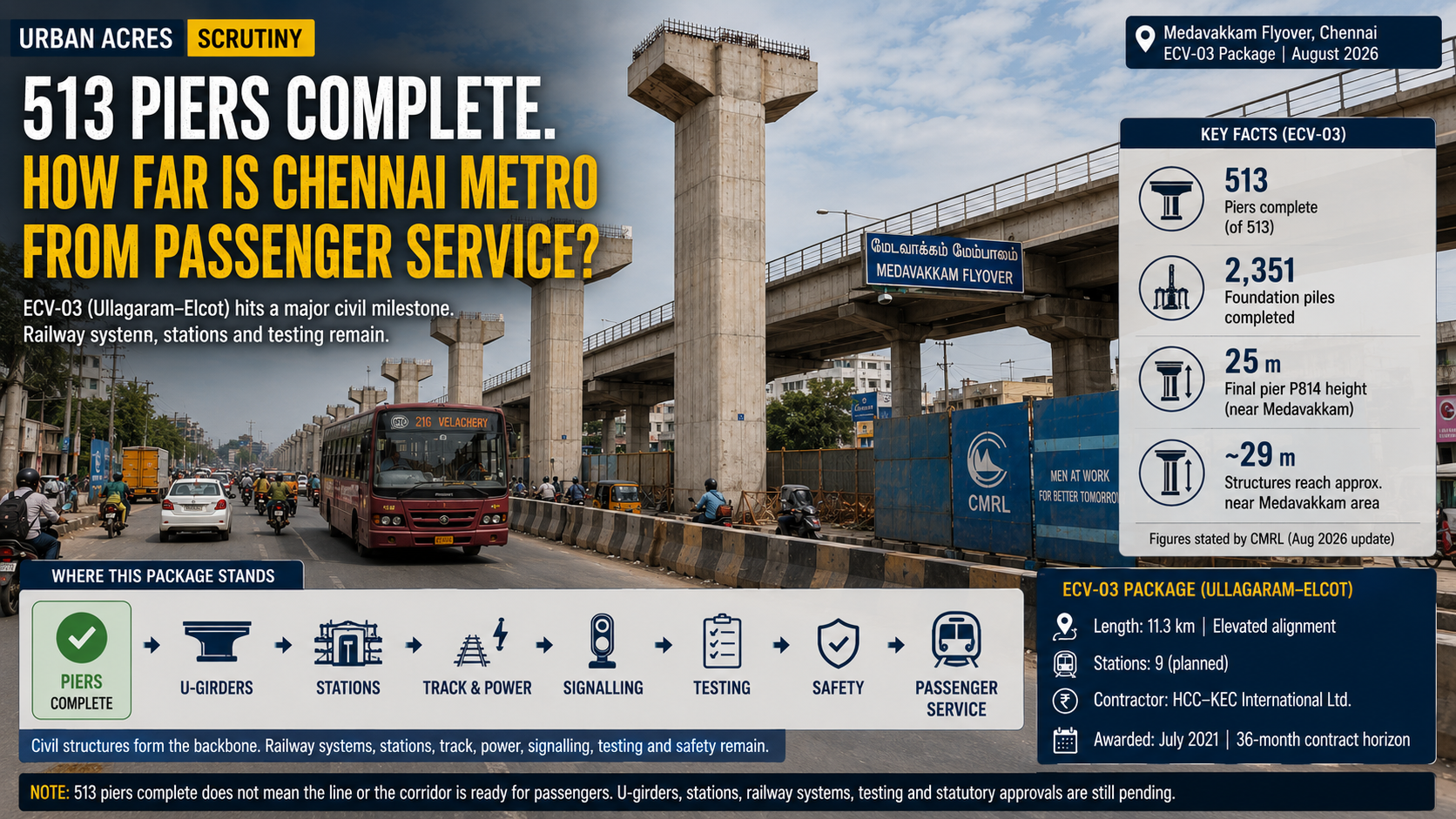
CMRL has cast the 513th and final pier on the Ullagaram–Elcot section of Phase II Corridor 5. The civil milestone is significant, particularly around the complex Medavakkam flyover crossing, but it does not complete the viaduct or establish when passengers will be able to use the section.
Chennai Metro Rail Limited has completed all pier construction on one of the principal elevated civil packages at the southern end of Phase II Corridor 5, closing a major structural stage while leaving several layers of construction and railway systems unfinished.
The final structure, Pier P814, is approximately 25 metres high and stands beside the future Medavakkam-1 station. According to CMRL, it is the 513th pier on the roughly 11.3-km Ullagaram–Elcot section and the package’s foundations comprise 2,351 piles.
That distinction matters. All piers are complete; the Metro section itself is not.
CMRL says erection of the remaining U-girders and construction of station buildings are continuing. Only after the civil structure is sufficiently complete can the complete passenger railway chain—track, traction and electrical systems, signalling, telecommunications, station equipment, integrated testing, safety processes and operational commissioning—translate the concrete milestone into usable public transport.
Medavakkam is an unusually complex part of the package
The most notable engineering work lies around Medavakkam.
CMRL says some piers between Medavakkam Koot Road and Semmozhi Salai reach approximately 29 metres. The elevated Metro passes above the existing Medavakkam flyover and incorporates a 57-metre steel girder span on a horizontal curve of roughly 125 metres radius. The two Medavakkam stations in this stretch are likewise being constructed at a high elevation.
This is more consequential than a routine count of concrete columns because the project has had to insert another major transport structure into an already constrained road-and-flyover environment while maintaining movement through a dense commercial corridor.
CMRL has documented traffic diversions for the ECV-03 package on Medavakkam Main Road dating from July 2023. Whether every diversion listed on that older page remains operative today is not established by the record reviewed.
The more important question is the delivery timeline
The package was not conceived as an open-ended construction programme.
AIIB’s contract-award documentation records C5-ECV-03 as an approximately 11.61-km viaduct and station contract with a duration of 1,095 days, or three years.
Hindustan Construction Company announced the award in November 2021 and similarly said the project was to be completed in 36 months.
The completion of the final pier in August 2026 is therefore clearly later than the delivery horizon publicised when the contract was awarded.
That does not, by itself, establish contractor fault.
Large urban rail contracts can be affected by access constraints, utility relocation, design interfaces, traffic requirements, land availability, changes in scope, exceptional structures and formally approved extensions of time. CMRL itself describes the Medavakkam crossing as particularly difficult.
The accountability gap is different: Urban Acres could not locate a clear current public disclosure showing the approved revised contractual completion date for ECV-03, the extensions granted, their causes, or the corresponding financial consequences.
Without that information, commuters can see physical progress but cannot readily judge schedule performance.
An older CMRL programme shows how much the timetable has moved
An implementation schedule included in CMRL’s environmental documentation, dated February 2021, initially envisaged completing all piers by August 8, 2022 and proceeding through subsequent viaduct, station, track, systems and testing stages thereafter.
That schedule must be handled carefully. It assumed a July 2021 contract commencement, whereas the award was ultimately announced months later. It is therefore not a fair current contractual deadline.
But the document remains useful for understanding the original sequencing: pier completion was intended to occur early in the package, not at the end of the railway-delivery process.
The current milestone should therefore be reported as a catch-up and sequencing point—not as evidence that passenger opening is imminent.
The money also needs precise treatment
Two figures circulate around the ECV-03 award.
AIIB’s official contract notice records approximately ₹1,122.03 crore excluding provisional sums and GST.
CMRL’s tender archive records approximately ₹1,309.80 crore including provisional sums and GST.
The figures describe different cost bases and should not be used as evidence of a ₹188-crore overrun.
The package also sits inside a larger multilateral financing structure. AIIB’s April 2026 project document assigns $197.44 million to the 11.61-km elevated component corresponding to this part of Balance Corridor 5. The wider 24.04-km Balance Corridor 5 programme is financed through AIIB, ADB and Government of Tamil Nadu contributions covering civil works, electrical and mechanical systems, signalling, lifts and escalators, permanent way, platform screen doors, land and associated expenditure.
One pier milestone cannot answer the commuter’s main question
For residents of Madipakkam, Kilkattalai, Kovilambakkam, Medavakkam and Perumbakkam, the relevant outcome is not how many piers stand beside the road.
It is when the full transport system becomes reliably usable.
That requires CMRL to disclose more than ceremonial construction milestones. A useful public dashboard for C5-ECV-03 would show the percentage of U-girders erected, each station’s civil and architectural progress, track handover, traction readiness, signalling and telecom installation, integrated testing status, safety milestones, road-restoration progress and the current approved completion date.
Until those indicators are available, the 513th pier should be understood exactly for what it is:
the completion of one important structural layer of the Metro—not completion of the Metro service itself.
