


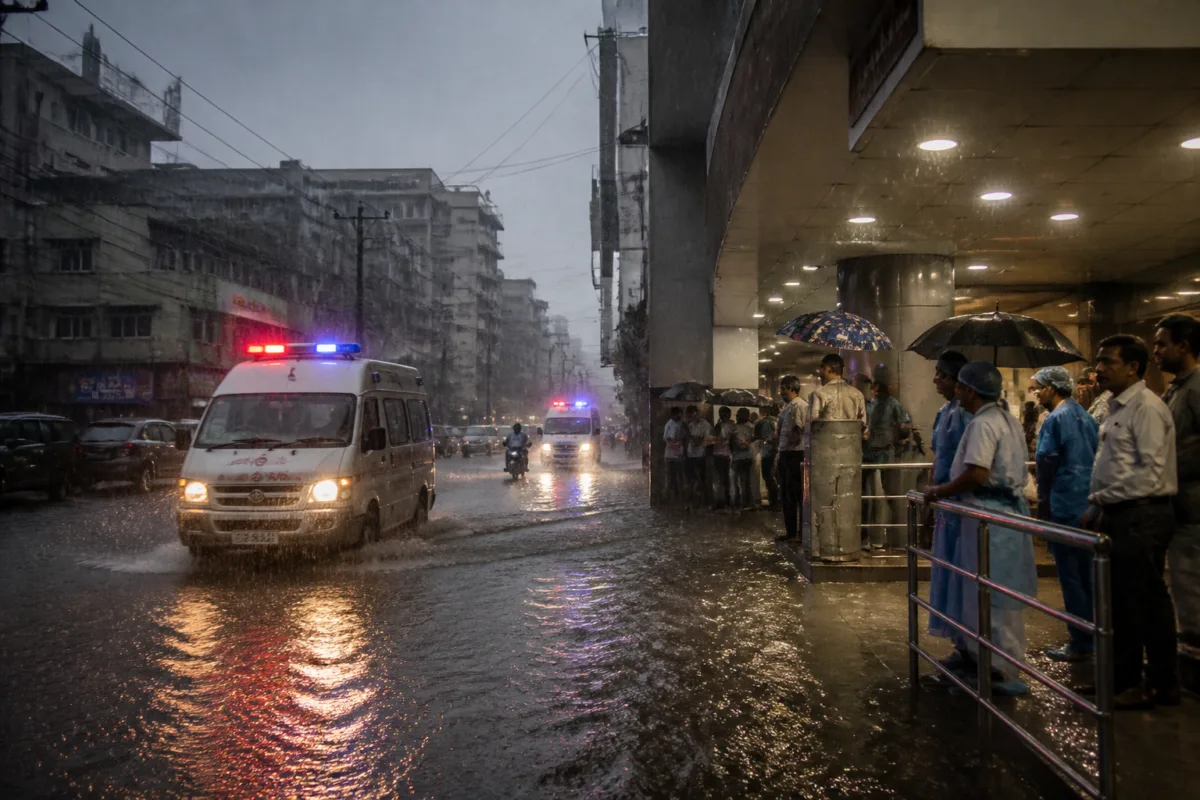
A Tamil Nadu minister has alleged that the India Meteorological Department did not issue an advance warning to the state government about the extreme rainfall recorded in Chennai, raising questions about how weather alerts are converted into emergency preparedness measures. The allegation was reported by Dinamalar after a review meeting on monsoon-related medical preparedness.
The report attributes the statement to a state health minister, but identifies the minister inconsistently as Arun Raj in the main account and Rajmohan in its concluding reference. The supplied report does not include a copy of the minister’s statement, an official government release or an India Meteorological Department bulletin confirming the warning timeline. The attribution and the warning record therefore require verification.
According to the report, the minister said Chennai received more than 36 centimetres of rain in three hours, described as the heaviest rainfall in the city in 30 years. The minister reportedly said that no advance warning about such extreme rainfall had been provided to the state government by the India Meteorological Department. The report does not specify the date of the rainfall, the affected weather station, the alert categories issued or the time difference between any forecast and the rainfall event.
The review meeting focused on the health system’s preparedness for the monsoon. Government hospitals were instructed to remain ready, with uninterrupted electricity and oxygen supplies. Ambulance services in Chennai were also directed to reach patients within five minutes, according to the report. These instructions place hospitals and emergency transport at the centre of the response, particularly when heavy rain affects road access and local mobility.
The report also states that 1,000 medical camps have been established across Tamil Nadu. Officials were instructed to monitor waterborne infections, amid the risk of sewage mixing with drinking water during the rainy season. Residents were advised to boil drinking water before consumption. These measures indicate that the reported response extends beyond immediate rescue operations to disease surveillance and public-health protection.
The warning dispute also highlights the operational importance of timing. Weather forecasts are used by state and city authorities to prepare hospitals, position ambulances, manage waterlogging risks and decide whether schools should close. The report says that school-holiday decisions will be taken after consultations involving India Meteorological Department officials and private weather forecasters, with the aim of announcing closures at the appropriate time.
The supplied account says the minister also stated that Chennai had returned to normal conditions. It does not provide details of the rainfall’s impact on roads, public transport, power supply, hospitals or residential areas, nor does it identify the specific government agency responsible for issuing the alleged warning to the state. Confirmation from the India Meteorological Department and the Tamil Nadu government is needed to establish what forecasts and alerts were issued before the rainfall.
For now, the verified element in the supplied material is that Tamil Nadu authorities reviewed hospital and public-health preparations for the monsoon and announced measures involving medical facilities, ambulances, medical camps and disease monitoring. The claim that no warning was issued for the extreme rainfall remains attributed to the minister and should not be treated as independently established until the relevant official records and the minister’s identity are confirmed.

