


Chandigarh’s claim of full compliance with solid and liquid waste-management requirements has been questioned by the Amicus Curiae appointed by the National Green Tribunal, which has identified inconsistencies in the city’s records on segregation, legacy waste, compost quality and sewage treatment.
The amicus noted a contradiction in the administration’s account of door-to-door collection. The report states that 100 per cent of household waste is collected in four categories, while also saying that extending door-to-door collection to remaining areas would provide segregated service to households that currently contribute mixed waste. The two claims cannot both be accurate, the note observed.
Mixed waste has declined from 70 tonnes per day to 65 TPD, a reduction of about 7 per cent in nearly seven months. This was despite 10,363 challans issued between January and October 2026 for non-segregation. The report annexed only 15 sample challans, while the residential fine is Rs 200.
The amicus also flagged missing information on the collection and incineration of sanitary waste and domestic hazardous waste. Chandigarh’s report states that 522 compartmentalised collection vehicles have been deployed, sanitary waste is sent to an incinerator at Raipur Kalan, and domestic hazardous waste is managed through a tripartite agreement. However, it does not disclose the quantities collected or incinerated.
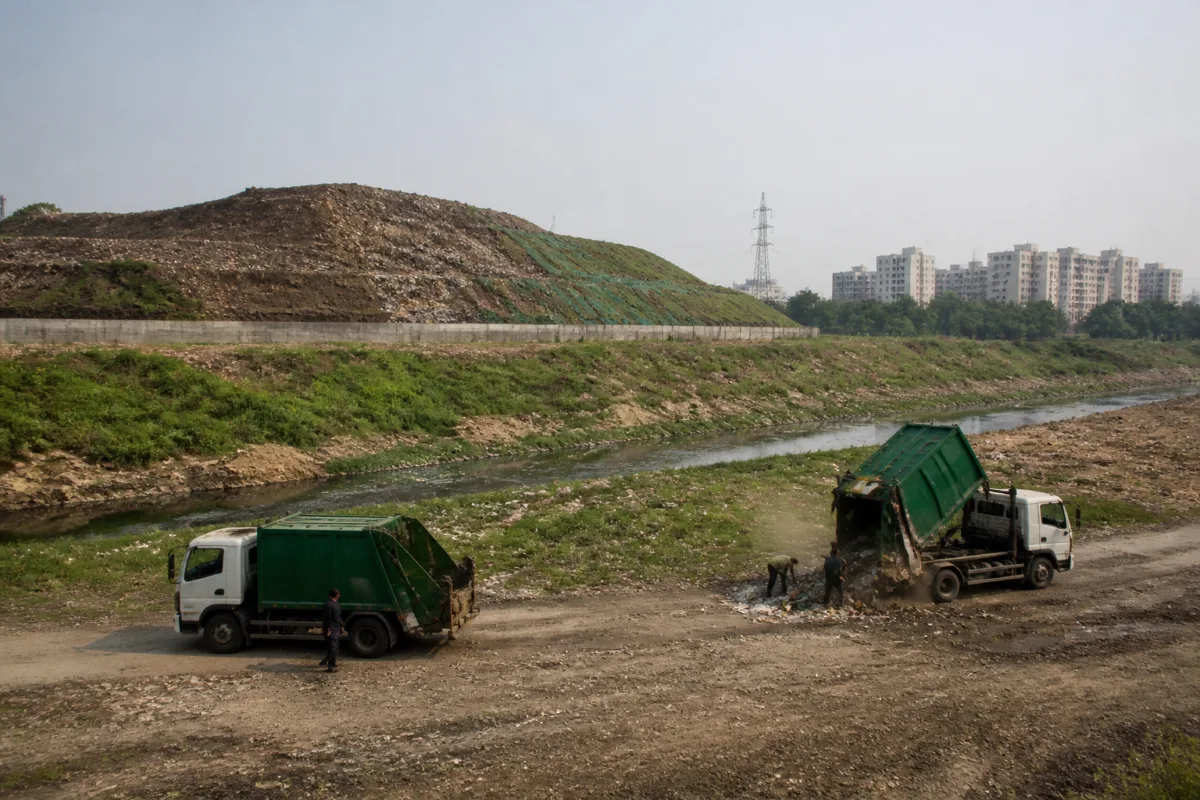
The record on legacy waste remediation was also questioned. The administration’s report claims that about 15.4 lakh metric tonnes of legacy waste has been remediated, including the balance quantity of 6,100 MT. The amicus relied on an Environment Quality Report prepared by IIT Ropar for the Dadumajra legacy dumpsite.
According to the IIT report, the Sector 50 site is next to a civil dispensary, raising concern for elderly and vulnerable people. The report indicates that the location may previously have been a pond or water body that was not conclusively closed and filled to create flat land. A similar condition was reported at the Sector 47 site.
Both low-lying locations were filled with bio-soil along with materials including e-waste, battery residue, glass and plastic. IIT-Ropar warned that weathering could release metals towards the aquifer if the fill remains uncapped. No groundwater sample was taken, and the aquifer depth was described only as considerable.
The liquid-waste assessment contains a similar gap between capacity and actual conveyance. Chandigarh’s report says that all 2,41,171 households are connected to the sewer network and that the city has more than 100 per cent sewage-treatment capacity. In the same section, however, it acknowledges outlets into Sukhna Choe caused by blockage, silting and collapsing pipelines.
The amicus noted that surplus treatment capacity does not establish that sewage reaches a treatment plant. A collapsing sewer that discharges into a seasonal stream can undermine both the connection and treatment claims, the note said.
To improve verification, the amicus recommended a weighbridge-based daily mass-balance system at Dadumajra. The proposed system would record waste generated, processed material, recovered products, rejects and material sent to landfill, with the information published daily on the Municipal Corporation website.
It also recommended a ward-wise map of the 65 TPD of mixed waste, together with GPS and radio-frequency identification tracking for all 522 collection vehicles. The proposals would make it possible to compare household collection, vehicle movement, processing and final disposal rather than relying only on aggregate compliance figures.
For waterway monitoring, the amicus proposed monthly upstream and downstream testing of all four choes—Sukhna Choe, N-Choe, Patiala Ki Rao and Faidan Choe—by the Chandigarh Pollution Control Committee. It also recommended a microbial source-tracking study within four months.
The findings place the focus on the difference between nominal infrastructure capacity and functioning systems. Collection coverage, treatment capacity and remediation totals do not by themselves establish that waste is segregated, hazardous material is safely contained or sewage is reaching treatment plants. The recommendations would require Chandigarh’s waste and sewerage data to be linked to locations, quantities and daily operating records, allowing regulators and residents to assess performance more directly.

