


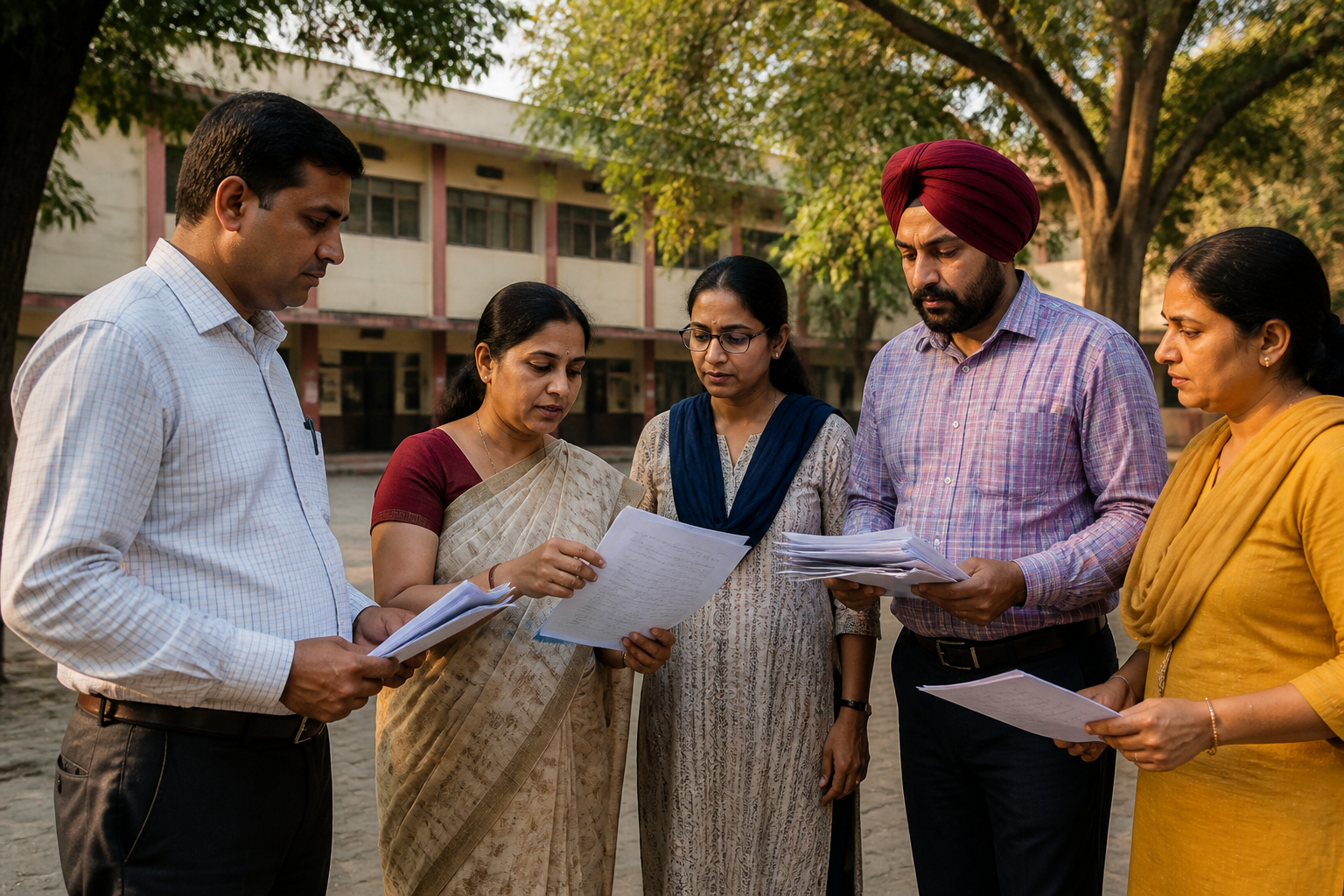
Around three-fourths of more than Rs 100 crore in arrears owed to Chandigarh government schoolteachers recruited through the 2014-15 process has now been released, according to teachers and beneficiaries. The payment follows a Supreme Court intervention that allowed the recruitment to stand after a prolonged dispute over allegations of a paper leak. The episode shows how a recruitment controversy can continue to affect public employees, government finances and school administration for years after appointments are made.
The teachers were recruited against 1,149 posts for Nursery Teacher, Junior Basic Teacher and Trained Graduate Teacher positions. After the recruitment, the Chandigarh administration cancelled the selection following allegations of a paper leak. The cancellation triggered proceedings before the Central Administrative Tribunal, followed by litigation in the Punjab and Haryana High Court and the Supreme Court.
The Supreme Court’s directions on April 21, 2026 allowed the recruitment to stand after the administration failed to establish the allegations against the selection as a whole. The court treated separately those cases in which material had emerged against individual candidates during the investigation. That distinction became central to the subsequent administrative process: the broader recruitment was restored, while the administration retained the power to act against teachers whose involvement in an alleged recruitment-related offence is established through investigation or further investigation.
The financial consequences of the dispute extend well beyond the question of appointment. The teachers are entitled to arrears under the sixth pay scale from January 1, 2016 and benefits under the seventh pay scale from April 1, 2022. The exact amount depends on the post held, date of joining, length of service and pay fixation. According to beneficiaries, arrears for a TGT teacher are around Rs 23-25 lakh, while JBT teachers are owed approximately Rs 18-19 lakh each.
These figures illustrate why the matter became a major financial obligation for the administration. The arrears are not a single compensation payment. They result from the correction of pay and service records across different appointment dates and categories of teachers. Each employee’s liability has to be calculated through pay fixation, taking account of the applicable pay revisions and the period for which the teacher was in service.
The Directorate of School Education, Chandigarh administration, issued an order on September 30 to implement the consequential service and financial benefits. The order provides for completion of probation after two years from the respective dates of joining and confirmation after probation is cleared. It also provides for revision of pay from January 1, 2016 under the Punjab Civil Services (Revised Pay) Rules, 2021, corresponding to the sixth pay revision.
A further revision is to apply from April 1, 2022 under the Chandigarh Employees (Revised Pay) Rules, 2023, corresponding to the seventh pay revision. Assured Career Progression and Modified Assured Career Progression benefits have also been provided wherever applicable. Together, these provisions determine not only the immediate arrears but also the service position from which future salary and progression may be calculated.
The order also reveals the administrative mechanics behind a payment that is being described in broad terms as the release of arrears. The concerned school heads and drawing and disbursing officers have been directed to undertake pay fixation and prepare statements for payment. This places the responsibility for converting the legal decision into individual financial records at the school and departmental levels.
The process remains dependent on the Finance Department. The Directorate has stated that payment of arrears is subject to the availability of funds and has requested the Finance Department to release the required amount. Teachers have said that about 75% of the total arrears has been received, while the remaining amount is still awaited. The difference between an entitlement recognised in an administrative order and money credited to an employee’s account is therefore important in this case.
The episode also demonstrates how the consequences of a disputed public recruitment process can be distributed across several institutions. The administration initiated the recruitment and later cancelled it after allegations were raised. The tribunals and courts examined the legal position. The education directorate then had to restore service benefits and instruct schools to revise records. The Finance Department remains involved because the implementation carries a substantial financial requirement.
For the teachers, the dispute affected more than the timing of a salary payment. The September 30 order addresses probation, confirmation, pay revision and career progression, meaning that the legal outcome has to be reflected in their continuing employment records. The arrears under the sixth and seventh pay revisions are connected to this wider service regularisation rather than being an isolated settlement.
For Chandigarh’s school system, the case highlights the administrative cost of uncertainty in recruitment. The posts involved teaching positions in government schools, and the dispute concerned employees who had already entered service through the 2014-15 process. The supplied information does not establish how the litigation affected classroom operations or vacancies during the intervening period, but it does establish that the legal dispute continued to shape the teachers’ service and financial status long after the recruitment exercise.
The case also places limits on how the administration can implement the Supreme Court’s directions. The September 30 order allows disciplinary proceedings or cancellation of a selection if material emerges during investigation or further investigation regarding a teacher’s involvement in the alleged recruitment-related offence. This preserves an individual-level scrutiny mechanism even as the recruitment is allowed to stand overall.
That structure is significant. The administration’s failure to establish the allegations against the selection as a whole did not remove the possibility of action in cases involving specific candidates. At the same time, the broader recruitment could not continue to be treated as cancelled once the Supreme Court had issued its directions. The resulting administrative order therefore combines recognition of service rights with a reservation of power to act where individual evidence exists.
The available figures also explain why the final stage may require continued monitoring. More than Rs 100 crore is involved overall, while the amount due to each teacher varies considerably. Pay fixation has to be completed by the relevant authorities, statements have to be prepared, and funds have to be released. The reported release of around 75% indicates substantial implementation, but it does not amount to completion for teachers awaiting the balance.
The next stage is therefore administrative rather than judicial: completing the remaining pay calculations, securing the funds requested from the Finance Department and disbursing the unpaid balance. The September 30 order provides the framework for that process. Whether the entire liability is cleared will depend on the completion of school-level documentation and the availability and release of funds by the Finance Department.
