


Chalet Hotels is targeting a portfolio of about 5,500 hotel keys by FY30, but the more consequential change in its expansion plan is structural: the company is moving beyond a model centred largely on owning hotel assets and is combining third-party operations, franchises and its own Athiva brand. The shift reflects how hospitality companies are seeking to grow their presence in Indian cities without relying on a single form of capital-intensive development.
The company currently has approximately 3,389 operational keys and an announced pipeline of close to 2,300 keys, according to managing director and chief executive Shwetank Singh in an interview reported by PTI. Together, the figures take Chalet’s stated portfolio ambition to around 5,500 keys. The company’s own description uses approximate numbers, so the target should be read as a portfolio objective rather than a fixed room count.
That distinction matters because a hotel key can sit within different commercial arrangements. A company may own the underlying property, operate a hotel for another owner, use a franchise agreement, or develop a brand that is managed under its own operating system. Chalet is now pursuing all three models. Singh described the company as having “graduated from a pure asset-ownership model” and said it would continue with properties operated by third parties, franchise properties and hotels under Athiva.
The portfolio therefore combines different forms of exposure to the hospitality market. The Ritz-Carlton, for example, is cited as a property operated by a third party, while Taj is identified as a franchise relationship. Athiva represents Chalet’s own brand platform. These arrangements do not carry identical capital requirements, operating responsibilities or revenue structures, although the supplied material does not provide a financial comparison between them.
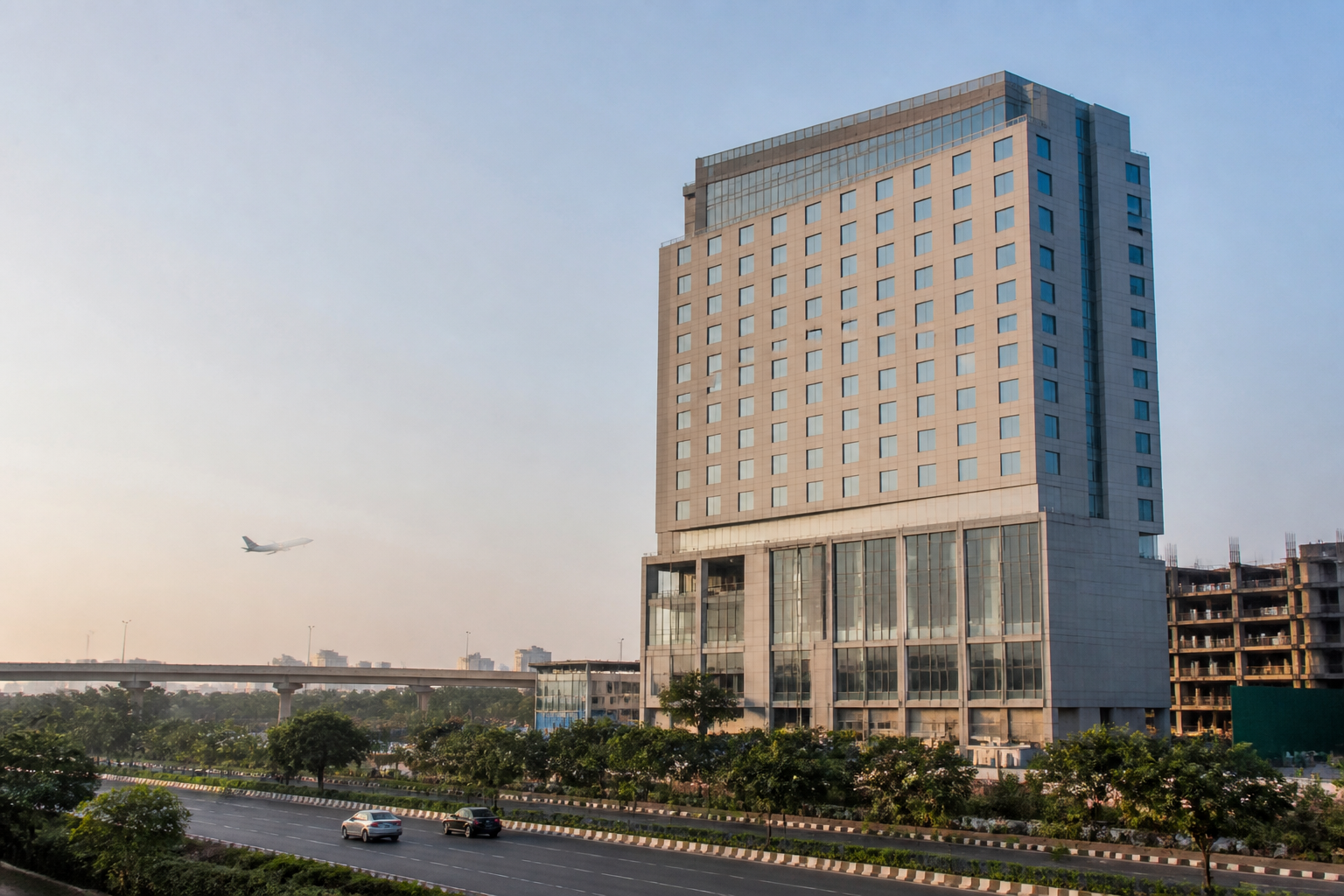
The announced pipeline includes a 380-room Taj hotel at Delhi Airport. Approximately 70 rooms are expected to open by the end of the current financial year, according to the company. Other projects named by Singh include the Ritz-Carlton Hyderabad, Hyatt Regency Airoli and a hotel in Udaipur, all expected to come online in FY29. A recently announced project in Pune’s Yerawada area is targeted for FY31.
The timing of these projects shows that the 5,500-key ambition is linked to a staggered development programme rather than a single opening cycle. It also introduces a qualification to the stated FY30 target: the Pune project is scheduled for FY31, beyond that financial-year horizon. The company’s announced pipeline may therefore contain projects that contribute to the broader portfolio trajectory while opening after FY30.
Athiva is the clearest expression of Chalet’s attempt to build an identifiable in-house platform. Launched in 2025, the brand initially had a pipeline of around 900 keys. Chalet has since added approximately 380 keys through recently announced projects in Pune and Hyderabad, taking the brand’s pipeline to roughly 1,200-1,300 keys. Singh said the company was not planning another hotel brand and would remain focused on establishing Athiva.
For urban development, the brand strategy is significant because it connects hotel expansion with the reuse and development of city land, airport districts, commercial corridors and mixed-use growth areas. The available material does not specify the land-use plans, built-up areas or approvals for each hotel. It does, however, indicate that Chalet’s expansion is distributed across locations with different urban functions: Delhi Airport, Hyderabad, Airoli, Udaipur and Pune’s Yerawada area.
Delhi Airport is associated with a large hotel project and a phased opening. Airoli is identified as the location of a Hyatt Regency project, while Pune’s Yerawada project belongs to the company’s later pipeline. These locations point to a portfolio that is not limited to a single established hospitality district. At the same time, the source material does not provide occupancy forecasts, room demand estimates, construction costs or project-level investment figures, so the commercial rationale for each location cannot be assessed from the announcement alone.
Chalet’s hotel strategy is also being pursued alongside a sizeable commercial real estate portfolio. The company has approximately 2.4 million square feet of commercial space in operation and another 900,000 square feet under construction. Once that construction is completed, the overall commercial portfolio is expected to reach approximately 3.2-3.3 million square feet.
The coexistence of hotels and offices gives Chalet a broader urban real estate footprint, but the company says hospitality will remain its main focus. Singh described Chalet as “fundamentally a hospitality-first company”. That statement places the commercial portfolio in a supporting rather than defining role, even as the office space adds another source of activity and asset exposure across the company’s developments.
The mixed model also changes the question of what growth means. Under a pure asset-ownership approach, expansion is closely associated with acquiring land, financing construction and adding owned properties to the balance sheet. A portfolio that includes franchises, third-party operations and an in-house brand can expand through a combination of ownership and contractual or operating relationships. The supplied material does not disclose how many of the 5,500 targeted keys will be owned, franchised or operated for third parties, which limits the ability to measure the precise change in capital intensity.
That missing breakdown is important. The headline room count provides a measure of network scale, but it does not by itself reveal the amount of capital committed, the level of operational control or the financial contribution expected from each hotel. Two portfolios with the same number of keys can have very different ownership structures and risk profiles. Chalet’s announcement establishes the direction of travel, but not the full economics of the transition.
Funding is another part of the shift. Singh said the company was well positioned to execute its announced projects without substantially increasing debt. He attributed that position to the strength of Chalet’s balance sheet. No debt figure, funding schedule, project cost or cash-flow estimate was included in the supplied material, so the claim cannot be tested here against a detailed financing plan.
The statement nevertheless identifies the immediate implementation question: whether Chalet can deliver its announced pipeline while keeping additional borrowing limited. That question will be especially relevant as projects move from announcement to construction, phased opening and full operation. The company has also said it is evaluating additional greenfield and brownfield opportunities, but it has not set a separate expansion target beyond the announced pipeline.
This distinction between an announced pipeline and a possible future pipeline is central to understanding the company’s current position. The 5,500-key objective is tied to projects already identified by Chalet, while further opportunities remain under evaluation. Singh said the company had multiple conversations underway but would continue focusing on the announced pipeline for now. Those conversations should not be treated as committed projects unless the company provides further details.
For cities, the broader issue is how hospitality growth is being assembled. Hotels require access, utilities, commercial viability, construction capacity and an operating ecosystem that includes workers, suppliers and surrounding businesses. The source material does not provide evidence on local employment, transport demand, water use, energy consumption or public infrastructure requirements for the listed projects. Those effects therefore remain outside what can be established from the announcement.
What is clear is that Chalet is treating hotel development as a portfolio exercise rather than a sequence of standalone owned properties. The company is pairing established international and Indian hospitality names with an internally developed brand, while maintaining a separate commercial real estate presence. Its stated ambition is to add roughly 2,300 keys to an operating base of approximately 3,389 keys, alongside the expansion of commercial space to as much as 3.3 million square feet.
The evidence confirms a change in business model and a defined set of projects, but it does not yet establish the eventual mix of ownership arrangements, the financial returns from each format or the precise delivery schedule for every hotel. The next useful markers will be the opening of the first Delhi Airport rooms, progress on the FY29 projects, further details on the Pune project targeted for FY31, and any disclosure of how the 5,500-key portfolio will be divided among owned, franchised, third-party-operated and Athiva properties.
