


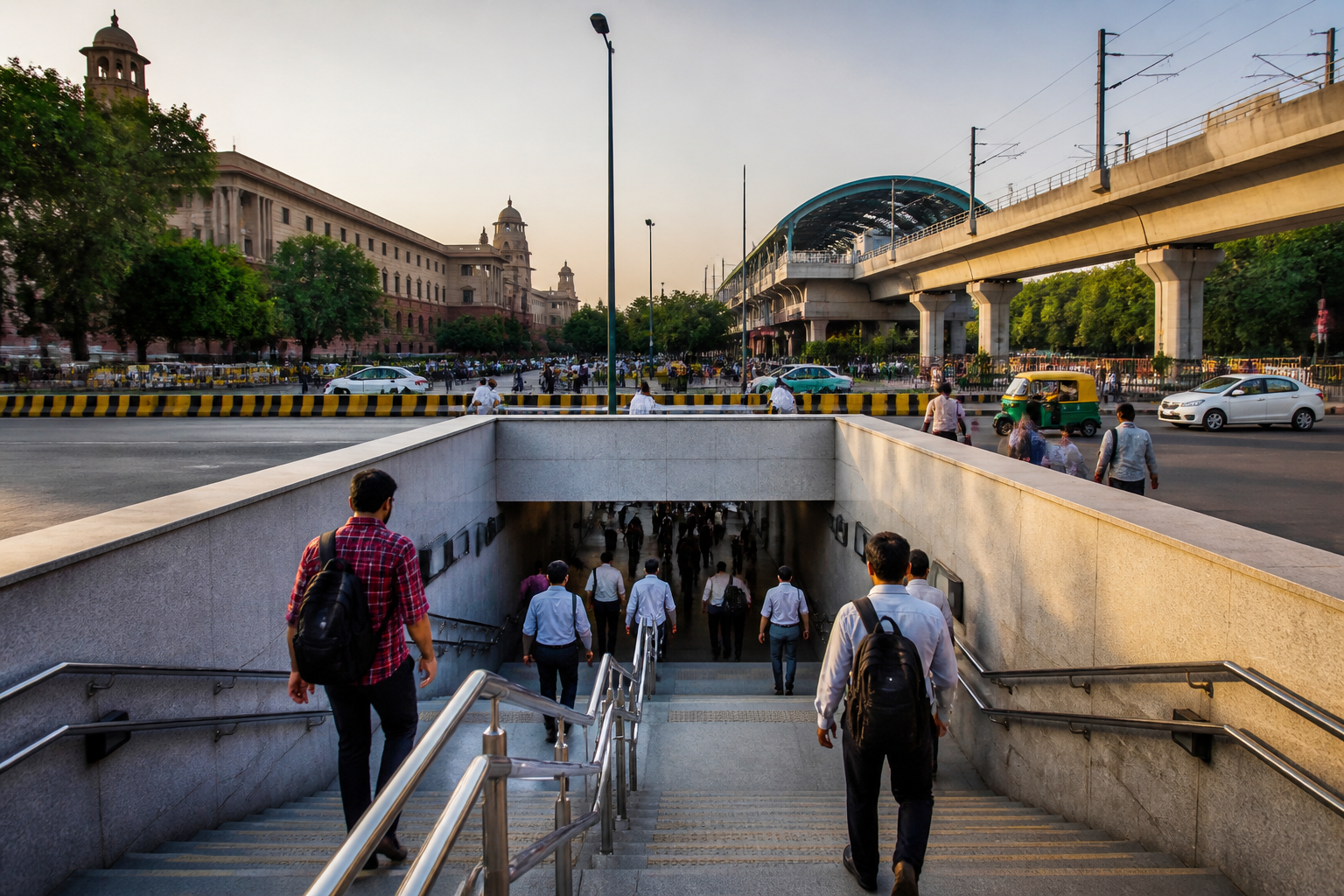
Central Secretariat Metro is set to become Delhi’s first four-line interchange once the Kishangarh–Central Secretariat corridor under Phase 5-B is completed, scheduled for 2029. The development is being presented as a major improvement in connectivity between Delhi, Gurugram, Noida and Faridabad. But its larger significance lies in how Delhi Metro is moving from a system built around a few interchange points to one with a wider, more distributed transfer network.
The Central Secretariat station currently connects the Yellow Line and the Violet Line. The Yellow Line runs from Samaypur Badli to Millennium City Centre Gurugram, while the Violet Line connects Kashmere Gate with Raja Nahar Singh in Faridabad. The proposed corridor will add an interchange with the Magenta Line, which runs from Noida Botanical Garden towards the R K Ashram extension, and with the new line linking Kishangarh and Central Secretariat.
The result, according to the report by Jagran – New Delhi, will be a four-line interchange at one of the capital’s most important administrative and transport locations. The station will provide a direct transfer point for passengers travelling towards Gurugram, Noida and Faridabad, although the supplied report does not provide projected passenger numbers, train frequencies, station capacity or interchange design details.
That limitation is important. A four-line interchange is not simply a matter of adding another route to a station map. Its value depends on how easily passengers can move between platforms, how trains are scheduled, whether station circulation can handle transfer volumes and whether surrounding streets and public spaces can absorb the additional movement. The available information establishes the planned network connection, but not yet how the station will perform operationally after the new corridor opens.
The proposed change also reflects the uneven geography of Delhi Metro’s existing network. Kashmere Gate is currently the only triple interchange station, connecting the Red, Yellow and Violet lines. Under the broader expansion programme, the number of triple interchanges is expected to rise from one to six. Central Secretariat, Lajpat Nagar, Azadpur, Inderlok and New Delhi are identified as locations that will gain triple-interchange capability after the relevant corridors are completed.
This expansion matters because transfer points determine how passengers move across a metropolitan rail network. A system with more interchange options can allow passengers to change routes closer to their origin or destination rather than travelling through one dominant central station. The report does not quantify how many journeys would be diverted from existing interchanges, but the proposed additions indicate an effort to create more route combinations across the capital.
The planned role of Central Secretariat is also linked to the changing relationship between Delhi and the wider National Capital Region. The station already sits on corridors serving southern and central Delhi, while the lines connected to it extend towards Gurugram, Faridabad and Noida. Adding the new corridor would place these directions within a single interchange location. For passengers, that could reduce the need to make separate transfers at other stations, depending on their starting point and final destination.
However, better regional connectivity does not automatically mean simpler journeys for all passengers. The report confirms that the new corridor is intended to improve movement between NCR cities, but it does not specify fare integration arrangements, last-mile facilities, interchange walking distances or accessibility provisions. These factors will influence whether a faster rail connection translates into a more convenient door-to-door trip.
The project forms part of a sequence of corridor approvals and construction activity. In December last year, three corridors of about 16 kilometres in total were approved under Phase 5-A. They include the R K Ashram Marg–Indraprastha corridor, the Aerocity–IGI Airport Terminal 1 corridor and the Tughlakabad–Kalindi Kunj corridor. Construction on these corridors has begun, according to the report.
Once these projects are completed, Central Secretariat, Lajpat Nagar, Azadpur, Inderlok and New Delhi are expected to gain triple-interchange facilities. This means the city’s future interchange structure is not being shaped by one project alone. Phase 5-A is expanding the number of locations where lines meet, while Phase 5-B is expected to add further corridors and, in Central Secretariat’s case, a fourth line.
The Phase 5-A projects also show how interchange expansion is being distributed across different types of urban destinations. The identified corridors connect administrative and central-city areas, the airport, southern Delhi and existing transport routes. The supplied report does not establish whether these projects share a common interchange design or whether construction schedules are coordinated, but their combined effect will be measured through the reliability of transfers across the network rather than through individual corridor length alone.
In May this year, the Delhi government approved seven corridors under Phase 5-B. The Kishangarh–Central Secretariat and Jorbagh–Mithapur corridors are among them. The Kishangarh–Central Secretariat corridor is scheduled for completion by 2029. The report does not state the total length, cost, funding arrangement, tender status or construction milestones for this corridor, leaving those elements outside the confirmed evidence available here.
The Jorbagh–Mithapur corridor would also alter Delhi’s interchange map. Lajpat Nagar currently connects the Pink Line, described in the report as the Ring Metro, with the Violet Line. The Golden Line from Lajpat Nagar to Saket G Block is under construction. After the construction and proposed corridors are completed, Lajpat Nagar is also expected to become a four-line interchange.
The comparison between Central Secretariat and Lajpat Nagar highlights a broader planning pattern. Delhi Metro’s next stage is not only about extending tracks into new areas. It is also about adding connections between existing lines so that the network can function with more transfer choices. This approach can improve network reach without requiring every passenger to travel towards a single central interchange, but its effectiveness depends on the quality and timing of each linked project.
The institutional structure behind the expansion is equally significant. The report attributes the Phase 5-B approvals to the Delhi government and identifies ongoing construction under Phase 4 and Phase 5-A. These references show that the metropolitan rail network is being built through successive phases rather than through one unified project announcement. Each phase introduces new corridors, but the passenger benefit emerges only when adjacent or intersecting corridors become operational.
That sequencing creates a practical implementation challenge. A station may be designed to become a major interchange, but its full function remains dependent on the completion of the corridors that feed it. In Central Secretariat’s case, the four-line configuration depends on the Kishangarh–Central Secretariat corridor being completed by 2029, alongside the availability of the relevant Magenta Line connection. The supplied report does not provide a commissioning sequence for these links or explain how temporary interchange arrangements will operate during construction.
The numbers available in the report describe network structure rather than passenger demand. Delhi currently has one triple interchange at Kashmere Gate. The number is expected to rise to six after the identified Phase 4-related corridors are completed. Two locations—Central Secretariat and Lajpat Nagar—are then expected to move towards four-line interchange status through additional corridors. These figures indicate a substantial change in the network’s transfer architecture, but they do not establish how many passengers will use each station or whether crowding will shift from one interchange to another.
That distinction is central to evaluating the project. More interchanges can increase resilience by giving passengers alternative routes, but they can also concentrate large volumes at stations where multiple lines meet. The report confirms the expectation that Central Secretariat will become the capital’s busiest metro station, yet it does not provide the ridership forecast or operational analysis supporting that projection. The claim should therefore be treated as a reported expectation rather than a measured outcome.
For NCR residents, the most visible benefit will be the possibility of changing between regional directions at a single station. A passenger travelling between areas connected by the Yellow, Violet, Magenta and the new corridor could gain a more direct route. The scale of that benefit will depend on station access, platform layouts, service frequency and the ease of transferring between lines—details that have not been provided in the source material.
The Central Secretariat plan therefore represents both an expansion milestone and a test of implementation. The evidence confirms approvals for seven Phase 5-B corridors, ongoing construction on Phase 5-A projects, the planned Kishangarh–Central Secretariat connection and a target of 2029 for its completion. It does not yet confirm the final passenger capacity, cost, detailed design, construction progress or opening date beyond that stated target.
The next stage to watch is whether the approved corridors move from plans and approvals into clearly defined construction and delivery milestones. For Central Secretariat, the decisive point will be the completion of the Kishangarh–Central Secretariat corridor and the integration of the new connection with the Yellow, Violet and Magenta lines. Until those details are established, the four-line interchange remains a significant planned change to Delhi’s metro geography rather than an operational reality.

